全文目录Contents
- 0 · The Project at a Glance, and a Map of the Code
- 1 · The Gateway Layer
- 2 · Identity and Session Routing
- 3 · The Main Loop ★
- 3.1 The Loop Entry: A Triple Budget Gate
- 3.2 Per-Turn Preparation: build_turn_context
- 3.3 Mid-Turn Interjection: /steer
- 3.4 The Wall-Clock Budget Wrap-Up Reminder
- 3.5 The Interrupt Check
- 3.6 The Step Callback: An Observation Point for the Gateway
- 3.7 Other State Inside the Loop
- 3.8 Why the Loop Exited
- 3.9 An Optional Bypass: The Codex App Server Runtime
- 4 · The Tool System
- 4.1 The Most Important Design Decision: Implementation Separated from Exposure
- 4.2 Composing and Resolving Toolsets
- 4.3 Central Tool Dispatch
- 4.4 The Argument Coercion Layer
- 4.5 Sanitizing Tool Error Messages
- 4.6 Observing Tool Results, and Hooks
- 4.7 Recognizing a Delegation Context
- 4.8 Caching Tool Definitions
- 5 · Approval and Safety Red Lines ★
- 5.1 The Overall Structure
- 5.2 The 12 Hard Red Lines
- 5.3 The Real Difficulty: Telling “Command” from “Data”
- 5.4 Quote Masking: But Leave a Way In for “the Part That Really Executes”
- 5.5 Quoting Is Not a Bypass
- 5.6 Sensitive Paths and Write Targets
- 5.7 The sudo Stdin Guard
- 5.8 Performance: Why Precompile
- 5.9 Retaining Blocked Commands
- 5.10 Smart Approval: An Optional Model Judgment
- 5.11 Context Awareness: Different Situations, Different Policies
- 5.12 Where This Layer Sits: Outermost, and Thinnest
- 6 · Execution Environments
- 7 · The Context Engine ★
- 7.1 What It Defines
- 7.2 Lifecycle
- 7.3 The Three Methods You Must Implement
- 7.4 The Sharpest Design Decision: select and compress Are Two Orthogonal Verbs
- 7.5 The Post-Turn Observation Hook
- 7.6 Other Optional Hooks
- 7.7 Default Parameter Values
- 7.8 Control Over User-Visible Status
- 7.9 Size Comparison of the Built-in Implementation
- 8 · The Memory System ★
- 8.1 The Memory Provider Interface
- 8.2 Lifecycle and Hooks
- 8.3 The Interface's Versioned Contract
- 8.4 The Trivial-Prompt Filter
- 8.5 The Memory-Usage Indicator
- 8.6 The Built-in Holographic Memory
- 8.7 The Storage Layer and Trust Scores
- 8.8 The SQLite State Layer
- 8.9 Summing Up the Division of Labor Among Three Kinds of Memory
- 9 · The Plugin System
- 9.1 Three Discovery Sources
- 9.2 What a Plugin Can Provide
- 9.3 The Most Important Design Decision: “Stackable Capabilities” vs. “Mutually Exclusive Strategies”
- 9.4 Plugin Storage
- 9.5 How Plugins Tie into Toolsets
- 9.6 Plugin Hooks
- 9.7 MCP: The Other Extension Path
- 9.8 The Overall Shape of This Extension System
- 10 · Delegation and Multi-Agent
- 11 · Model Providers and the Credential Pool
- 12 · Scheduled Tasks (Cron)
- 12.1 What “cron” Is
- 12.2 Scenarios for Scheduled Agents
- 12.3 The Single Most Important Class: CronPromptInjectionBlocked
- 12.4 Narrowing the Toolset for Scheduled Tasks
- 12.5 Failure Handling
- 12.6 Preventing Duplicate Runs
- 12.7 Why scheduler.py Is 367 KB
- 12.8 Where Scheduled Tasks Sit in the Overall Architecture
- 13 · The Skill System
- 13.1 What a Skill Is
- 13.2 The Front Matter, Field by Field
- 13.3 Progressive Disclosure: The Core Mechanism of the Skill System
- 13.4 The Infrastructure Around Skills
- 13.5 Skills vs. Tools vs. Plugins
- 13.6 An Implicit Design in the Skill System: Composability
- 13.7 The 15 Skill Categories
- 13.8 Looking Back Across the Book: The Overall Shape of Hermes
Hermes 架构全解
191.8 万行 Python · 4,772 个文件 · 单系统深潜 · 不做任何对比
这一篇只讲 Hermes 一个系统。不和任何其他项目对比,只回答:这个系统是怎么造出来的?
从 22 个聊天平台的消息入口,到全息记忆的向量运算,逐层拆开每一个可插拔子系统 —— 包括常驻网关进程、多身份路由、凭据池故障转移、定时任务、以及那套让它自称「自我改进」的技能演化机制。
阅读门槛:不需要人工智能背景。所有概念在首次出现时都会解释。如果你完全没接触过大语言模型,建议先读《合刊》那一篇的第 1 章(零基础前置知识),大约 20 分钟,之后再回来。
0 · 项目全景与代码地图
0.1 这个软件是什么
项目自己的定位写在 README 第一句:
「The self-improving AI agent built by Nous Research. It's the only agent with a built-in learning loop — it creates skills from experience, improves them during use, nudges itself to persist knowledge, searches its own past conversations, and builds a deepening model of who you are across sessions. Run it on a $5 VPS, a GPU cluster, or serverless infrastructure that costs nearly nothing when idle. It's not tied to your laptop — talk to it from Telegram while it works on a cloud VM.」
译:由 Nous Research 打造的自我改进型 AI 智能体。它是唯一内置学习闭环的智能体 —— 它从经验中创建技能、在使用中改进它们、提醒自己持久化知识、搜索自己过往的对话,并跨会话地建立一个对你越来越深入的认知模型。你可以把它跑在一台每月 5 美元的虚拟服务器上、跑在 GPU 集群上、或者跑在闲置时几乎零成本的无服务器基础设施上。它不绑定在你的笔记本上 —— 你可以从 Telegram 和它对话,而它在一台云端虚拟机上干活。
把这段话拆开,它声明了四个核心主张,而这四个主张各自对应了架构里的一大块:
| 主张 | 对应的架构 | 哪一章 |
|---|---|---|
| 不绑定你的笔记本 从 Telegram 对话,在云端干活 | 常驻网关进程 + 22 个平台适配器 | 第 1 章 |
| 用任何你想用的模型 切换不改代码、不锁定 | 供应商适配层 + 凭据池 | 第 11 章 |
| 跨会话建立对你的认知 | 记忆提供者抽象 + 8 种后端 | 第 8 章 |
| 内置学习闭环 从经验创建技能并改进 | 技能系统(81 个技能,近 9,000 行管理代码) | 第 13 章 |
| 属性 | 值 |
|---|---|
| 开发方 | Nous Research |
| 编程语言 | Python 3.11 |
| 包管理 | uv —— 一个用 Rust 写的、比 pip 快很多的 Python 包管理器 |
| 许可证 | MIT(最宽松的开源许可证之一) |
| 发布 | 2026 年 2 月 25 日。8 周后在代码托管平台 GitHub 上获得约 9.9 万收藏,6 月突破 17.5 万 |
| 代码规模 | 4,772 个 Python 文件,191.8 万行 |
0.2 目录地图
括号里是文件数,能直观看出体量分布:
0.3 从这张地图能读出的三件事
第一:外围远大于核心,而且外围就是产品本身
| 核心(智能体逻辑) | 外围(集成与扩展) |
|---|---|
conversation_loop.py 主循环model_tools.py 工具分发context_engine.py 引擎抽象 —— 490 行memory_provider.py 记忆抽象
|
plugins/ 351 个文件hermes_cli/ 299 个文件ui-tui/ 475 个文件skills/ 484 个文件gateway/ 99 个文件
|
注意 context_engine.py 只有 490 行,而它旁边的 context_compressor.py 有 419 KB。前者是接口(规定「一个上下文引擎必须提供哪些功能」),后者是内置的一个实现。
这个比例关系贯穿全系统:抽象层薄,实现层厚,而且实现层可以整个换掉。
第二:有一层叫「网关」,而且它是最大的模块
gateway/run.py 单文件 1.55 MB —— 是整个项目最大的文件。
这一层解决的是一个很具体的问题:一个长期在线的智能体,怎么被 22 个不同的聊天软件以统一的方式触达。
它带来的能力是:你在电脑上用 Slack 和智能体聊到一半,出门换成手机上的 Telegram 继续聊,对话上下文完全连续。对智能体来说这始终是同一场会话,只是消息的进出口换了。
第三:几乎每个关键决策点都是一个抽象基类
「抽象基类」(Abstract Base Class,缩写 ABC)是 Python 里的一种「插座标准」:它规定「任何想接进来的东西必须提供哪几个功能」,但不规定这些功能怎么实现。
| 抽象基类 | 规定了什么 | 已有的实现 |
|---|---|---|
ContextEngine | 上下文怎么管理 | 内置压缩器 + 第三方引擎 |
MemoryProvider | 长期记忆怎么存取 | 8 种(内置全息记忆 + 7 种外部服务) |
BasePlatformAdapter | 一个聊天平台怎么接入 | 22 种 |
Environment | 工具在哪里执行 | 7 种(本机 / Docker / 云沙箱 / SSH…) |
| Provider Adapter | 一个模型服务怎么调用 | Anthropic / OpenAI / Gemini / Bedrock / Vertex / Azure / Codex / Ollama… |
这是 Hermes 最核心的架构立场:把每一个「可能有多种做法」的决策点,都定义成接口交出去。
代价是显而易见的:接口必须照顾所有实现的最低公分母,拿不到任何单一实现的深度优化。
收益也是显而易见的:1,000 多位贡献者可以并行地往这些插座上接东西,而不需要碰核心代码。
0.4 一条消息的完整旅程

0.5 全文章节索引
| 章 | 标题 | 核心内容 |
|---|---|---|
| 1 | 网关层 | 常驻进程、22 平台适配器抽象、能力声明式设计、投递账本、重启守卫 |
| 2 | 身份与会话路由 | Profile 多身份、四级路由、SOUL.md 人格文件、跨平台会话连续性 |
| 3 | 主循环 | ★ 预算驱动的循环、宽限调用、中途插话、每轮 prologue |
| 4 | 工具系统 | TOOLSETS 投放策略、中心分发、参数强制矫正层、错误净化 |
| 5 | 审批与安全红线 | ★ 12 条硬红线、命令位置锚定、引号遮蔽、反混淆、路径归一化 |
| 6 | 执行环境 | 7 种可插拔环境、本机默认无沙箱的审计发现 |
| 7 | 上下文引擎 | ★ 抽象基类、select 与 compress 双动词、缓存契约 |
| 8 | 记忆系统 | ★ HRR 全息记忆、SQLite + FTS5、信任分衰减、8 种可插拔后端 |
| 9 | 插件系统 | 3 个发现来源、可叠加能力与互斥策略的区分 |
| 10 | 委派与看板 | 子智能体、实时干预(插话/中止/暂停)、看板协作、心跳 |
| 11 | 供应商适配 | 十余种后端、凭据池故障转移、按供应商重打缓存断点 |
| 12 | 定时任务 | 自主触发、失败连击提醒、事故记录、注入防护 |
| 13 | 技能系统 | 81 个技能、渐进式披露、使用记录、自我改进闭环 |
1 · 网关层
gateway/,99 个文件,其中 run.py 单文件 1.55 MB —— 是整个项目最大的模块。这一章讲一个常驻进程如何让 22 个聊天软件都能触达同一个智能体。
1.1 它解决什么问题
先说清楚没有网关会怎样。假设你想让智能体支持 Slack 和 Telegram 两个平台:
网关就是把这些共性抽出来的那一层。它是一个长期不关闭的后台进程,同时连着所有平台,负责:
- 把各平台千奇百怪的消息格式归一化成统一的事件对象
- 做会话路由 —— 判断这条消息属于哪一场对话
- 做用户授权
- 分发斜杠命令
- 驱动定时任务的时钟
- 管理智能体实例的缓存(同一场会话复用同一个实例)
- 把回复按各平台的规则发出去
1.2 平台适配器抽象基类
gateway/platforms/base.py,333 KB。这是那份「插座标准」—— 规定任何一个平台想接进来必须提供什么。
核心思路:把差异抽象成「能力查询方法」
class BasePlatformAdapter(ABC):
# —— 消息长度限制 ——
def max_message_length_for_chat(self, chat_id: str) -> int
def message_len_fn(self) -> Callable[[str], int]
def message_len_fn_for_chat(self, chat_id: str) -> Callable[[str], int]
# —— 流式输出能力 ——
def supports_draft_streaming(self, ...) -> bool
def prefers_fresh_final_streaming(self, ...) -> bool
def streaming_overflow_limit(self) -> Optional[int]
async def send_draft(self, ...)
# —— 权限模型 ——
def enforces_own_access_policy(self) -> bool
def authorization_is_upstream(self) -> bool
# —— 渲染 ——
def render_message_event(self, event, sink) -> None
def format_tool_event(self, event, *, mode: str = "all", ...) -> str
def format_tool_preview(self, preview: "ToolPreview") -> str
def set_status_text(self, chat_id: str, text: Optional[str]) -> Nonehermes-agent/gateway/platforms/base.py
对比两种写法:
# 写法 A:在主流程里判断平台
if platform == 'slack':
max_len = 40000
elif platform == 'discord':
max_len = 2000
elif platform == 'telegram':
max_len = 4096
elif platform == 'sms':
max_len = 160
# ... 22 个分支,而且这样的判断散落在几十处
# 写法 B:问适配器
max_len = adapter.max_message_length_for_chat(chat_id)写法 A 的问题不是难看,是「新增平台要改几十个地方」。而且你不知道要改哪几个 —— 只能靠搜索和运气。
写法 B 下,新增一个平台 = 实现一组能力声明。主流程一行都不用动。而且抽象基类会强制你实现所有必需的方法,漏一个直接报错。
这就是这一层能撑住 22 个平台的根本原因。
被抽象出来的差异有多大
| 能力 | 各平台的实际差异 |
|---|---|
能不能编辑已发消息supports_draft_streaming |
Slack / Telegram / Discord:能。所以可以流式更新同一条消息,用户看到文字逐渐生长。 短信:不能。只能发新消息 —— 流式输出根本没法做,只能等全部生成完再发一条。 |
偏好重发最终版吗prefers_fresh_final_streaming |
有些平台编辑消息会触发通知或者把消息顶到最新,体验很差。这类平台宁可「流式过程用草稿,最终结果发一条新的」。 |
单条消息长度上限max_message_length_for_chat |
Discord 2,000 / Telegram 4,096 / 短信 160 / Slack 约 40,000。 注意这个方法接收 chat_id 参数 —— 因为同一平台的不同频道可能有不同限制(比如企业版和免费版)。 |
长度怎么算message_len_fn |
更微妙:「长度」的定义各平台不同。有的按字符数,有的按 UTF-16 码元,有的把 emoji 算多个。所以返回的是一个计算函数而不是一个数字。 |
平台自己管权限吗enforces_own_access_policy |
企业微信 / 飞书:有完整的企业权限体系,能进到这个群的人就是被授权的。 IRC:完全没有权限概念。任何人都能发消息,必须由智能体自己做授权。 |
授权在上游吗authorization_is_upstream |
有些接入方式(比如通过企业网关代理)已经在上游做过身份认证,智能体这里不该再问一遍。 |
1.3 消息事件的归一化
各平台的消息格式完全不同。网关把它们统一成一个事件对象:
class MessageType(Enum): ...
class ProcessingOutcome(Enum): ...
class MessageEvent:
...
def is_command(self) -> bool # 是不是斜杠命令
def get_command(self) -> Optional[str] # 命令名
def get_command_args(self) -> str # 命令参数
class CachedMedia:
def context_note(self) -> str # 附件的上下文说明
class TextDebounceState: ... # ★ 文本去抖动
class SendResult: ...
class EphemeralReply(str): # ★ 带过期时间的临时回复
def __new__(cls, text: str, ttl_seconds: Optional[int] = None): ...
def text(self) -> str: ...两个值得单独说的类
TextDebounceState(文本去抖动状态)解决的是这个场景:
EphemeralReply(临时回复)是一个继承自 str 的类,带一个过期时间。用于那些「说完就该消失」的消息 —— 比如「正在思考…」这类状态提示。在支持的平台上,这类消息会在一段时间后自动删除,不污染聊天记录。
让它继承 str 是一个很实用的设计:所有原本处理字符串的代码不用改,照常工作;只有关心过期时间的代码才去检查它是不是 EphemeralReply。
1.4 网关主循环里的那些防御机制
run.py 里的函数名本身就是一份「长驻进程会遇到什么问题」的清单:
① 卫生冷却:防止压缩失败反复重试
def _hygiene_cooldown_for_failure(...)
def _reset_hygiene_failure_streak(gateway, session_key: str) -> None
def hygiene_compaction_recovered(...)
def _record_hygiene_cooldown(...)「卫生」(hygiene)在这里指的是后台自动做的上下文整理。如果某个会话的压缩连续失败,就给它一个冷却期,别再反复尝试 —— 否则会持续消耗资源而且持续失败。
_reset_hygiene_failure_streak(重置失败连击)这个命名说明它跟踪的是连续失败次数,成功一次就清零。这和第 3 章会讲的幂等锁是同一个思路。
② 瞬时网络错误识别
def _is_transient_network_error(exc: BaseException) -> bool长驻进程必须区分「网络抖了一下」和「真的出问题了」。前者应该静默重试,后者应该告警。如果不区分,用户会被无意义的网络波动告警淹没,最终屏蔽所有告警。
③ 用户可见文本的密钥脱敏
def _redact_gateway_user_facing_secrets(text: str) -> str
def _redact_approval_command(cmd: "str | None") -> str网关会把一些内部信息发到聊天窗口(错误提示、审批请求)。这些文本里可能夹带 API 密钥、令牌、密码。而聊天窗口是多人可见的、会被搜索的、会被归档的。所以发出去之前必须脱敏。
注意有两个脱敏函数:一个给通用文本,一个专门给「待审批的命令」。因为命令里的密钥形态不一样(可能在环境变量赋值里、在参数里、在管道里)。
④ 供应商错误的用户友好化
def _gateway_provider_error_reply(text: str) -> str
def _looks_like_gateway_provider_error(text: str) -> bool
def _sanitize_gateway_final_response(platform: Any, text: str) -> str模型服务返回的错误信息通常是给开发者看的(含堆栈、内部错误码、请求 ID)。直接发到聊天窗口对用户毫无意义。所以要识别出来并翻译成人话。
⑤ 重启守卫
gateway/restart.py
gateway/restart_loop_guard.py ← ★ 重启风暴防护重启风暴是长驻进程的经典故障:进程崩溃 → 自动重启 → 启动时又崩 → 又重启 → 无限循环。每秒重启几十次,日志被刷爆,CPU 打满。
守卫的做法通常是:记录最近的重启次数和间隔,如果在短时间内重启太多次,就停止自动重启并保持崩溃状态 —— 让人来看一眼。
⑥ 内存监控与优雅排空
gateway/memory_monitor.py 内存占用监控
gateway/agent_cache_pressure.py 智能体缓存压力
gateway/drain_control.py ★ 优雅排空
gateway/disk_status.py 磁盘状态智能体缓存压力:网关会缓存智能体实例(同一场会话复用同一个)。但每个实例都持有完整的消息历史 —— 几十场活跃会话就能吃掉几 GB 内存。所以需要监控压力并在必要时淘汰不活跃的实例。
优雅排空:要关闭网关时,不能直接杀掉 —— 手头正在处理的消息会丢。正确做法是「停止接受新消息,把手头的处理完,然后退出」。
⑦ 投递账本
gateway/delivery.py
gateway/delivery_ledger.py ← ★ 投递账本
gateway/rich_sent_store.py
gateway/message_timestamps.py
gateway/dead_targets.py ← 死目标(比如被删掉的频道)投递账本记录「哪条回复已经发到哪里了」。它防的是重复投递:网络超时时你不知道消息发出去没有,重试可能导致用户收到两遍。有账本就能判断。
死目标处理的是:智能体要回复的那个频道被删了、机器人被踢出群了、用户拉黑了。这些投递会永久失败,必须识别出来并停止重试,否则重试队列会无限增长。
1.5 状态消息与进度反馈
def _status_template_to_regex(template: str) -> str
def _gateway_compression_progress_notices_enabled() -> bool
def _prepare_gateway_status_message(platform, event_type: str, message: str) -> Optional[str]
async def _send_or_update_status_coro(adapter, chat_id, status_key, content, metadata)
def render_notice_line(notice) -> str智能体在长任务中需要给用户反馈「我还在干活」。但在聊天软件里做这件事很微妙:
- 发太多状态消息 → 刷屏
- 不发 → 用户以为死了
- 用编辑同一条消息的方式更新 → 只在支持编辑的平台可行
_status_template_to_regex 这个函数值得注意:它把状态消息的模板转成正则表达式。用途应该是「识别聊天记录里哪些消息是自己之前发的状态消息」,从而可以更新或删除它们 —— 因为平台 API 返回的消息 ID 可能已经丢失,只能靠内容匹配来找。
1.6 中断与恢复
def _is_fresh_gateway_interruption(...)
def build_resume_recovery_note(...)
def _prepare_resume_pending_message(...)
def _build_replay_entry(...)
def _startup_restore_drain_timeout_secs() -> float
def _auto_continue_freshness_window() -> float这一组函数处理的是:网关重启后,那些「进行到一半」的会话怎么办。
这一组函数是「长驻」和「命令行工具」的本质差别所在。
命令行工具崩了就崩了,用户重新跑一次。长驻进程崩了之后必须自己判断「刚才干到哪了、该不该继续、要不要告诉用户」 —— 而且判断依据只有磁盘上的状态。
这部分逻辑在架构图上完全看不见,但它占了网关模块相当大的比重。
1.7 网关内置钩子
gateway/hooks.py
gateway/builtin_hooks/网关层有自己的钩子系统,让插件可以在消息进出的关键节点插入逻辑。和第 9 章讲的插件系统配合,构成了「不改核心代码就能扩展网关行为」的能力。
1.8 这一层的代价
1.55 MB 的单文件是这一层最直观的代价。它不是设计缺陷,是「22 个平台 × 每个平台的边角情况」组合爆炸的必然结果。
从函数名可以看出,这个文件里塞了:冷却策略、错误分类、脱敏、状态渲染、时间戳处理、审批转发、进度线程解析、平台显示配置、Telegram 特有的提及格式转换(_telegramize_command_mentions)……
每一个都很小,但加起来就是 1.55 MB。而且它们大多无法被抽象掉 —— 因为它们本质上就是在处理外部世界的不规则性。
2 · 身份与会话路由
这一章讲两件相关但不同的事:一条消息属于「哪个智能体身份」,以及属于「哪一场对话」。
2.1 Profile:一个进程承载多个身份
「Profile」在 Hermes 里指一个完整的智能体身份。文档第一句定义得很清楚:
「Allows a single Hermes instance to route specific Discord guilds/channels/threads to different profiles — each with their own model, tools, memory, and persona.」
译:让单个 Hermes 实例把特定的 Discord 服务器 / 频道 / 会话线程路由到不同的身份 —— 每个身份有自己的模型、工具、记忆和人格。
一个 Profile 拥有独立的:
| 组成部分 | 说明 |
|---|---|
config.yaml | 自己的配置:用哪个模型、开哪些工具集、上下文阈值多少 |
SOUL.md | 人格与行为准则文件。这个身份是什么风格、遵循什么原则 |
MEMORY.md / USER.md | 这个身份的长期记忆和对用户的认知 |
memory_store.db | 独立的 SQLite 记忆数据库 |
| 网关进程 | 可以有自己的网关实例 |
| 定时任务 | 自己的任务清单 |
典型场景:
- 公司的 Discord 服务器:技术频道要一个会看代码、能跑命令的身份;客服频道要一个只读文档、语气礼貌的身份。它们绝不能共享记忆 —— 客服频道的智能体不该知道内部技术讨论。
- 个人使用:工作用一个身份(严肃、有代码权限),生活用另一个(轻松、只有日程和搜索)。
- 成本控制:重要频道用贵的强模型,闲聊频道用便宜的小模型。
关键在于「一个进程」。如果每个身份都要跑一个独立进程,那么内存占用、部署复杂度、定时任务的协调都会变成问题。
2.2 四级路由与「具体度」打分
路由规则写在配置文件里:
gateway:
profile_routes:
- name: server-default # 规则名
platform: discord
guild_id: "服务器ID"
profile: server-profile # 路由到哪个身份
- name: special-channel
platform: discord
guild_id: "服务器ID"
chat_id: "频道ID"
profile: channel-profile
- name: thread-route
platform: discord
chat_id: "频道ID"
thread_id: "线程ID"
profile: thread-profile具体度打分
@dataclass(frozen=True)
class ProfileRoute:
name: str
platform: str
profile: str
guild_id: Optional[str] = None # 服务器
chat_id: Optional[str] = None # 频道
thread_id: Optional[str] = None # 会话线程
enabled: bool = True
@property
def specificity(self) -> int:
"""Higher value = more specific match."""
s = 0
if self.guild_id: s += 2 # 服务器 权重 2
if self.chat_id: s += 4 # 频道 权重 4
if self.thread_id: s += 8 # 线程 权重 8
return shermes-agent/gateway/profile_routing.py
这个打分用的是二进制位权重(2、4、8),所以四级优先级刚好对应文档里那张表:
| 优先级 | 匹配条件 | 具体度 | 含义 |
|---|---|---|---|
| 1 | 平台 + 频道 + 线程 | 14 = 2+4+8 | 精确到某个会话线程 |
| 2 | 平台 + 频道 | 6 = 2+4 | 整个频道 |
| 3 | 平台 + 服务器 | 2 | 整个服务器 |
| 4 | 都不匹配 | — | 回落到默认身份 |
(严格说打分只是排序依据,实际优先级 14 > 6 > 2 是位权重的自然结果。用 2/4/8 而不是 1/2/3 的好处是:任意组合的分数都不重复,排序永远确定。)
匹配是「合取」的
def matches(self, platform, guild_id=None, chat_id=None,
thread_id=None, parent_chat_id=None) -> bool:
if not self.enabled: return False
if self.platform != platform: return False
if self.thread_id and self.thread_id != thread_id: return False
if self.chat_id and self.chat_id != chat_id \
and self.chat_id != parent_chat_id: return False # ★
if self.guild_id and self.guild_id != guild_id: return False
return True文档明确了语义:
「All configured discriminators are matched conjunctively (AND): every discriminator that the route declares must hold. …A route declaring both guild_id and chat_id requires both to match (a chat match alone does not satisfy a guild constraint).」
译:所有配置的判别条件都是「与」关系:路由声明的每一个条件都必须成立。……一条同时声明了服务器和频道的路由,要求两者都匹配(光频道匹配不能满足服务器约束)。
父链匹配:Discord 论坛与线程
那个 parent_chat_id 分支处理的是 Discord 特有的层级结构:
这个细节体现的是「抽象要贴合真实世界的结构」。
如果只做扁平的「频道 ID 精确匹配」,用户会遇到一个非常困惑的行为:在频道里说话是一个身份,在这个频道开个线程说话就换成默认身份了。而用户的心智模型里,线程明显属于那个频道。
抽象和用户心智模型不一致时,用户会认为是 bug —— 即使代码完全按设计工作。
2.3 显式路由被拒绝的情况
class ProfileRouteRejected(RuntimeError):
"""An explicit route matched a profile this gateway does not serve."""译:一条显式路由匹配到了一个「本网关不服务」的身份。
场景是:你可以跑多个网关进程,每个只服务一部分身份(比如为了资源隔离)。这时一条消息可能匹配到一个「不归我管」的身份 —— 这不是错误配置,只是这条消息该由另一个网关处理。
用一个专门的异常类型而不是「静默回落到默认身份」,是正确的选择 —— 因为静默回落会导致消息被错误的身份处理,而用户很难发现。
2.4 SOUL.md:人格文件
每个身份有一个 SOUL.md。它和系统提示词的关系是:
这个分层和 Claude Code 的 CLAUDE.md 是同类东西,但有一个重要区别:Hermes 把「人格」和「记忆」「用户认知」拆成了三个独立文件。
| 文件 | 谁写的 | 内容性质 |
|---|---|---|
SOUL.md | 人写的 | 身份设定。基本不变,改动是刻意的 |
MEMORY.md | 智能体自己写的 | 它学到的事实。持续增长 |
USER.md | 智能体自己写的 | 对用户的建模。持续修正 |
这个拆分对「自我改进」是必要的。
如果人格和记忆混在一个文件里,那么智能体在写记忆时就有可能改到人格设定 —— 而人格是不该由智能体自己修改的。
拆开之后:智能体只往 MEMORY.md 和 USER.md 里写,SOUL.md 是只读的。「可自我修改的部分」和「不可自我修改的部分」有了物理边界。
2.5 会话路由:跨平台的连续性
身份路由决定「用哪个人格」,会话路由决定「接哪场对话」。
这是网关最有价值的能力之一:你在电脑上用 Slack 聊到一半,出门换成手机上的 Telegram 继续聊,对话上下文完全连续。
它是怎么做到的
相关的模块:
gateway/channel_directory.py 频道目录
gateway/pairing.py ★ 配对(把不同平台的账号关联到同一个用户)
gateway/mirror.py 镜像
gateway/profile_routing.py 身份路由pairing.py(配对)是这套机制的基础:系统需要知道「Slack 上的 @alice」和「Telegram 上的 alice_w」是同一个人。这通常通过一次性验证码之类的方式建立关联。
2.6 智能体实例的缓存
网关会缓存 AIAgent 实例,同一场会话复用同一个。这带来两个后果:
好处:状态自然连续
消息历史、上下文引擎的记账、压缩计数器都在实例里,不需要每次从磁盘重建。
代价:跨轮次的状态污染风险
主循环开头有一段专门处理这个问题的代码,注释说得很清楚:
「The gateway caches agents across user turns. Compression state is per-turn: carrying a prior in-place boundary forward would make a later uncompressed result look like a compacted transcript to gateway writers.」
译:网关跨用户轮次缓存智能体。而压缩状态是每轮独立的:把上一轮的就地分界点带到下一轮,会让后面一个未压缩的结果在网关写入方看来像是一份已压缩的记录。
还有一段处理配置热更新:
「Adopt any ~/.hermes/.env credential/base-url edits made since the last turn — a Settings save updates .env but not this worker's client, which was built at agent init. No-op when .env is unchanged.」
译:采纳自上一轮以来对凭据 / 服务地址所做的任何修改 —— 用户在设置界面保存时会更新 .env 文件,但不会更新这个工作进程的客户端对象(那是在智能体初始化时创建的)。如果 .env 没变,这一步是空操作。
这是长驻进程特有的问题:用户在设置界面改了 API 密钥,期待立刻生效。但智能体实例是几小时前创建的,它手里的客户端对象还用着旧密钥。所以每轮开头要检查一次配置文件有没有变。
「长驻 + 多入口 + 多身份」这三个特性一旦叠加,就会产生一整类命令行工具不会遇到的问题:
· 状态在轮次之间要不要清?哪些清哪些留?
· 配置改了怎么热更新?
· 同一个用户从不同入口进来,算不算同一场对话?
· 一条消息该由哪个身份处理?规则冲突怎么办?
· 进程重启后,进行到一半的会话怎么恢复?
这些问题的答案构成了 gateway/ 那 99 个文件的绝大部分。
3 · 主循环 ★
agent/conversation_loop.py,8,676 行。核心函数 run_conversation 从第 1,834 行开始。
3.1 循环入口:三重预算闸门
while (api_call_count < agent.max_iterations # 调用次数没超上限
and agent.iteration_budget.remaining > 0) # 迭代预算还有余额
or agent._budget_grace_call: # 或者:还有一次"宽限调用"hermes-agent/agent/conversation_loop.py:2029
三个条件的分工:
| 条件 | 作用 |
|---|---|
api_call_count < max_iterations | 硬性的调用次数上限。防失控 |
iteration_budget.remaining > 0 | 可配置的迭代预算。比上限更灵活,可以按任务重要性分配 |
_budget_grace_call | 宽限调用。预算用完时不硬切断,再给一次机会 |
宽限调用的实现
if agent._budget_grace_call:
agent._budget_grace_call = False # ★ 消费掉标记,下轮必退出
elif not agent.iteration_budget.consume(): # 尝试扣一次预算,扣不动了
_turn_exit_reason = "budget_exhausted"
if not agent.quiet_mode:
agent._safe_print(f"\n⚠️ Iteration budget exhausted "
f"({agent.iteration_budget.used}/{agent.iteration_budget.max_total} "
f"iterations used)")
break硬切断:预算撞线 → 立刻 break → 用户看到一个半成品和一句「预算用完了」。
软着陆:预算撞线 → 再给一次调用(此时模型知道自己该收尾了)→ 用户看到「我已经完成了 A 和 B,C 还差最后一步,当前进度是……」。
同样的成本上限,体验差距很大。而且那句总结对用户下一步怎么做非常有价值。
3.2 每轮的准备工作:build_turn_context
循环开始前有一大段「每轮序章」,源码把它抽到了 agent/turn_context.py:
「All once-per-turn setup — stdio guarding, retry-counter resets, user message sanitization, todo/nudge hydration, system-prompt restore-or-build, preflight compression, the pre_llm_call plugin hook, external-memory prefetch, and crash-resilience persistence — lives in build_turn_context. It mutates agent exactly as the inline code did and returns the locals the loop below reads back.」
译:所有每轮只做一次的准备工作 —— 标准输入输出守卫、重试计数器重置、用户消息净化、待办与提醒的填充、系统提示词的恢复或构建、预检压缩、pre_llm_call 插件钩子、外部记忆预取、崩溃恢复持久化 —— 全部在 build_turn_context 里。它以和原来内联代码完全相同的方式修改 agent 对象,并返回下面循环要读取的局部变量。
逐项解释这九件事:
| 准备工作 | 为什么需要 |
|---|---|
| 标准输入输出守卫 | 防止工具执行时的输出污染智能体自己的输出流。终端界面下这会导致画面错乱 |
| 重试计数器重置 | 新一轮开始,上一轮的重试次数清零 |
| 用户消息净化 | 清理用户输入里可能干扰模型的内容 |
| 待办与提醒填充 | 把待办清单和「该做某事了」的提醒注入上下文 |
| 系统提示词恢复或构建 | 如果已缓存就复用(保护提示词缓存),否则重新组装 |
| 预检压缩 | 发请求前先粗略估算 token 数,超了就先压缩 |
pre_llm_call 插件钩子 | 让插件在调模型前插入内容 |
| 外部记忆预取 | 提前从记忆服务拉取相关内容(见第 8 章) |
| 崩溃恢复持久化 | 先把状态写盘,这样进程被杀也能恢复 |
系统提示词的「恢复或构建」
def _restore_or_build_system_prompt(agent, system_message, conversation_history)
def _stored_prompt_matches_runtime(agent, prompt: str) -> bool
def _ensure_cached_system_prompt_static(agent, system_message=None) -> None这三个函数的存在说明:系统提示词是被缓存并跨轮次复用的,而且有一个「校验它是否还和当前运行时配置一致」的检查。
为什么要校验?因为运行时配置可能变了 —— 用户换了模型、启用了新工具集、编辑了 SOUL.md。这时缓存的提示词就过期了,必须重建。但如果没变,就绝不能重建 —— 重建可能产生不同的字节,破坏提示词缓存。
3.3 中途插话:/steer
这是 Hermes 一个很有特色的能力:模型正在思考时,用户可以插一句话,而且这句话在本轮就生效。
两个难点
| 难点 | 为什么难 |
|---|---|
| 不能破坏角色交替 | 接口要求消息按「用户 → 模型 → 用户 → 模型」交替。如果模型正在等工具结果,你插一条用户消息进去,就打断了「工具调用 → 工具结果」的配对,请求会被拒绝 |
| 不能破坏提示词缓存 | 往对话中间插入新消息 = 改变了上下文的中段 = 从插入点往后的缓存全部失效 |
解法:追加到最新一条工具结果消息的末尾
_pre_api_steer = agent._drain_pending_steer() # 取出待处理的插话
if _pre_api_steer:
_injected = False
for _si in range(len(messages) - 1, -1, -1): # 从最后一条往前找
_sm = messages[_si]
if isinstance(_sm, dict) and _sm.get("role") == "tool": # 找到最近的工具消息
from agent.prompt_builder import format_steer_marker
marker = format_steer_marker(_pre_api_steer)
existing = _sm.get("content", "")
if isinstance(existing, str):
_sm["content"] = existing + marker # ★ 追加,不新增消息
else:
# 多模态内容块 —— 追加一个文本块
try:
blocks = list(existing) if existing else []
blocks.append({"type": "text", "text": marker})
_sm["content"] = blocks
except Exception:
pass
_injected = True
break
if not _injected:
# 还没有任何工具消息(第一轮)—— 放回队列,
# 等下一批工具结果出现时再注入。
# 注入用户消息会破坏角色交替,而现在没有工具输出可以搭载
agent._pending_steer = _pre_api_steerhermes-agent/agent/conversation_loop.py · 调用接口前排空插话
往对话里塞一条新消息 = 破坏缓存前缀 + 可能破坏角色交替。
往「最后一条消息的末尾」追加 = 只让最后一小段缓存失效,前面全部命中。
这个「最新工具结果消息的尾部」槽位,在 Hermes 里被复用了至少三次:
· /steer 用户中途插话
· 墙上时钟预算用到 80% 时的「请开始收尾」提醒(下一节)
· 待办事项的提示
固定预留一个注入点,让所有带外信号都从这里进 —— 这样你只需要保证一个地方的缓存安全性,而不是每加一个功能就重新想一遍。
还有一个更强的:重定向
_redirect_text = agent._drain_pending_redirect()
if _redirect_text:
_apply_active_turn_redirect(agent, messages, _redirect_text)
if isinstance(original_user_message, str):
original_user_message = (
f"{original_user_message}\n\n"
f"User correction during the turn: {_redirect_text}" # 用户在本轮中的更正
)
agent._persist_session(messages, conversation_history)「重定向」比「插话」更强:它会修改「原始用户消息」的记录,把更正内容附加上去。这样即使后面发生压缩,这条更正也会被保留在摘要的依据里 —— 因为它成了用户请求的一部分。
3.4 墙上时钟预算的收尾提醒
if getattr(agent, "run_budget_seconds", None):
_maybe_inject_run_budget_wrapup(agent, messages)对应的函数注释说明了机制:一次性的 —— 当运行预算(--run-budget)激活且已消耗 80% 时,提醒模型开始收尾、用手头已有的状态交付。走和 /steer 相同的缓存安全通道(追加到最新的工具结果上);没设预算时完全休眠。
注意这是「时间预算」而不是「token 预算」。
两者防的是不同的问题:
· token 预算 防的是花太多钱
· 时间预算 防的是用户等太久
一个跑在聊天软件里的智能体,用户的耐心是有限的。跑了 10 分钟还没回复,用户已经走开了。所以「到 80% 时提醒收尾」比「到 100% 时切断」有意义得多。
3.5 中断检查
if agent._interrupt_requested:
interrupted = True
_turn_exit_reason = "interrupted_by_user"
if not agent.quiet_mode:
agent._safe_print("\n⚡ Breaking out of tool loop due to interrupt...")
breakHermes 用的是标记位轮询:中断请求设置一个布尔标记,循环每轮开头检查一次。
还有一个更细的中断类型 —— 审查任务的输入预算耗尽:
if _review_input_budget_exhausted(agent):
_turn_exit_reason = "review_input_budget_exhausted"
if not agent.quiet_mode:
agent._safe_print(
f"\n⏹️ Review input budget exhausted "
f"({int(agent.session_input_tokens):,} tokens) — stopping "
f"the review tool loop before the next provider call.")
break注释解释了它的定位:「为分离出去的后台审查任务准备的聚合输入预算:压缩限制的是单次请求,而这个限制的是整个审查任务。它在两次迭代之间触发 —— 跨越预算线的那次请求已经完成(它的工具写入已经落地),然后工具循环在下一次调用模型之前停下,和迭代预算的退出方式一致。」
「在两次迭代之间退出」这个时机选择很讲究。
不在请求中途退 —— 那会留下未完成的工具调用(第 4 章会讲这个问题)。
不在工具执行中途退 —— 那会留下写了一半的文件。
在「一轮完整结束、下一轮开始之前」退出,是唯一能保证状态一致的时机。
3.6 步骤回调:给网关的观测点
if agent.step_callback is not None:
try:
prev_tools = []
# 从后往前找最近一条带工具调用的模型消息
for _idx, _m in enumerate(reversed(messages)):
if _m.get("role") == "assistant" and _m.get("tool_calls"):
_fwd_start = len(messages) - _idx
_results_by_id = {}
# 收集紧随其后的所有工具结果
for _tm in messages[_fwd_start:]:
if _tm.get("role") != "tool": break
_tcid = _tm.get("tool_call_id")
if _tcid: _results_by_id[_tcid] = _tm.get("content", "")
prev_tools = [
{ "name": tc["function"]["name"],
"result": _results_by_id.get(tc.get("id")),
"arguments": tc["function"].get("arguments") }
for tc in _m["tool_calls"] if isinstance(tc, dict)
]
break
agent.step_callback(api_call_count, prev_tools)
except Exception as _step_err:
logger.debug("step_callback error (iteration %s): %s", api_call_count, _step_err)这个回调让网关能实时知道「智能体走到第几步了、上一步用了哪些工具、结果是什么」,用于向聊天窗口推送进度。
注意整段被 try/except 包住,而且失败只记 debug 级日志。这是正确的:观测代码绝不能影响主流程。如果 step_callback 因为网络问题抛异常,智能体不该因此停止工作。
3.7 循环里的其他状态
从循环开头那一大段注释可以看出跨轮次维护的状态:
| 状态 | 作用 |
|---|---|
compression_attempts |
压缩尝试计数。注释:「一个解析出来的每轮压缩尝试上限,被所有消费它的地方共享:调用接口前的压力闸门、溢出/413 重试处理器、以及工具调用后的压缩闸门。这个计数器是连续「未验证/无效」尝试的兜底:一次完成的压缩只有在后续接口响应报告提示词已低于阈值后才会重新武装它。」 配置项 compression.max_attempts,默认 3 |
_outer_loop_errors |
本轮外层循环异常总数,有上限 _MAX_OUTER_LOOP_ERRORS |
_persistence_failed_persistence_failure_cause |
持久化失败标记与原因(locked 锁竞争 / disk 磁盘 / unknown)。每轮重置,防止上一轮的诊断泄露到这一轮 |
_pending_verification_answer_response_was_previewed |
被验证闸门扣住的待定回答,以及它是否已经作为中间内容流式发给用户过 |
| MoA 引导保留 | 如果调用接口前的压缩在「多智能体建议」产出之后触发,保留那些临时输出并在下一轮迭代时重新挂到压缩后的记录上 —— 避免第二次顾问扇出 |
| 凭据刷新计数 | 见第 11 章。防止「持续 401 让单条目凭据池永远刷新成功」的自旋 |
_turn_usage |
本轮用量,转发给上下文引擎的 on_turn_complete() 钩子。没走到响应就为 None,让钩子收到 None 而不是上一轮的过期数据 |
那个「重新武装」的机制值得展开
这比「压缩了就算数」严格得多,而且是必要的。
因为压缩可能是无效的:如果超长的内容全在「保护窗口」里(比如最后 6 条消息里有一个巨大的文件内容),那么压缩掉前面的部分完全不解决问题。
如果不验证,系统会陷入「压缩 → 还是超 → 再压缩 → 已经没东西可压了 → 还是超」的循环。用「验证后才重新武装」的计数器,3 次之后就会放弃并报错,而不是无限尝试。
3.8 循环退出原因
已经在代码里见到的 _turn_exit_reason 取值:
| 退出原因 | 含义 |
|---|---|
interrupted_by_user | 用户中断 |
budget_exhausted | 迭代预算耗尽 |
review_input_budget_exhausted | 审查任务的聚合输入预算耗尽 |
这个字段和第 3.6 节的步骤回调一样,是纯粹为了可观测而存在的 —— 它不参与业务逻辑,但让「这个智能体为什么停了」变成一个可以直接查询的数据字段,而不需要去翻日志推断。
3.9 一个可选的旁路:Codex 应用服务运行时
# 可选的加入式运行时:如果 api_mode == codex_app_server,
# 把这一轮交给 codex 应用服务子进程处理(终端操作、文件操作、打补丁
# 全部在 Codex 内部完成)。默认的 Hermes 路径被完全绕过。这是一个很彻底的扩展点:整个主循环可以被一个外部子进程接管。
它的存在说明了 Hermes 的一个立场:连「智能体循环」本身都不是必须由自己实现的。如果用户想用另一套智能体运行时(这里是 OpenAI 的 Codex),Hermes 可以退化成一个「网关 + 会话管理 + 记忆」的壳。
4 · 工具系统
162 个工具文件,加上一个 39 KB 的投放策略文件。这一章讲工具怎么被组织、怎么被投放、以及调用参数怎么被矫正。
4.1 最重要的设计:实现与投放分离
tools/ 目录里是 157 个工具「怎么做」;toolsets.py 里是它们「在什么场景下该被拿出来用」。
这两件事被彻底拆开了 —— 这是 Hermes 最值得直接搬走的一个设计。
核心工具清单
# 命令行界面和所有消息平台共用的工具清单。
# 改这一处就同时更新了所有平台。
_HERMES_CORE_TOOLS = [
# 网络
"web_search", "web_extract",
# 终端与进程管理
"terminal", "process",
# 注意:桌面图形界面相关的能力(read_terminal、open_preview 等)
# 刻意不放在这里,理由和下面的 project 工具一样:
# 它们只在有图形渲染器能响应的地方才有意义。它们住在 desktop_ui
# 工具集里,只由图形网关为"来源是桌面应用"的会话启用 ——
# 绝不基于进程环境变量判断,因为那看不见"桌面客户端连的是远程后端"这种情况。
# 文件操作
"read_file", "write_file", "patch", "search_files",
# 视觉与图像生成
"vision_analyze", "image_generate",
# 技能
"skills_list", "skill_view", "skill_manage",
# 浏览器自动化
"browser_navigate", "browser_snapshot", "browser_click",
"browser_type", "browser_scroll", "browser_back",
"browser_press", "browser_get_images",
"browser_vision", "browser_console", "browser_cdp", "browser_dialog",
"browser_exec", # browser.backend 为 "browser-use" 时替代其他浏览器工具
# 文字转语音
"text_to_speech",
# 规划与记忆
"todo", "memory",
# 会话历史搜索
"session_search",
# 澄清提问
"clarify",
# 代码执行与委派
"execute_code", "delegate_task",
# 定时任务
"cronjob",
# 智能家居(通过 check_fn 检查 HASS_TOKEN 决定是否启用)
"ha_list_entities", "ha_get_state", "ha_list_services", "ha_call_service",
# 看板多智能体协作 —— 只有当智能体是作为看板工人被派生
# (设置了 HERMES_KANBAN_TASK 环境变量),或当前身份显式启用了
# kanban 工具集时,才会进入 schema。通过 check_fn 控制。
"kanban_show", "kanban_list", "kanban_complete", "kanban_block",
"kanban_request_review", "kanban_request_changes", "kanban_heartbeat",
"kanban_comment", "kanban_create", "kanban_link", "kanban_unblock",
"kanban_attach", "kanban_attach_url", "kanban_attachments",
# 计算机操作(macOS,通过 check_fn 检查 cua-driver 是否安装)
"computer_use",
]hermes-agent/toolsets.py
那两条注释揭示的设计原则
注释里那句话值得逐字读:
「…enabled solely by the GUI gateway for a session whose SOURCE is the desktop app — never keyed on a process env var, which is blind to a desktop client talking to a remote/cloud backend.」
译:只由图形网关为「来源是桌面应用」的会话启用 —— 绝不基于进程环境变量判断,因为那看不见「桌面客户端连接的是一个远程/云端后端」这种情况。
展开这个坑:桌面应用相关的工具(比如「打开预览窗口」)需要有一个图形界面来响应。最直觉的判断方式是看环境变量「我是不是跑在桌面环境里」。
但 Hermes 的部署形态里,桌面客户端可能连着一台云端服务器上的智能体。那台服务器上没有图形界面,环境变量说「不是桌面环境」—— 但用户确实是从桌面应用发来的消息,确实需要这些工具。
正确的判断依据是「这条消息从哪个入口进来的」,而这个信息只有网关知道。
信任边界收窄:webhook 工具集
# Webhook 事件可能源自不可信的第三方内容(例如公开代码仓库的
# 合并请求标题或评论)。默认的 webhook 工具集刻意保持收窄,
# 以避免提示词注入触发本地的文件读写或系统命令执行。
_HERMES_WEBHOOK_SAFE_TOOLS = [
"web_search", # 联网搜索(只读)
"web_extract", # 提取网页内容(只读)
"vision_analyze", # 分析图片(只读)
"clarify", # 向用户提问(无副作用)
]对比一下核心清单里被排除的:terminal(执行命令)、write_file(写文件)、patch(改文件)、execute_code(跑代码)、delegate_task(派生子智能体)—— 全部是有副作用的。
留下的四个的共同点是:即使模型被完全操控,它能造成的最大伤害也只是「搜了些无关的东西」。
这就是「按信任边界配置工具面」的范式。安全性不是靠在提示词里写「请不要执行危险命令」实现的 —— 模型无法调用一个它不知道存在的工具。
4.2 工具集的组合与解析
TOOLSETS = {
"web": {
"description": "Web research and content extraction tools",
"tools": ["web_search", "web_extract"],
"includes": [] # ★ 可以包含其他工具集
},
"search": {
"description": "Web search only (no content extraction/scraping)",
"tools": ["web_search"],
"includes": []
},
"vision": { "tools": ["vision_analyze"], ... },
"video": { "description": "…(选择性加入,不在默认工具集里)",
"tools": ["video_analyze"], ... },
"image_gen": { "tools": ["image_generate"], ... },
...
}每个工具集有三个字段:描述(给人看的)、工具清单、包含的其他工具集。
解析函数
def get_toolset(name: str, *, include_registry: bool = True) -> Optional[Dict]
def bundle_non_core_tools(toolset_name: str) -> Set[str]
def resolve_toolset(name: str, visited: Set[str] = None, *,
include_registry: bool = True) -> List[str] # ★ 带环检测
def resolve_multiple_toolsets(toolset_names: List[str]) -> List[str]
def _get_plugin_toolset_names() -> Set[str] # 插件提供的工具集
def _get_registry_toolset_aliases() -> Dict[str, str] # 别名
def get_all_toolsets() -> Dict[str, Dict[str, Any]]
def get_toolset_names() -> List[str]
def validate_toolset(name: str) -> bool
def create_custom_toolset(...)
def get_toolset_info(name: str) -> Dict[str, Any]resolve_toolset 的 visited 参数是环检测:工具集 A 包含 B,B 又包含 A,会造成无限递归。用一个「已访问集合」防住。
bundle_non_core_tools(打包非核心工具)的存在说明:系统需要区分「核心工具」和「附加工具」 —— 大概是为了在计算 token 成本或做投放决策时区别对待。
三个来源的工具集
从函数名可以看出工具集有三个来源:
- 内置 ——
TOOLSETS字典里写死的 - 插件提供 ——
_get_plugin_toolset_names() - 注册表 ——
include_registry参数控制,还支持别名_get_registry_toolset_aliases()
4.3 工具的中心分发
Hermes 没有 Tool 类抽象,所有工具调用都进同一个函数:
def handle_function_call(...) # model_tools.py 第 1240 行配套的注册表机制:
TOOL_TO_TOOLSET_MAP: Dict[str, str] = registry.get_tool_to_toolset_map()
TOOLSET_REQUIREMENTS: Dict[str, dict] = registry.get_toolset_requirements()
def get_all_tool_names() -> List[str]
def get_toolset_for_tool(tool_name: str) -> Optional[str]
def get_available_toolsets() -> Dict[str, dict]
def check_toolset_requirements() -> Dict[str, bool] # ★ 依赖检查
def check_tool_availability(quiet: bool = False) -> Tuple[List[str], List[dict]]TOOLSET_REQUIREMENTS(工具集依赖要求)是一个重要机制:有些工具需要外部条件才能工作。
| 工具 | 依赖条件 |
|---|---|
| 智能家居工具 | 环境变量 HASS_TOKEN(Home Assistant 的访问令牌) |
| 计算机操作 | 安装了 cua-driver 驱动,而且只在 macOS 上 |
| 看板工具 | 环境变量 HERMES_KANBAN_TASK,或身份配置显式启用 |
| 浏览器工具 | 安装了对应的浏览器自动化后端 |
核心清单里注释提到这些是「通过 check_fn 控制」的 —— 也就是每个工具可以提供一个检查函数,运行时判断自己是否可用。不可用的工具不会进入模型的工具清单,从而不占用 token、也不会被调用后失败。
4.4 参数强制矫正层
这是 Hermes 特有的、而且非常实用的一层:
def coerce_tool_args(tool_name: str, args: Dict[str, Any]) -> Dict[str, Any] # 845 行
def _schema_accepts_kind(schema: Any, kind: str) -> bool # 953
def _normalize_json_strings_for_schema(value: Any, schema: Any) -> Any # 974
def _coerce_value(value: str, expected_type, schema: dict | None = None) # 1051
def _schema_allows_null(schema: dict | None) -> bool # 1080
def _coerce_json(value: str, expected_python_type: type) # 1104
def _coerce_number(value: str, integer_only: bool = False) # 1135
def _coerce_boolean(value: str) # 1153
def _canonicalize_tool_call_arguments(arg_str: str) -> str # 1293hermes-agent/model_tools.py
为什么需要这一层
因为 Hermes 是不绑定模型供应商的。
强模型输出的工具参数类型基本可靠 —— 说要数字就给数字。但 Hermes 要支持 Qwen、DeepSeek、以及跑在用户本机的各种小模型。这些模型经常:
| 模型输出的 | 工具期望的 |
|---|---|
"true"(字符串) | true(布尔值) |
"5"(字符串) | 5(数字) |
"{\"a\": 1}"(JSON 字符串) | {"a": 1}(对象) |
"null"(字符串) | None |
| 带 Markdown 代码围栏的 JSON | 纯 JSON |
如果不矫正、直接按格式报错,弱模型上的工具调用成功率会崩塌 —— 而这些弱模型正是「本地部署、不花钱」这个卖点的基础。
这是「模型无关」的隐性成本。它不体现在架构图上,而体现为几百行防御性代码。
矫正是按 schema 进行的,不是盲目转换
注意函数签名:_coerce_value(value, expected_type, schema) —— 它接收目标 schema。所以矫正是有依据的:
_schema_accepts_kind(schema, kind)—— 先问「这个 schema 接受这种类型吗」_schema_allows_null(schema)—— 「允许空值吗」,决定要不要把"null"转成None_normalize_json_strings_for_schema(value, schema)—— 按 schema 递归处理嵌套结构里的 JSON 字符串
如果盲目转换(比如「所有看起来像数字的字符串都转成数字」),会造成新的 bug —— 比如一个本该是字符串的版本号 "1.20" 被转成数字 1.2。按 schema 判断就不会。
4.5 工具错误消息的净化
_TOOL_ERROR_ROLE_TAG_RE = re.compile(...) # 剥离伪造的角色标签
_TOOL_ERROR_FENCE_OPEN_RE = re.compile(r'^\s*```(?:json|xml|html|markdown)?\s*',
re.MULTILINE)
_TOOL_ERROR_FENCE_CLOSE_RE = re.compile(r'\s*```\s*$', re.MULTILINE)
_TOOL_ERROR_CDATA_RE = re.compile(r'<!\[CDATA\[.*?\]\]>', re.DOTALL)
def _sanitize_tool_error(error_msg: str) -> str: ...这防的是什么攻击
四个正则各自处理一类载体:
| 正则 | 剥离什么 |
|---|---|
_TOOL_ERROR_ROLE_TAG_RE | 伪造的角色标签(</system>、<user> 之类) |
_TOOL_ERROR_FENCE_OPEN/CLOSE_RE | Markdown 代码围栏 —— 攻击者可以用它来「关闭」当前的代码块,让后面的文字被当成正文 |
_TOOL_ERROR_CDATA_RE | XML 的 CDATA 段 —— 另一种可以藏内容的结构 |
这类攻击面的共同特征是:它们走的是异常路径,所以正常的功能测试完全覆盖不到。你的测试会验证「工具成功时行为正确」,但很少验证「工具失败时的报错信息里有什么」。
值得在自己的项目里专门排查一遍:列出所有会把外部数据回灌进模型上下文的路径。工具执行结果、错误消息、日志内容、异常堆栈 —— 每一条都是潜在的注入入口。
4.6 工具结果的观测与钩子
def suppress_post_tool_call_hook() # 上下文管理器:临时禁用钩子
def _tool_result_observer_fields(...)
def _emit_post_tool_call_hook(...)suppress_post_tool_call_hook()(抑制工具调用后钩子)是一个上下文管理器。它的用途是:某些内部的工具调用不该触发用户的钩子。
比如:智能体内部为了做压缩而调用某个工具,这不是用户任务的一部分,不该触发用户配置的「每次工具调用后记录一下」钩子 —— 否则日志会被内部操作淹没。
4.7 委派上下文识别
def _is_delegated_child_context() -> bool # 我是不是一个被委派的子智能体
def _is_dispatcher_owned_worker() -> bool # 我是不是调度器拥有的工人
def _get_tool_loop() # 获取工具执行的事件循环
def _get_worker_loop() # 获取工人的事件循环
def _run_async(coro) # 在正确的事件循环里跑协程这一组函数处理的是 Python 异步编程的一个实际问题:子智能体可能跑在不同的事件循环里(甚至不同的线程里)。工具执行时必须找到正确的循环去调度协程,否则会抛「事件循环已关闭」或者死锁。
_is_delegated_child_context() 还有一个业务用途:子智能体需要知道自己是子智能体,从而应用不同的行为(比如自动审批策略,见第 10 章)。
4.8 工具定义的缓存
_TOOL_DEFS_CACHE_MAX = 8
def _clear_tool_defs_cache() -> None
def get_tool_definitions(...) # 第 323 行,带缓存
def _compute_tool_definitions(...) # 第 417 行,实际计算
def _resolve_active_context_length() -> int工具定义(也就是发给模型的那份工具清单和参数说明)被缓存了,最多 8 份。
为什么需要多份?因为不同场景的工具集不同:主智能体一份、子智能体一份、看板工人一份、webhook 一份……而每份的计算涉及遍历所有工具、解析 schema、检查依赖条件,不便宜。
_resolve_active_context_length() 出现在这里说明:工具定义的生成可能和上下文窗口大小有关 —— 大概是在窗口较小时裁剪掉一些工具或简化描述。
5 · 审批与安全红线 ★
tools/approval.py,5,802 行。这是整个项目里对抗性思维最密集的一个文件。
5.1 整体结构

5.2 12 条硬红线
HARDLINE_PATTERNS = [
# rm 递归删除根文件系统或受保护的根目录
(_RM_FLAG_PREFIX + _hardline_rm_path(r'/(?:(?:\.\.?)?/)*(?:\.\.?)?\**|/ \*'),
"recursive delete of root filesystem"),
(_RM_FLAG_PREFIX + _hardline_rm_path(_HARDLINE_SYSTEM_DIRS),
"recursive delete of system directory"),
(_RM_FLAG_PREFIX + _hardline_rm_path(r'(?:~|\$\{?HOME\}?)(?:/?|/\*)?'),
"recursive delete of home directory"),
# 格式化文件系统
(_CMDPOS + r'mkfs(\.[a-z0-9]+)?\b', "format filesystem (mkfs)"),
# 直接往裸磁盘设备写数据
(_CMDPOS + r'dd\b[^\n]*\bof=/dev/(sd|nvme|hd|mmcblk|vd|xvd)[a-z0-9]*',
"dd to raw block device"),
(r'>\s*/dev/(sd|nvme|hd|mmcblk|vd|xvd)[a-z0-9]*\b',
"redirect to raw block device"),
# 分叉炸弹:无限自我复制进程,直接卡死机器
(r':\(\)\s*\{\s*:\s*\|\s*:\s*&\s*\}\s*;\s*:', "fork bomb"),
# 杀死系统所有进程
(_CMDPOS + r'kill\s+(-[^\s]+\s+)*-1\b', "kill all processes"),
# 关机 / 重启(四种写法)
(_CMDPOS + r'(shutdown|reboot|halt|poweroff)\b', "system shutdown/reboot"),
(_CMDPOS + r'init\s+[06]\b', "init 0/6"),
(_CMDPOS + r'systemctl\s+(poweroff|reboot|halt|kexec)\b', "systemctl poweroff/reboot"),
(_CMDPOS + r'telinit\s+[06]\b', "telinit 0/6"),
]
_HARDLINE_SYSTEM_DIRS = (
r'/home|/home/\*|/root|/root/\*|/etc|/etc/\*|/usr|/usr/\*|'
r'/var|/var/\*|/bin|/bin/\*|/sbin|/sbin/\*|/boot|/boot/\*|/lib|/lib/\*'
)hermes-agent/tools/approval.py
「无条件」的意思是:用户配了什么都没用,这些命令永远不会被执行。
5.3 真正的难点:区分「命令」和「数据」
一个真实的事故
最朴素的实现是 if "rm -rf /" in command: 拦截。源码注释记录了它造成的问题:
「…so the rule fires only when rm is an actual command word — not when the literal string "rm -rf /" appears as DATA inside another command's argument, e.g. gh pr create --title "block rm -rf / spellings" or git commit -m "…rm -rf /…". Those tripped the unconditional floor and could not run at all before the anchor.」
译:……所以这条规则只在 rm 确实处于「命令词」位置时才触发 —— 而不是当字符串 "rm -rf /" 作为数据出现在另一个命令的参数里时也触发,比如 gh pr create --title "block rm -rf / spellings"(创建一个标题里含这段文字的合并请求)或 git commit -m "…rm -rf /…"。在加上位置锚点之前,这些命令都会撞上无条件红线,完全无法执行。
也就是说:你没法提交一条说明文字里含 "rm -rf /" 的代码提交。
解法:命令位置锚点
_CMDPOS = (
# 行首 / 命令分隔符之后 / 子 shell 开启符之后 / sudo|env|exec 包装之后
...
)
# rm 加上它的标志组,被三条 rm 规则共享。保持成普通的字符串拼接
# (而不是 f-string),这样正则里的反斜杠永远不会出现在 f-string 的
# 替换字段里 —— 那在 Python 3.11 下不支持。
_RM_FLAG_PREFIX = _CMDPOS + r'rm\s+(-[^\s]*\s+)*'_CMDPOS 只在这几个位置匹配:
| 位置 | 例子 |
|---|---|
| 行首 | rm -rf / |
| 命令分隔符之后 | cd /tmp; rm -rf / · make && rm -rf / · a || rm -rf / · x | rm -rf / |
| 子 shell 开启符之后 | $(rm -rf /) · 反引号包裹 |
| 包装命令之后 | sudo rm -rf / · env X=1 rm -rf / · exec rm -rf / |
而在 --title "block rm -rf / spellings" 里,rm 前面是空格和引号,不属于上述任何一种位置 —— 所以不匹配,命令正常执行。
路径归一化:哪些写法其实等于根目录
那条根目录规则的正则是 /(?:(?:\.\.?)?/)*(?:\.\.?)?\**|/ \*,注释解释了它的设计:
「The path token matches any root-anchored path whose components collapse back to "/" in the shell: a bare "/", repeated slashes ("//"), and "."/".." current/parent segments ("/.", "/./", "/..", "/../..") all resolve to root, optionally followed by a trailing glob ("/*", "//*"). Each inter-slash segment must be exactly "." or "..", so a longer dot run or any real name is a literal directory, NOT root — "/tmp", "/home", "/.ssh", "/.config" and even "/..." (a dir literally named "...") fall through…」
译:这个路径词元匹配任何「在 shell 里会塌缩回根目录」的根锚定路径:裸的 "/"、重复斜杠 "//"、以及 "." / ".." 这样的当前/父目录段("/."、"/./"、"/.."、"/../..")全部解析为根目录,后面可以可选地跟一个通配符("/*"、"//*")。每两个斜杠之间的段必须恰好是 "." 或 "..",所以更长的点串或任何真实名字都是字面目录、不是根目录 —— "/tmp"、"/home"、"/.ssh"、"/.config"、甚至 "/..."(一个真的叫「...」的目录)都会落到更宽松的规则去处理……
| 判为根目录(拦) | 不判为根目录(放行到软规则) |
|---|---|
/ · // · /. · /./ · /.. · /../../* · //* · / *(shell 看成两个参数)带引号的 "/"、"$HOME"、${HOME} |
/tmp · /home · /.ssh · /.config/...(真的叫「...」的目录) |
注释里还提到:「显式的 "/ \*" 分支保留了「斜杠-空格-通配符」这种写法(rm -rf / *,shell 看到的是两个参数:/ 和通配符 *)」 —— 这是一个经典的手滑事故写法(本来想删 /tmp/*,多打了个空格)。
5.4 引号遮蔽:但要给「真会执行的部分」留后门
有两条红线规则没有命令名可以锚定 —— 重定向符号 > /dev/sda 和分叉炸弹的函数定义,它们在命令行任意位置都有效。
_QUOTE_MASKED_HARDLINE_DESCRIPTIONS = frozenset({
"redirect to raw block device",
"fork bomb",
})
HARDLINE_PATTERNS_COMPILED = [
(re.compile(pattern, _RE_FLAGS),
description,
description in _QUOTE_MASKED_HARDLINE_DESCRIPTIONS) # ★ 第三个字段:要不要遮蔽
for pattern, description in HARDLINE_PATTERNS
]遮蔽函数的精确语义
def _mask_quoted_prose(command: str) -> str:
"""Blank out quoted string CONTENT for positionless hardline matching.
Detection-only rewrite used by the quote-masked hardline rules
(redirect-to-block-device, fork bomb): text inside single or double
quotes is data the shell passes as an argument, so `echo "cat f >
/dev/sda"` must not trip the unconditional floor. Structure is
preserved: the quote characters themselves stay, and inside double
quotes `$(...)` command substitutions and backtick spans are kept RAW
because the shell really executes them (`echo "$(cat f > /dev/sda)"`
remains a true positive). Unquoted text is untouched.
"""译:为那些无位置的红线规则,把引号里的内容清空。这是一次仅用于检测的重写……引号里的文字是 shell 作为参数传递的数据,所以 echo "cat f > /dev/sda" 不该撞上无条件红线。结构会被保留:引号字符本身留着,而且双引号里的 $(...) 命令替换和反引号片段保持原样不遮蔽,因为 shell 真的会执行它们。未加引号的文字不动。
| 命令 | 该拦吗 | 为什么 |
|---|---|---|
cat f > /dev/sda | 拦 | 真的在往磁盘设备写数据 |
echo "cat f > /dev/sda" | 不拦 | 引号里是数据,只是打印一段文字 |
echo "$(cat f > /dev/sda)" | 拦 | 虽然在引号里,但 $(...) 会被 shell 真正执行 |
这一段体现的是对 shell 语义的精确建模,不是简单的字符串处理。
写这段代码的人必须准确知道:单引号和双引号的区别、双引号里哪些结构会被展开、命令替换的两种写法、以及它们嵌套时的行为。
这类知识没法从文档里查到「该怎么写安全检查」—— 只能从「shell 到底怎么解析」反推。
5.5 引号不能成为绕过手段
_SHELL_CARRIER_NAMES = frozenset({
"eval", "sh", "bash", "zsh", "ksh", "dash", "source", ".",
})
def _contains_shell_carrier(command: str) -> bool:
"""Return whether any command-position word is a shell-carrying command."""
for _, _, word in _iter_shell_command_word_spans(command):
name = os.path.basename(
_deobfuscate_shell_word_for_detection(word) # ★ 反混淆
).lower()
if name in _SHELL_CARRIER_NAMES:
return True
return False逻辑:如果命令里出现了 sh -c "..."、bash -c "..."、eval "..." 这类「把引号内容交给另一个 shell 执行」的命令,那么引号里的东西就是代码而不是散文 —— 遮蔽规则整个失效,必须扫描原始字符串。
注释一句话总结:「quoting is not a bypass」(加引号不是绕过手段)。
三层防御的叠加
还有反混淆
_deobfuscate_shell_word_for_detection(为检测目的对 shell 词做反混淆)处理的是这类写法:
| 攻击者写的 | shell 实际解析成 |
|---|---|
b''ash -c '...' | bash -c '...'(空字符串拼接被消除) |
ba\sh -c '...' | bash -c '...'(反斜杠转义了一个普通字符) |
"bash" -c '...' | bash -c '...' |
/bin/bash -c '...' | 用 os.path.basename 取出 bash |
5.6 敏感路径与写入目标
除了危险命令,还有一组针对敏感文件写入的模式:
_SSH_SENSITIVE_PATH = r'(?:~|\$home|\$\{home\})/\.ssh(?:/|$)'
_HERMES_ENV_PATH = ... # ~/.hermes/.env(智能体自己的凭据)
_HERMES_CONFIG_PATH = ... # ~/.hermes/config.yaml(智能体自己的配置)
_PROJECT_ENV_PATH = r'(?:(?:/|\.{1,2}/)?(?:[^\s/"\'`]+/)*\.env(?:\.[^/\s"\'`]+)*)'
_PROJECT_CONFIG_PATH = r'(?:(?:/|\.{1,2}/)?(?:[^\s/"\'`]+/)*config\.yaml)'
_SHELL_RC_FILES = (...) # .bashrc / .zshrc 等 shell 启动脚本
_CREDENTIAL_FILES = (...)
_MACOS_PRIVATE_SYSTEM_PATH = r'/private/(?:etc|var|tmp|home)/'
_SYSTEM_CONFIG_PATH = (...)
_SENSITIVE_WRITE_TARGET = (...)
_USER_SENSITIVE_WRITE_TARGET = (...)
_PROJECT_SENSITIVE_WRITE_TARGET = rf'(?:{_PROJECT_ENV_PATH}|{_PROJECT_CONFIG_PATH})'
_COMMAND_TAIL = r'(?:\s*(?:&&|\|\||;).*)?$'
_WRITE_TARGET_BOUNDARY = r'(?=[\s;&|<>"\']|$)'_HERMES_ENV_PATH 和 _HERMES_CONFIG_PATH这两条保护的是智能体自己的配置和凭据文件。
为什么必须保护?因为如果智能体能改自己的配置,它就能改掉自己的安全设置 —— 比如把审批模式改成「全部自动批准」、把红线规则关掉、或者把 API 密钥改成攻击者的。
一个能修改自己权限配置的系统,等于没有权限配置。这条边界必须是硬的。
另外两个正则值得注意:
_COMMAND_TAIL—— 匹配「命令后面还跟着更多命令」的情况(&&、||、;)。防止echo ok && rm -rf /这种把危险命令藏在后面的写法。_WRITE_TARGET_BOUNDARY—— 一个前瞻断言,要求写入目标后面必须是空白、分隔符或行尾。防止.env误匹配.envrc这类不同的文件。
5.7 sudo 标准输入守卫
_SUDO_STDIN_RE = re.compile(...)
def _check_sudo_stdin_guard(command: str) -> tuple: ...
def _sudo_stdin_block_result(description: str) -> dict: ...这防的是 echo 密码 | sudo -S 危险命令 这种写法 —— sudo -S 表示「从标准输入读密码」,所以可以把密码通过管道喂进去,完全绕过交互式的密码确认。
而交互式密码确认本来是最后一道人工闸门。绕过它意味着智能体可以在用户毫不知情的情况下执行任意特权命令。
5.8 性能:预编译的理由
# 在模块加载时构建这些,可以消除每个进程第一次调用 terminal() 时
# 约 2.6 毫秒的冷缓存 re.compile 扇出开销
# (12 条 HARDLINE + 47 条 DANGEROUS 模式,每一条都可能因为程序其他
# 地方无关的正则操作,而被 Python 那个只有 512 项的 re._cache 挤出去)。
_RE_FLAGS = re.IGNORECASE | re.DOTALL
HARDLINE_PATTERNS_COMPILED = [...]两层问题:
- 首次编译开销 —— 59 条正则第一次使用时要现场编译,约 2.6 毫秒
- 缓存被挤出 —— Python 内置的正则缓存只有 512 项。程序其他地方一忙(比如日志格式化、文本处理),这些安全正则就会被挤出去,导致反复重新编译
预编译成模块级常量之后,两个问题都消失了。
5.9 被拦截命令的留存
def _save_blocked_payload(command: str) -> Optional[str]: ...
def _hardline_block_result(description: str, command: str = "") -> dict: ...
def _user_deny_block_result(pattern: str) -> dict: ..._save_blocked_payload(保存被拦截的载荷)把被拦下来的命令存起来。用途有两个:
- 取证 —— 如果真的发生了攻击,可以回溯攻击者试图执行什么
- 误报分析 —— 如果用户抱怨「正常命令被拦了」,可以看到具体是哪条规则命中了什么
5.10 智能审批:可选的模型判断
def _prepare_smart_approval_observer(...)
def _observe_smart_approval_verdict(payload: dict | None, verdict: str) -> None
def _fire_approval_hook(hook_name: str, **kwargs) -> None除了确定性规则,Hermes 还有一个可选的「智能审批」—— 用模型来判断某个操作安不安全。
注意函数名里的 observer(观察者)和 verdict(裁决):这套机制被设计成可观测的,每次裁决都会被记录。这样才能评估「智能审批的准确率是多少、误判了哪些」。
5.11 上下文感知:不同场景不同策略
def set_hermes_interactive_context(interactive: bool) -> contextvars.Token
def reset_hermes_interactive_context(token: contextvars.Token) -> None
def _is_interactive_cli() -> bool
def _is_cron_approval_context() -> bool
def _is_single_query_approval_context() -> bool
def _is_gateway_approval_context() -> bool
def _get_session_platform() -> str
def _resolve_cli_approval_callback(approval_callback=None)
def _should_fall_through_to_cli_approval(...)
def set_current_session_key(session_key: str) -> contextvars.Token[str]
def get_current_session_key(default: str = "default") -> str
def set_current_observability_context(...)用的是 Python 的 contextvars(上下文变量)—— 一种「在异步调用链里自动传递、且各协程互不干扰」的变量机制。
为什么必须用 contextvars 而不是全局变量:
网关进程里同时可能有几十个会话在跑。如果用全局变量存「当前是不是交互式」,那么会话 A(终端交互)和会话 B(定时任务)会互相覆盖 —— 结果是定时任务弹出了一个没人会看到的确认框,然后永远卡住。
contextvars 保证每个异步任务看到的是自己的值。这是在并发环境下做「上下文相关决策」的正确工具。
而不同场景的策略差异是:
| 场景 | 能不能弹确认框 | 策略 |
|---|---|---|
| 交互式命令行 | 能 | 危险操作弹框问人 |
| 网关(聊天平台) | 能,但走聊天消息 | 把审批请求发到聊天窗口,等用户回复 |
| 定时任务 | 不能(没人在场) | 要么按预设规则自动决定,要么直接拒绝 |
| 一次性查询 | 取决于调用方 | — |
5.12 这一层的定位:最外面也最薄
5,802 行的对抗性代码,能拦住的是「一眼看去就是灾难」的命令。
它拦不住:
· 一条精心构造的、语法上无害而语义上有害的命令
· 通过合法工具组合达成的破坏(先 read_file 读密钥,再 web_extract 发出去)
· 利用某个具体程序的漏洞
真正的边界是隔离,不是模式匹配。下一章讲执行环境。
6 · 执行环境
tools/environments/,12 个文件。这一章讲工具实际在哪里跑 —— 也就是纵深防御里唯一真正的硬边界。
6.1 七种可选环境
| 环境 | 大小 | 隔离程度与用途 |
|---|---|---|
local.py本机 |
91.9 KB | 默认。⚠️ 无沙箱。命令直接交给宿主机的 shell 执行。速度最快,但智能体拥有和你完全相同的权限 |
docker.py容器 |
91.2 KB | 在 Docker 容器里执行。文件系统、进程、网络都被隔离。这是最常见的生产选择 |
modal.pymanaged_modal.py |
16.9 + 9.7 KB | Modal 云端沙箱。按需启动、闲置零成本。适合「智能体大部分时间在睡觉」的场景 |
vercel_sandbox.py |
21.0 KB | Vercel 的沙箱服务 |
daytona.py |
9.8 KB | Daytona 远程开发环境 |
singularity.py |
10.0 KB | Singularity 容器 —— 高性能计算集群常用(大学、科研机构的 GPU 集群通常不给 Docker 权限,只给 Singularity) |
ssh.py |
17.1 KB | 通过 SSH 在另一台主机上执行 |
另外两个辅助模块:base.py(68.3 KB,抽象基类与共用逻辑)和 file_sync.py(20.2 KB,宿主机与环境之间的文件同步)。
6.2 必须诚实说明的一件事
审计检查了约 36.4 万行代码。结论是:没有发现恶意代码、后门或隐藏的数据上报。
但同时报告了 4 个「严重」(critical)级别、9 个「高」(high)级别的架构问题。头号问题是:
在默认的本机后端下,terminal 工具把命令直接交给系统 shell 执行,没有沙箱、没有白名单。也就是说:默认安装等于给模型一个真实的、完整权限的终端。
上一章那 5,802 行的红线代码不能替代这一层。它拦的是「一眼看去就是灾难」的命令,拦不住一条精心构造的、或者通过合法工具组合达成的破坏。
6.3 抽象基类里的共用逻辑
base.py 有 68.3 KB —— 它不只是一个接口定义,还包含了所有环境共用的实现。
连接类失败的专门异常
class EnvironmentConnectionError(RuntimeError):
"""Infrastructure/connection-class failure of a terminal backend."""
def __init__(self, reason: str, *, retry_hint: str = ""):
...为什么要单独一个异常类型?因为需要区分两种失败:
| 失败类型 | 该怎么处理 |
|---|---|
| 命令本身失败 (编译错误、文件不存在) | 把错误信息返回给模型,让它自己想办法。这是正常的工作流程 |
| 环境连接失败 (容器没启动、SSH 断了、云沙箱超时) | 不是模型的问题。应该重试、或者告诉用户去检查基础设施 |
如果不区分,模型会收到「连接失败」并试图「修复」它 —— 但它根本无能为力,只会白白浪费几轮尝试。而 retry_hint(重试提示)字段说明这个异常还携带了「该怎么重试」的信息。
有界输出收集器
class _BoundedOutputCollector:
"""Retain a bounded 40/60 head-tail window of streamed text."""
def __init__(self, max_chars: int, spill_path: "Path | None" = None): ...
def _maybe_spill(self, text: str) -> None:
"""Tee ``text`` to the spill file (opened lazily on first overflow)."""
def close_spill(self) -> "str | None":
"""Close the spill file and return its path if it was used."""
def buffered_chars(self) -> int
def total_chars(self) -> int
def append(self, text: str) -> None
def render(self, *, suffix: str = "") -> str:
"""Render within ``max_chars``, preserving a required status suffix."""一条命令可能输出几十万行(比如跑一个大项目的测试)。这些输出不能全部进上下文。
朴素做法:只留前 N 行,或者只留后 N 行。两种都有问题:
- 只留开头 → 丢失了最关键的错误摘要和退出码(那些通常在末尾)
- 只留结尾 → 丢失了是哪一步开始出问题的(那在开头)
头尾窗口:保留开头 40%、结尾 60%,中间省略。这样两端的关键信息都在。
而且比例是不对称的(40/60 而不是 50/50)—— 因为结尾通常信息密度更高(错误汇总、失败列表、退出状态)。
_maybe_spill(溢出落盘)的设计也很实用:超出窗口的完整输出被写到一个文件里,而且是「第一次溢出时才惰性打开文件」。大多数命令输出很短,根本不会溢出 —— 那就完全不产生文件 I/O。真的溢出了,模型可以拿到文件路径去读全文。
render(suffix=...) 里那个「保留必需的状态后缀」也值得注意:无论怎么截断,「命令退出码是多少」这类状态信息必须保留。它们不能因为输出太长就被截掉。
活动回调:长命令的心跳
def set_activity_callback(cb: Callable[[str], None] | None) -> None:
"""Register a callback that _wait_for_process fires periodically."""
def get_activity_callback() -> Callable[[str], None] | None:
"""Return the thread-local activity callback…"""
def touch_activity_if_due(...):
"""Fire the activity callback at most once every ``state['interval']`` seconds."""一条命令可能跑几分钟(编译、测试、下载)。这段时间里:
- 用户需要知道「还在跑,没死」
- 网关需要更新聊天窗口的状态消息
- 但不能每秒都刷 —— 会刷屏、会触发平台的频率限制
touch_activity_if_due(到期才触发)就是节流器:最多每 N 秒触发一次回调。而且它是线程局部的 —— 因为多个工具可能在不同线程里并行执行,各自需要自己的回调。
沙箱目录
def get_sandbox_dir() -> Path:
"""Return the host-side root for all sandbox storage (Docker workspaces, …)"""所有沙箱的宿主机侧存储都在一个统一的根目录下。这样清理、备份、磁盘配额管理都有单一入口。
6.4 文件同步
file_sync.py(20.2 KB)解决的是一个必然出现的问题:如果工具在容器/远程主机里执行,那么它读写的文件在哪里?
这一层的存在解释了为什么隔离是有成本的:不只是「启动容器慢」,还有持续的文件同步开销和一致性问题。这也是为什么本机模式是默认值 —— 它最快、最简单,代价是没有隔离。
6.5 环境的选择时机
环境是按会话/身份配置的,不是按单次工具调用。这个粒度选择有它的道理:
- 如果按单次调用切换环境,那么「先写个文件、再读它」这样的连续操作会跨环境失效
- 而且每次切换都有启动开销
所以更合理的模式是:高信任场景(你自己的终端)用本机;低信任场景(公开 webhook、多用户群聊)用容器。而这个判断和第 4 章的工具集投放是同一个维度 —— 信任边界。
| 信任级别 | 工具集(第 4 章) | 执行环境(本章) |
|---|---|---|
| 高 你自己的终端 | 全量核心工具 | 本机(快) |
| 中 团队群聊 | 核心工具,可能去掉几个 | Docker 容器 |
| 低 公开 webhook | 只有 4 个只读工具 | 容器(即使工具已经很安全,也不给例外) |
两层是相乘的关系,不是二选一。工具集收窄减少了攻击面,执行隔离限制了攻击的后果。任何一层单独都不够。
7 · 上下文引擎 ★
agent/context_engine.py,490 行。这个文件不做任何实际工作 —— 它只定义一份契约。但它是 Hermes 架构立场最集中的体现。
7.1 它定义的是什么
文件开头的说明:「A context engine controls how conversation context is managed when approaching the model's token limit. The built-in ContextCompressor is the default implementation. Third-party engines (e.g. LCM) can replace it via the plugin system or by being placed in the plugins/context_engine/<name>/ directory. Selection is config-driven: context.engine in config.yaml. Default is "compressor". Only one engine is active.」
译:上下文引擎控制「当接近模型 token 上限时,对话上下文如何被管理」。内置的 ContextCompressor 是默认实现。第三方引擎可以通过插件系统、或者放在 plugins/context_engine/<名字>/ 目录下来替换它。选择由配置驱动:config.yaml 里的 context.engine。默认是 "compressor"。同一时刻只有一个引擎生效。
「只有一个引擎生效」这句话很重要 —— 它把上下文引擎归类为「互斥策略」而不是「可叠加能力」。第 9 章会讲这个区分为什么必须在插件系统层面就做出来。
7.2 生命周期
"""
Lifecycle:
1. Engine is instantiated and registered (plugin register() or default)
2. on_session_start() called when a conversation begins
3. update_from_response() called after each API response with usage data
4. should_compress() checked after each turn
5. compress() called when should_compress() returns True
6. on_session_end() called at real session boundaries (CLI exit, /reset,
gateway session expiry) — NOT per-turn
"""注意第 6 步那句「NOT per-turn」(不是每轮)。这是一个容易搞错的地方:
7.3 三个必须实现的方法
class ContextEngine(ABC):
@property
@abstractmethod
def name(self) -> str:
"""Short identifier (e.g. 'compressor', 'lcm')."""
@abstractmethod
def update_from_response(self, usage: Dict[str, Any]) -> None:
"""Update tracked token usage from an API response."""
@abstractmethod
def should_compress(self, prompt_tokens: int = None) -> bool:
"""Return True if compaction should fire this turn."""
@abstractmethod
def compress(self, messages, current_tokens=None, focus_topic=None,
force=False, memory_context="") -> List[Dict[str, Any]]:
"""Compact the message list and return the new message list."""用量字典的向后兼容设计
「Called after every LLM call with a normalized usage dict. The legacy keys prompt_tokens, completion_tokens, and total_tokens are always present. Newer hosts also include canonical buckets: input_tokens, output_tokens, cache_read_tokens, cache_write_tokens, and reasoning_tokens. Engines should treat those fields as optional for compatibility with older hosts.」
译:每次模型调用后传入一个归一化的用量字典。旧的三个键永远存在。较新的宿主还会包含标准分桶……引擎应该把这些字段当作可选的,以兼容旧宿主。
这是一份「接口演进」的教科书示范:旧字段永不删除(保证老引擎能跑),新字段可选(保证新引擎能用上更细的数据),而且在文档里明确写出兼容性契约。
compress 的四个可选参数各有用途
| 参数 | 用途 |
|---|---|
focus_topic | 来自用户手动执行 /compress <主题>。支持引导式压缩的引擎应该优先保留和这个主题相关的信息。不支持的引擎可以直接忽略 |
force | 用户主动要求的压缩是否应该绕过引擎自己的冷却期。没有冷却机制的引擎可以忽略 |
memory_context | 压缩前记忆提供者返回的文本。做摘要的引擎应该把非空内容纳入交接提示词 |
current_tokens | 当前 token 数(如果宿主知道的话) |
而且文档写明了参数演进的处理方式:「较老的引擎可以省略这个参数;宿主会按签名过滤掉不支持的可选参数。」—— 宿主用反射检查引擎方法的签名,只传它接受的参数。这样新增参数不会破坏老引擎。
7.4 最精辟的设计:select 和 compress 是两个正交动词
def select_context(
self,
request_messages: List[Dict[str, Any]],
*,
conversation_messages: List[Dict[str, Any]] = None,
incoming_message: Dict[str, Any] = None,
budget_tokens: int = 0,
) -> List[Dict[str, Any]]:
"""Optionally choose/replace the context for THIS request, pre-generation."""
return None # 默认空操作compress():上下文太长了 → 把它变短。
select_context():这一轮属于另一个上下文 → 换那一个来用。
源码原文:「This lets an engine select which context enters the prompt (retrieval, topic routing, role/branch switching) rather than shrink context that is already there. The two verbs are orthogonal.」
译:这让引擎可以「选择」哪些上下文进入提示词(检索、话题路由、角色/分支切换),而不是「缩小」已经在那里的上下文。这两个动词是正交的。
这个接口是被真实的误用逼出来的
「Without this hook, engines that need per-turn access to the message list have to force should_compress() to return True so that compress() is invoked every turn purely as a callback — which conflates selection with compression and degrades behaviour when the engine's backend is unavailable.」
译:没有这个钩子的话,那些需要每轮都拿到消息列表的引擎,只能强迫 should_compress() 永远返回 True,从而让 compress() 每轮都被调用、纯粹当成一个回调用。这就把「选择」和「压缩」混为一谈了,而且当引擎的后端服务不可用时行为会变得很糟。
还原这个故事:
关键约束:只作用于本次请求
「The returned list is request-only: it replaces the messages sent to the provider for this single call and MUST NOT be treated as persisted transcript state. The conversation history in the session DB is left untouched, so nothing leaks across turns.」
译:返回的列表只作用于本次请求:它替换这一次调用发给供应商的消息,绝不能被当成持久化的记录状态。会话数据库里的对话历史不受影响,所以不会跨轮次泄露任何东西。
这个约束把风险控制住了:即使引擎选错了上下文,损失也只是这一轮的回答质量,不会污染永久记录。
缓存契约写得比什么都清楚
「Ordering / cache contract: the host runs this hook before prompt cache-control and before every request sanitizer (orphaned-tool cleanup, thinking-only/role normalization, whitespace/JSON normalization). So (a) whatever the hook returns still passes through the same validation as any request — a malformed replacement cannot reach the provider — and (b) prompt-cache stability (an AGENTS.md invariant) is preserved: the default no-op leaves the request byte-identical, so cache behaviour is unchanged for the built-in compressor and any non-implementing engine.」
译:顺序与缓存契约:宿主在「提示词缓存控制」之前、以及在「每一个请求净化器」之前运行这个钩子(净化器包括:孤儿工具清理、纯思考块与角色规范化、空白字符与 JSON 规范化)。因此:(a) 钩子返回什么,都仍要经过和普通请求一样的全部校验 —— 格式错误的替换结果无法抵达供应商;(b) 提示词缓存的稳定性得到保持:默认的空操作让请求保持字节级完全相同。
翻译成设计原则:插件钩子必须跑在所有校验器之前。
这样插件返回的垃圾数据也过不了校验,不会污染到模型供应商。这是「不完全信任插件」的正确姿势 —— 你给了第三方替换整个上下文的权力,但你保留了最终的把关权。
而且注释还提到这是「AGENTS.md 里的一条不变式」—— 说明「提示词缓存稳定性」在这个项目里是一条被明文记录的、跨模块的架构约束。
7.5 后置观察钩子
def on_turn_complete(self, messages, usage: Dict[str, Any] = None, **kwargs) -> None:
"""Observe a finished user turn (post-turn ingestion / observation)."""
return None这是 select_context() 的对称面:选择发生在请求之前,观察发生在轮次之后。
「It lets an engine ingest, index, summarize, or update routing / topic / session state from what actually happened — so the next select_context() can act on it. …Together the two hooks remove the need to abuse should_compress() / compress() as a generic per-turn callback.」
译:它让引擎可以从「实际发生了什么」中摄取、索引、总结,或更新路由/话题/会话状态 —— 这样下一次 select_context() 就能用上。……这两个钩子合起来,消除了滥用 should_compress()/compress() 当作通用每轮回调的必要。
一段诚实的覆盖范围说明
「Coverage: this fires from the normal finalization seam. Some abnormal early-return paths in the loop (e.g. a content-policy block or a provider terminal failure) persist and return without routing through finalization, and therefore do not currently emit this hook. Treat it as a best-effort post-turn observation for completed turns, not a guaranteed callback for every possible early exit; unifying all terminal paths behind one finalization seam is a separate follow-up.」
译:覆盖范围:这个钩子从正常的收尾接缝处触发。循环里某些异常的提前返回路径(比如内容策略拦截、或供应商终端失败)会直接持久化并返回,不经过收尾流程,因此目前不会发出这个钩子。请把它当作「已完成轮次的尽力而为的后置观察」,而不是「每一种可能的提前退出都保证回调」;把所有终端路径统一到一个收尾接缝之后,是一个独立的后续工作。
这段注释值得单独表扬。它做了三件很少见的事:
· 明确说出接口的不完整之处(有些路径不会触发)
· 说明具体是哪些路径(内容策略拦截、供应商终端失败)
· 说明这是已知的技术债并且有计划(统一收尾接缝是独立的后续工作)
对第三方实现者来说,这比一句「本方法会在每轮结束时调用」有用得多 —— 后者会让人写出依赖「保证被调用」的代码,然后在生产环境里遇到诡异的状态不一致。
7.6 其他可选钩子
# 不调模型的确定性裁剪
def prune_tool_results_only(self, messages, current_tokens=None) -> tuple[List, int]:
return messages, 0 # 默认安全空操作
# 便宜的预检
def should_compress_preflight(self, messages) -> bool:
return False
def should_defer_preflight_to_real_usage(self, rough_tokens: int) -> bool:
return False
# 手动 /compress 的预检守卫
def has_content_to_compress(self, messages) -> bool:
return True
# 会话生命周期
def on_session_start(self, session_id: str, **kwargs) -> None
def on_session_end(self, session_id: str, messages) -> None
def on_session_reset(self) -> None
# ★ 引擎可以自带工具
def get_tool_schemas(self) -> List[Dict[str, Any]]:
return []
def handle_tool_call(self, name: str, args: Dict[str, Any], **kwargs) -> str
# 状态显示
def get_status(self) -> Dict[str, Any]
# 模型切换
def update_model(self, model, context_length, base_url="", api_key="",
provider="", api_mode="") -> None不调模型的裁剪:为什么要单独一个钩子
「Runs on a low, cost-oriented trigger independent of should_compress so large-window engines can reclaim re-sent tool output long before full compaction would fire. …Default is a safe no-op… so the agent loop's post-tool-call prune path never raises AttributeError on them.」
译:它跑在一个「低阈值、成本导向」的触发器上,独立于 should_compress —— 这样大窗口引擎可以在完整压缩触发之前很久,就回收那些被反复重发的工具输出。……默认是一个安全的空操作……这样智能体循环里那条「工具调用后裁剪」的路径永远不会在它们身上抛属性不存在错误。
关键在于「独立的低触发器」。使用 100 万 token 窗口的模型时,should_compress 可能几十轮都不触发 —— 但那些旧的工具输出每一轮都在被重发、每一轮都在花钱。所以需要一个成本导向的、和「会不会超窗口」无关的裁剪触发器。
引擎可以自带工具
get_tool_schemas() / handle_tool_call() 让引擎向模型暴露自己的工具。文档举的例子是:LCM 引擎可以提供 lcm_grep、lcm_describe、lcm_expand 这些工具 —— 也就是让模型能主动去搜索、描述、展开被折叠的上下文。
这是一个很有想象力的设计:上下文管理从「后台自动做的事」变成了「模型可以主动参与的事」。
模型可以说「我记得之前讨论过数据库设计,帮我把那段展开」—— 而不是被动接受一个已经压缩好的摘要。
7.7 默认参数值
threshold_percent: float = 0.75 # 用到窗口的 75% 就开始压缩
protect_first_n: int = 3 # 开头保护 3 条(系统提示词之外)
protect_last_n: int = 6 # 结尾保护 6 条
emit_automatic_compaction_status: bool = True # 自动压缩要不要通知用户protect_first_n 的语义有一条演进说明:
「protect_first_n semantics (since PR #13754): count of non-system head messages always preserved verbatim, IN ADDITION to the system prompt which is always implicitly protected. Default 3 keeps the historical "system + first 3 non-system messages" head shape.」
译:protect_first_n 的语义(自某次改动起):始终原样保留的「非系统消息」头部条数,这是在「系统提示词永远隐式受保护」之外的。默认 3 保持了历史上「系统提示词 + 前 3 条非系统消息」的头部形态。
这条注释存在的原因是语义变过。以前 protect_first_n=3 可能是「包括系统提示词在内的前 3 条」,改成了「系统提示词之外的前 3 条」。这种改动如果不写清楚,所有第三方引擎都会算错一条消息。
7.8 用户可见状态的可控性
def automatic_compaction_status_message(engine, *, phase: str,
default_message: str, **context) -> str | None:
"""Resolve host-visible status for an automatic compaction event.
Engines can suppress routine automatic status with
``emit_automatic_compaction_status = False`` or customize it by defining
``get_automatic_compaction_status_message(...)``. Empty strings and
``None`` mean "do not emit a lifecycle status".
"""这个设计考虑的是:不同引擎对「压缩」这件事的定位不同。
- 内置压缩器:压缩是大事(有损、不可逆),应该通知用户
- 某个检索型引擎:上下文重组是常规后台维护,每轮都在做,通知用户只会造成噪音
而且分得很细:「警告、错误、以及用户显式执行的手动命令,仍然会通知」 —— 只有「例行的自动成功」可以被静默。
7.9 内置实现的体量对比
| 文件 | 大小 | 性质 |
|---|---|---|
agent/context_engine.py | 16 KB / 490 行 | 接口定义,零实现 |
agent/context_compressor.py | 419 KB | 内置的一个实现 |
agent/conversation_compression.py | — | 压缩的对话层逻辑 |
trajectory_compressor.py | 70 KB | 轨迹压缩 |
agent/context_compressor.py 相关 | — | compaction_display.py、context_breakdown.py、context_references.py |
接口 490 行,实现 419 KB —— 比例约 1:26。
这个比例本身就是 Hermes 架构立场的量化表达:把「怎么做」的复杂度全部留在实现里,让接口保持小到任何人都能在半小时内读完并写出自己的实现。
代价是接口必须照顾所有可能的实现,所以有大量「默认安全空操作」和「宿主会按签名过滤参数」这类兼容性设计。
8 · 记忆系统 ★
这一章讲 Hermes 怎么「跨会话记住事情」。它由三部分组成:一个可插拔的提供者接口、一个内置的全息记忆实现、以及一个 SQLite 状态层。
8.1 记忆提供者接口
「Memory providers give the agent persistent recall across sessions. The MemoryManager enforces a one-external-provider limit to prevent tool schema bloat and conflicting memory backends.」
译:记忆提供者让智能体拥有跨会话的持久回忆能力。MemoryManager 强制「只能有一个外部提供者」,以防止工具 schema 膨胀和记忆后端互相冲突。
「只能有一个」这条限制的两个理由
| 理由 | 说明 |
|---|---|
| 工具 schema 膨胀 | 每个记忆提供者都可以向模型暴露自己的工具(get_tool_schemas())。装 3 个就有 3 套「搜索记忆」「写入记忆」工具 —— 模型会困惑该用哪个,而且每套都占常驻 token |
| 后端冲突 | 两个提供者各自维护一份「用户是谁」的模型,可能互相矛盾。而且写入时该写哪个?读取时听谁的?没有正确答案 |
所以记忆提供者和上下文引擎一样,属于「互斥策略」而非「可叠加能力」。这个区分在第 9 章会展开。
八种可选后端
plugins/memory/
├── holographic/ ★ 内置:HRR 全息记忆(见 8.6)
├── honcho/ 外部服务
├── hindsight/ 外部服务
├── mem0/ 外部服务
├── byterover/ 外部服务
├── openviking/ 外部服务
├── retaindb/ 外部服务
├── supermemory/ 外部服务
├── query_rewrite.py 查询改写(通用辅助)
└── config_schema.py8.2 生命周期与钩子
"""
Lifecycle (called by MemoryManager, wired in run_agent.py):
initialize() — connect, create resources, warm up
system_prompt_block() — static text for the system prompt
prefetch(query) — background recall before each turn
sync_turn(user, asst) — async write after each turn
get_tool_schemas() — tool schemas to expose to the model
handle_tool_call() — dispatch a tool call
shutdown() — clean exit
Optional hooks (override to opt in):
on_turn_start(turn, message, **kwargs) — 每轮的时钟滴答,带运行时上下文
on_session_end(messages) — 会话结束时的提取
on_session_switch(new_session_id, **kwargs) — 进程中途的会话 ID 轮转
on_pre_compress(messages) -> str — ★ 上下文压缩前的提取
on_memory_write(action, target, content, metadata=None)
— 镜像内置记忆的写入
on_delegation(task, result, **kwargs) — 父侧观察子智能体的工作
backup_paths() -> list[str] — 备份时要包含的额外磁盘路径
"""hermes-agent/agent/memory_provider.py
三个值得单独说的钩子
on_pre_compress(messages) -> str(压缩前提取)是整套设计里最关键的一个:
on_delegation(task, result)(委派观察)解决的是:子智能体的工作过程不在父的上下文里(这正是子智能体的价值,见第 10 章)。但子智能体可能发现了值得长期记住的事实。这个钩子让父侧的记忆系统能观察到子任务的输入和结果。
backup_paths()(备份路径)是一个很实在的运维考虑:hermes backup 命令需要知道记忆提供者把数据存在哪些额外的磁盘位置,才能完整备份。
8.3 接口的版本化契约
# Version 1 is the historical, implicit contract every provider is already
# on: best-effort on_pre_compress() with the raw message list. Version 2 is
# the opt-in fail-closed checkpoint contract (normalized evidence handoff +
# strict-mode failure propagation).
PRE_COMPRESS_CHECKPOINT_API_VERSION = 2译:版本 1 是历史上的隐式契约,每个已有的提供者都在用:拿到原始消息列表、尽力而为地做 on_pre_compress。版本 2 是可选加入的「失败即闭合」检查点契约(归一化的证据交接 + 严格模式下的失败传播)。
| 版本 1(尽力而为) | 版本 2(失败即闭合) | |
|---|---|---|
| 输入 | 原始消息列表,提供者自己解析 | 归一化的证据交接 —— 宿主先整理好格式 |
| 提取失败时 | 静默继续,压缩照常进行 → 数据就这么丢了 |
失败会传播上去,严格模式下会阻止压缩 → 宁可不压缩,也不丢数据 |
为什么这个升级是必要的:版本 1 有一个静默数据丢失的风险 —— 记忆提取失败了(网络问题、服务宕机),但压缩照常执行,于是那批消息的原文和提取结果同时消失。而且没有任何人会发现。
版本 2 把它变成显式失败:要么提取成功再压缩,要么就别压缩。
而用一个「版本号常量」而不是直接改接口,是为了让老提供者继续能跑。提供者声明自己支持哪个版本,宿主据此选择调用方式。
8.4 琐碎提问过滤器
这是一个很小但很实用的优化:
# Prompts that carry no semantic signal — trivial acknowledgements, greetings,
# slash commands, empty input. Single source of truth shared by the core
# per-turn prefetch gate and provider-side classifiers so the two can never
# drift apart.
TRIVIAL_PROMPT_RE = re.compile(
r'^(yes|no|ok|okay|sure|thanks|thank you|y|n|yep|nope|yeah|nah|'
r'hi|hey|hello|yo|sup|'
r'continue|go ahead|do it|proceed|got it|cool|nice|great|done|next|lgtm|k)'
r'[\s!?.:;,"\'~…—–()\[\]{}<>*&^%$#@!+=` ]*$',
re.IGNORECASE,
)
def is_trivial_prompt(text: Optional[str]) -> bool:
"""Callers use this to skip memory-provider prefetch/injection on turns
that carry no semantic signal — saving a blocking network round-trip
and preventing stale user-model context from derailing one-word replies."""
if not text: return True
stripped = text.strip()
if not stripped: return True
if stripped.startswith("/"): return True # 斜杠命令
return bool(TRIVIAL_PROMPT_RE.match(stripped))它省掉的是什么
用户说「好的」「谢谢」「继续」这类话时:
- 省一次阻塞的网络往返 —— 外部记忆服务的检索是要联网的,通常几百毫秒
- 防止过期的用户模型把一个词的回复带偏 —— 用户只说了「好」,你却往上下文里注入了三段关于他的历史记忆,模型可能会莫名其妙地开始谈论那些内容
正则的锚定设计
「The alternation is anchored and may only be followed by whitespace or punctuation, so words that merely START with a trivial word ("k8s", "yolo", "note", "hindsight") do NOT match, while trailing-punctuation variants ("hi!", "hey.", "thanks :)", "done???") do.」
译:这个选择分支是锚定的,后面只允许跟空白或标点,所以那些「仅仅以琐碎词开头」的词("k8s"、"yolo"、"note"、"hindsight")不会匹配,而带尾部标点的变体("hi!"、"hey."、"thanks :)"、"done???")会匹配。
| 输入 | 判定 | 为什么 |
|---|---|---|
ok / thanks :) / done??? | 琐碎 | 整句就是一个确认词加标点 |
k8s 集群怎么配 | 不琐碎 | 虽然以 k 开头,但后面跟的是字母不是标点 |
note this down | 不琐碎 | 同上,no 后面跟的是 te |
hindsight 那个服务 | 不琐碎 | hi 后面跟的是 ndsight |
注意注释里提到的「单一真相来源」:这个正则被核心的每轮预取闸门和提供者侧的分类器共享,「so the two can never drift apart」(这样两者永远不会漂移)。如果各自实现一份,迟早会出现「核心认为琐碎、提供者认为不琐碎」的不一致。
8.5 记忆使用指示器
INDICATOR_GLYPH = "🧠" # 默认字形;各提供者可以用自己的品牌标记覆盖
# (比如 Hindsight 用 "👁️")
@dataclass(frozen=True)
class RecallStatus:
"""Summary of what a provider's most recent prefetch injected this turn.
…so the agent can emit a deterministic, model-independent
"memory was used" indicator. ``count`` is the number of discrete
memories injected; ``0`` means content was injected but has no discrete
count (e.g. a synthesized reflect answer), which the indicator renders
generically rather than as "0 memories".
"""
provider_label: str
count: int
glyph: str = INDICATOR_GLYPH用户需要知道「这次回答用到了我的历史记忆吗」。有两种做法:
- 让模型自己说「根据我们之前的对话……」→ 不可靠。模型可能忘了说,也可能在没用记忆时也这么说
- 由系统根据「实际注入了什么」生成一个确定性指示器 → 永远准确
而 count == 0 那个特殊情况的处理也很细:有些提供者注入的不是「N 条离散记忆」,而是一段综合出来的回答。这时显示「0 条记忆」会误导用户以为没用上,所以要渲染成通用形式(比如「🧠 使用了记忆」而不是「🧠 0 条记忆」)。
8.6 内置的全息记忆
plugins/memory/holographic/,四个文件:holographic.py(HRR 数学运算)、store.py(SQLite 存储)、retrieval.py(检索)、__init__.py(提供者实现)。
HRR 是什么
「Holographic Reduced Representations (HRR) with phase encoding. HRRs are a vector symbolic architecture for encoding compositional structure into fixed-width distributed representations. This module uses phase vectors: each concept is a vector of angles in [0, 2π).」
译:带相位编码的全息缩减表示。HRR 是一种向量符号架构,用于把「组合结构」编码进固定宽度的分布式表示里。本模块使用相位向量:每个概念是一个由 [0, 2π) 区间内的角度组成的向量。
引用的两篇论文:Plate (1995) 和 Gayler (2004)。
三个核心运算
def bind(a, b): # 绑定 = 循环卷积 = 逐元素相位相加
return (a + b) % _TWO_PI
# 把两个概念绑定成一个复合向量。
# 结果与两个输入都不相似(数学上叫"准正交")
def unbind(memory, key): # 解绑 = 循环相关 = 相位相减
return (memory - key) % _TWO_PI
# unbind(bind(a, b), a) ≈ b (差一个叠加噪声)
def bundle(*vectors): # 打包 = 叠加 = 复指数的圆均值
complex_sum = np.sum([np.exp(1j * v) for v in vectors], axis=0)
return np.angle(complex_sum) % _TWO_PI
# 结果与每个输入都相似;
# 能容纳 O(√dim) 项,超过就开始退化
def similarity(a, b): # 相似度 = 相位余弦,范围 [-1, 1]
return float(np.mean(np.cos(a - b)))hermes-agent/plugins/memory/holographic/holographic.py
不需要懂数学也能理解用途:
- 绑定把「键」和「值」粘成一个向量,比如把「用户的编辑器」和「Vim」绑起来
- 解绑是逆运算,给一个键能取回对应的值
- 打包把很多条记忆压成一个向量,用一个向量代表整个类别
源码还说明了选相位编码的理由:「Phase encoding is numerically stable, avoids the magnitude collapse of traditional complex-number HRRs, and maps cleanly to cosine similarity.」(相位编码数值稳定,避免了传统复数 HRR 的幅值塌缩,而且能干净地映射到余弦相似度。)
最值得注意的工程决策:用 SHA-256 而不是随机数
def encode_atom(word: str, dim: int = 1024) -> "np.ndarray":
"""Deterministic phase vector via SHA-256 counter blocks.
Uses hashlib (not numpy RNG) for cross-platform reproducibility.
Algorithm:
- Generate enough SHA-256 blocks by hashing f"{word}:{i}" for i=0,1,2,...
- Concatenate digests, interpret as uint16 values via struct.unpack
- Scale to [0, 2π): phases = values * (2π / 65536)
- Truncate to dim elements
"""
values_per_block = 16 # 每个 SHA-256 摘要 32 字节 = 16 个 uint16
blocks_needed = math.ceil(dim / values_per_block)
uint16_values = []
for i in range(blocks_needed):
digest = hashlib.sha256(f"{word}:{i}".encode()).digest()
uint16_values.extend(struct.unpack("<16H", digest))
phases = np.array(uint16_values[:dim], dtype=np.float64) * (_TWO_PI / 65536.0)
return phases同一个词(比如 "docker"),在任何机器、任何 Python 版本、任何进程里,编码出来的 1024 维相位向量完全一致。
好处:
· 向量可以直接存进 SQLite 的二进制字段
· 可以跨机器同步
· 彻底避开了「换了 embedding 模型就要重算全库」这个运维噩梦 —— 这是所有基于神经网络嵌入的记忆方案最大的痛点
代价:它是词袋级的符号组合,完全没有语义理解能力。"docker" 和 "container" 的相似度接近 0,因为它们是两个不同的字符串,哈希结果毫无关系。
所以它必须和全文检索配合,而不是替代它。这是一个很清醒的定位:用零成本的确定性方法解决「组合结构」问题,把「语义理解」问题留给别的手段。
诚实的容量上限
def snr_estimate(dim: int, n_items: int) -> float: ...因为 bundle() 打包运算只能容纳约 √维度 项 —— 1024 维大约在 32 项之后就开始退化。这个函数估算「在给定维度下塞进 N 条记忆后的信噪比」。
把自己方案的容量上限写成一个可调用的函数暴露出来,是很成熟的做法。它承认了「这个方法有边界」,并且让使用者能测出边界在哪。
8.7 存储层与信任分
CREATE TABLE IF NOT EXISTS facts (...) -- 事实,带 trust_score 和 category
CREATE TABLE IF NOT EXISTS entities (...) -- 实体(人、项目、技术名词)
CREATE TABLE IF NOT EXISTS fact_entities (...) -- 事实↔实体 多对多关联
CREATE INDEX IF NOT EXISTS idx_facts_trust ON facts(trust_score DESC);
CREATE INDEX IF NOT EXISTS idx_facts_category ON facts(category);
CREATE INDEX IF NOT EXISTS idx_entities_name ON entities(name);
CREATE VIRTUAL TABLE IF NOT EXISTS facts_fts -- ★ FTS5 全文索引
CREATE TABLE IF NOT EXISTS memory_banks (...) -- 按 category 聚合的 HRR 打包向量hermes-agent/plugins/memory/holographic/store.py
class MemoryStore:
def add_fact(...)
def search_facts(...)
def update_fact(...)
def remove_fact(fact_id: int) -> bool
def list_facts(...)
def record_feedback(self, fact_id: int, helpful: bool) -> dict # ★ 反馈闭环
def _extract_entities(self, text: str) -> list[str]
def _resolve_entity(self, name: str) -> int
def _link_fact_entity(self, fact_id: int, entity_id: int) -> None
def _compute_hrr_vector(self, fact_id: int, content: str) -> None
def _rebuild_bank(self, category: str) -> None
def rebuild_all_vectors(self, dim: int | None = None) -> int
@classmethod
def release_all_under(cls, directory) -> int
def close(self) -> None
def __enter__ / __exit__ # 支持 with 语句设想一个真实场景:智能体在第一次会话里误以为「这个项目用的是 npm」,把这条记忆存了下来。实际上项目用的是 pnpm。
如果没有信任分衰减机制,这条错误记忆会永久污染后续所有会话 —— 每次智能体都会先读到「这个项目用 npm」,然后执行 npm 命令,然后失败,然后困惑。
有了 record_feedback(fact_id, helpful):这条记忆被证明误导之后,信任分下降;而索引 idx_facts_trust ON facts(trust_score DESC) 保证了检索时高信任分的排前面。最终它沉底、不再被召回。
记忆系统必须有自我纠错的能力,否则它是负资产。
rebuild_all_vectors(dim) 的存在也值得注意:如果要调整向量维度(比如从 1024 提到 4096),需要重算全库。虽然 SHA-256 编码是确定性的、不受模型版本影响,但维度是一个参数 —— 改了还是要重算。这个函数把这件事变成一次显式的、可控的操作。
8.8 SQLite 状态层
除了记忆,还有一套更大的状态存储:
| 文件 | 大小 | 职责 |
|---|---|---|
hermes_state.py | 682 KB | 主状态存储 |
hermes_state_search.py | 116 KB | 全文检索(会话历史搜索) |
hermes_state_schema.py | 75 KB | 数据库结构定义与迁移 |
hermes_state_common.py | 37 KB | 共用逻辑 |
hermes_state_portability.py | 37 KB | 可移植性 —— 导出/导入,跨机器迁移 |
hermes_state_portability.py 的存在是「不绑定笔记本」这个主张的落地:你在本机试用,觉得不错,要迁到云服务器上 —— 会话历史、记忆、配置都得能整体搬过去。
而 session_search 这个工具(在核心工具清单里)让模型可以搜索自己过往的对话 —— 对应 README 里那句「searches its own past conversations」。它靠的就是 hermes_state_search.py 的 FTS5 索引。
8.9 三种记忆的分工总结
| 类型 | 存在哪 | 特征 |
|---|---|---|
| 指令性记忆 人格、规范、偏好 |
SOUL.md / USER.mdAGENTS.md / .hermes.md |
纯文本,全量加载进系统提示词。人类可读可编辑 |
| 事实性记忆 谁是谁、什么时候做了什么 |
SQLite facts 表+ HRR 向量 + FTS5 索引 |
需要检索。词法 + 向量混合,带信任分排序 |
| 过程性记忆 上次这个问题怎么解的 |
会话历史 + FTS5 索引 | 通过 session_search 工具由模型主动检索 |
这个三分法是这一章最值得带走的东西。
很多项目把所有记忆一股脑塞进向量数据库,结果是:用户改了偏好设置不能立刻生效(要等重新索引)、用户看不到自己的偏好被存成了什么、而且检索出来的偏好是片段化的。
指令性记忆不该用检索。它应该是纯文本、全量加载、人类可读可 review 的。
9 · 插件系统
plugins/,351 个文件。这一章讲第三方怎么在不改核心代码的前提下扩展系统。
9.1 三个发现来源
~/.hermes/plugins/ 用户级 —— 对这台机器上的所有项目生效
./.hermes/plugins/ 项目级 —— 跟着代码仓库走,团队共享
pip entry points 包级 —— 用 pip install 安装某个包就自动生效| 来源 | 适用场景 | 特点 |
|---|---|---|
| 用户级 | 「我个人习惯用的工具」 | 不进版本控制,不影响别人 |
| 项目级 | 「这个项目需要的能力」 | 提交进仓库,团队共享。新同事拉下代码就有 |
| 包级 | 「发布给社区用的插件」 | 走标准的 Python 包分发渠道,可以有版本、依赖、更新 |
「pip entry points」(入口点)是 Python 的标准机制:一个包可以在自己的元数据里声明「我提供了某类插件」,安装后框架自动发现,不需要用户手动注册。
9.2 插件能提供什么
plugins/
├── platforms/ 22 个聊天平台适配器 → 第 1 章
├── memory/ 8 种记忆后端 → 第 8 章
├── context_engine/ 上下文引擎 → 第 7 章
├── model-providers/ 模型供应商 → 第 11 章
├── cron_providers/ 定时任务提供者 → 第 12 章
├── kanban/ 看板协作 → 第 10 章
├── browser/ 浏览器自动化
├── image_gen/ 图像生成
├── video_gen/ 视频生成
├── observability/ 可观测性
├── dashboard_auth/ 仪表盘认证
├── security-guidance/ 安全指引
├── google_meet/ 会议集成
├── spotify/ 音乐
├── teams_pipeline/ Teams 流水线
├── disk-cleanup/ 磁盘清理
├── hermes-achievements/ 成就系统
├── web/ 网页相关
├── plugin_storage.py ★ 插件的持久化存储
└── plugin_utils.py ★ 插件工具函数插件通过一套「上下文 API」向系统注册三类东西:工具、钩子、命令行子命令。
9.3 最重要的设计:区分「可叠加能力」与「互斥策略」
| 可叠加能力 | 互斥策略 | |
|---|---|---|
| 例子 | 工具插件、平台适配器、图像生成后端 | 记忆提供者、上下文引擎 |
| 装 3 个会怎样 | 有 3 份能力,互不冲突。装得越多能力越强 | 系统不知道该听谁的 |
| 系统的处理 | 全部加载 | 「单选」—— 只允许激活一个 |
两处源码明确了这个约束:
// 上下文引擎(第 7 章)
「Selection is config-driven: `context.engine` in config.yaml.
Default is "compressor" (the built-in). Only one engine is active.」
// 记忆提供者(第 8 章)
「The MemoryManager enforces a one-external-provider limit to prevent
tool schema bloat and conflicting memory backends.
Only one external provider runs at a time.」如果不做这个区分会怎样
在你自己的插件系统里,这个区分要在设计阶段就做出来。
判据很简单:「装两个的语义是『两份能力』还是『两个互相矛盾的答案』?」
如果是后者,就必须标记为单选,并且在加载第二个时明确报错。留到运行时会产生极难排查的问题 —— 因为症状是「行为和预期不一样」,而不是「报错了」。
9.4 插件的存储
plugins/plugin_storage.py插件需要持久化自己的数据(配置、缓存、状态)。系统提供统一的存储抽象,而不是让每个插件自己决定往哪写。
这解决三个问题:
- 路径统一 —— 备份、清理、迁移都有单一入口(呼应第 8 章的
backup_paths()) - 隔离 —— 插件之间互相看不到对方的数据
- 清理 —— 卸载插件时能完整清理它的数据
9.5 插件与工具集的联动
回顾第 4 章的工具集解析函数:
def _get_plugin_toolset_names() -> Set[str] # 插件提供的工具集
def _get_registry_toolset_aliases() -> Dict[str, str]
def resolve_toolset(name, visited=None, *, include_registry: bool = True)插件不只是「注册几个工具」,它可以注册一整个工具集。这样用户在配置里写 toolsets: [my_plugin_set] 就能启用插件的全部能力,而不用逐个列工具名。
那个 include_registry 参数说明:系统区分「内置工具集」和「注册表里的工具集(含插件的)」,某些场景下可以只解析内置的 —— 大概是为了在插件还没加载完时也能工作,或者为了安全场景下排除第三方工具。
9.6 插件钩子
插件可以挂钩到系统的几个关键点:
| 钩子 | 时机与用途 |
|---|---|
pre_llm_call | 调模型前。注意它的约束:只能「追加到用户消息」,从不重写消息列表 —— 这是为了保护提示词缓存的前缀(第 7 章的 select_context() 才可以替换列表) |
post_tool_call | 工具执行后。可以观察、记录、告警 |
agent:step | 智能体每走一步(第 3.6 节的步骤回调) |
| 审批钩子 | 第 5 章的 _fire_approval_hook,让插件参与安全决策 |
| 网关钩子 | gateway/hooks.py + gateway/builtin_hooks/,消息进出的节点 |
pre_llm_call 与 select_context 的权限差别
第 7 章的原文:「Unlike the pre_llm_call plugin hook (which appends to the user message and intentionally never rewrites the list, to preserve the cache prefix), select_context() may replace the message list.」
译:不同于 pre_llm_call 插件钩子(它只追加到用户消息,并且刻意从不重写列表,以保护缓存前缀),select_context() 可以替换整个消息列表。
这是一个分级授权的设计:
· 普通插件(pre_llm_call)→ 只能追加,权限小,不会破坏缓存
· 上下文引擎(select_context)→ 可以整个替换,权限大 —— 但它是「单选」的,用户明确选择了它,而且它的输出仍要过所有校验器
权限的大小和「用户是否明确授权」成正比。一个可以随便装十个的普通插件,不该有替换整个上下文的权力。
9.7 MCP:另一条扩展路径
除了插件,Hermes 还支持 MCP(Model Context Protocol,模型上下文协议)—— 一个让智能体接入外部工具服务的开放标准。
tools/mcp_tool.py 378 KB MCP 客户端
mcp_serve.py 38 KB ★ 把 Hermes 自己作为 MCP 服务暴露
optional-mcps/ 65 个文件 内置的可选 MCP 服务| 插件 | MCP | |
|---|---|---|
| 语言 | 必须是 Python | 任何语言(跨进程通信) |
| 进程 | 同进程 | 独立进程或远程服务 |
| 能力 | 深 —— 可以挂钩子、注册工具集、替换核心策略 | 浅 —— 主要是提供工具和资源 |
| 崩溃影响 | 可能影响主进程 | 隔离,不影响 |
| 生态 | Hermes 专属 | 跨智能体产品通用 |
mcp_serve.py 那一项值得注意:Hermes 可以把自己作为 MCP 服务暴露出去。也就是说另一个智能体可以把 Hermes 当成一个工具来调用 —— 这让「智能体调用智能体」成为可能。
9.8 这套扩展体系的整体形状
这个梯度是有意义的:扩展的门槛和它能造成的破坏成正比。
写一个技能只需要写 Markdown,任何人都能做,最多让智能体多知道一些操作步骤。
写一个上下文引擎需要理解整套契约(缓存不变式、生命周期、版本兼容),而它一旦出错会让整个系统的上下文管理失效。
系统通过「不同层级用不同机制」把这个梯度显式化了 —— 而不是提供一个万能的插件接口让所有人都能做所有事。
10 · 委派与多智能体
tools/delegate_tool.py,5,071 行。这是 Hermes 里最长的单个工具文件 —— 比整个审批系统的核心还长。这一章讲一个智能体怎么派另一个智能体去干活。
10.1 为什么需要委派
委派的本质是「上下文分区」。
它不是为了「并行更快」(虽然确实更快),核心价值是:让每个子任务在一个干净、专注、不会被无关信息污染的上下文里执行,而主智能体只承担协调成本。
10.2 深度限制:只允许一层
MAX_DEPTH = 1这一行是整个多智能体系统里最重要的一个常量。它的意思是:主智能体可以派子智能体,但子智能体不能再派孙智能体。
如果不限制深度会怎样
这是一个「用最简单的手段消灭一整类问题」的典型例子。
想做「智能地限制递归」很难:要估算成本、要判断任务复杂度、要有熔断机制、要有预算传递……
而 MAX_DEPTH = 1 一行代码就让整类问题不存在了。代价是失去了「深层任务分解」的能力 —— 但实践中,一层委派已经覆盖了绝大多数场景,而两层带来的复杂度是指数级的。
在做架构设计时,先问「能不能用一个硬限制消灭这类问题」,再考虑「怎么智能地处理这类问题」。
10.3 并发限制
_DEFAULT_MAX_CONCURRENT_CHILDREN = 10
_RECENT_SUBAGENTS_CAP = 200| 常量 | 作用 |
|---|---|
_DEFAULT_MAX_CONCURRENT_CHILDREN = 10 |
同时最多跑 10 个子智能体。第 11 个要排队。防止一次性打爆模型供应商的速率限制,也防止本机内存和文件句柄耗尽 |
_RECENT_SUBAGENTS_CAP = 200 |
「最近的子智能体」记录最多保留 200 条。这是给「查看子智能体状态」这类功能用的历史缓冲,超出就丢弃最老的。防止长时间运行的会话把内存吃光 |
这两个数值配合 MAX_DEPTH = 1,把整个多智能体系统的资源占用锁在一个可预测的范围内:任意时刻最多 1 + 10 = 11 个智能体在跑,历史记录最多 200 条。
10.4 子智能体的工具限制
DELEGATE_BLOCKED_TOOLS子智能体不能使用某些工具。最重要的一条是:子智能体不能再调用 delegate 工具 —— 这是 MAX_DEPTH = 1 在工具层面的强制实现。
注意这是「双重保险」:
· 逻辑层:MAX_DEPTH = 1 在委派时检查深度
· 能力层:DELEGATE_BLOCKED_TOOLS 让子智能体根本看不到 delegate 这个工具
第二层更彻底 —— 模型连「我可以委派」这个念头都不会有,因为工具列表里没有。不给能力,比给了能力再拦截更可靠。这和第 4 章「webhook 只投放 4 个只读工具」是同一个思路。
10.5 子智能体的审批策略
def _subagent_auto_deny(...)
def _subagent_auto_approve(...)这里有一个必须解决的问题:子智能体跑起来后要求审批,谁来批?
| 函数 | 语义 |
|---|---|
_subagent_auto_deny |
自动拒绝。子智能体收到「被拒绝」的结果,它可以换个方式做,或者报告失败。安全但可能卡住任务 |
_subagent_auto_approve |
自动批准。不问人直接放行。能跑通但风险大 |
这是自动化系统里最难的一个权衡。
自动拒绝是安全的默认,但会让很多合法任务失败 —— 而且失败方式很隐蔽(子智能体报告「我做不到」,但真实原因是权限被拒)。
自动批准能跑通,但意味着红线之外的所有操作在无人监督下执行。第 5 章那 12 条红线依然生效(那是绝对禁止的),但「需要确认」这一档就被跳过了。
正确的做法是:让主智能体在委派时显式声明子智能体的权限档位,而不是有一个全局默认。做「只读分析」的子智能体应该自动拒绝一切写操作;做「批量重构」的子智能体则需要预先授权写文件。
10.6 运行中的控制
子智能体不是「发出去就不管了」。有三个控制接口:
def interrupt_subagent(...) # 中断某个子智能体
def steer_subagent(...) # 向运行中的子智能体注入指令
def set_spawn_paused(...) # 暂停/恢复新子智能体的派生| 接口 | 用途 |
|---|---|
interrupt_subagent |
发现某个子智能体走偏了 / 卡住了 / 在烧钱,单独把它停掉,不影响其他 9 个 |
steer_subagent |
不打断,但插一句话。对应第 3 章讲过的 /steer 机制 —— 把新指令注入到最后一条工具消息里,让智能体在下一轮就能看到。比如:「顺便也检查一下类型注解」 |
set_spawn_paused |
暂停派生新的子智能体,但已在跑的继续。用途:发现整批任务方向不对时,先止血 —— 不再派新的,让已经跑起来的自然结束,然后重新规划 |
set_spawn_paused 这个设计值得单独说。
最朴素的做法只有「全部继续」和「全部杀掉」两种。但实际场景里最常见的是第三种:「别再开新的了,让手上的跑完」。
这在运维上叫「排空」(drain)—— 优雅停机、滚动更新、限流降级都是这个模式。一个成熟的并发系统必须区分「停止接受新工作」和「终止现有工作」。
10.7 亲缘关系检查
def _is_descendant_of(..., max_hops: int = 8)「判断智能体 A 是不是智能体 B 的后代」。用途:
- 中断一个智能体时,要连带中断它的所有后代
- 统计成本时,要把后代的花费算到祖先头上
- 权限检查:某些操作只允许对自己的后代做
那个 max_hops = 8 是防御性的。既然 MAX_DEPTH = 1,理论上最多只需要查 1 跳。设成 8 是为了:
- 兼容将来可能放宽的深度限制
- 更重要的:万一数据里出现了环(A 的父亲是 B,B 的父亲是 A),这个上限保证函数一定会返回,而不是无限循环
这是「即使不变量被破坏,程序也不能挂死」的写法。
正常情况下永远不会走到第 8 跳。但如果某个 bug 导致父子关系成了环,有这个上限的版本会返回一个(可能错误的)答案并继续跑,没有上限的版本会把整个进程挂死。
在遍历任何「理论上应该是树,但数据由运行时构造」的结构时,都要加这样一个跳数上限。
10.8 看板:智能体之间的协作
plugins/kanban/ 提供了另一种多智能体模式 —— 不是「派下去等结果」,而是「共享一块任务板」。
kanban_create_task 创建任务
kanban_claim_task 认领任务
kanban_update_task 更新进度
kanban_complete_task 完成任务
kanban_list_tasks 查看任务列表
kanban_heartbeat ★ 心跳| 委派模式 | 看板模式 | |
|---|---|---|
| 关系 | 父子 —— 主智能体明确指派 | 对等 —— 谁有空谁认领 |
| 谁决定做什么 | 主智能体 | 各个智能体自己 |
| 生命周期 | 子智能体做完就结束 | 智能体长期存在,持续认领新任务 |
| 适合 | 已知的、可分解的批量任务 | 持续的、来源不定的工作流 |
kanban_heartbeat 为什么必须存在
任何「认领 - 执行 - 完成」的分布式任务系统,都必须有心跳或租约(lease)机制。
否则「认领了但没做完就死掉」的任务会永久卡住。这在消息队列、任务调度器、分布式锁里是同一个问题,解法也一样:认领是有时效的,需要持续续期。
10.9 委派系统为什么有 5,071 行
回到开头那个数字。真正做「派一个子智能体」的核心逻辑可能只要 200 行。剩下 4,800 行在做什么?
| 类别 | 内容 |
|---|---|
| 生命周期管理 | 创建、启动、监控、中断、清理、超时、僵尸回收 |
| 并发控制 | 并发上限、排队、暂停派生、优先级 |
| 结果聚合 | 收集 10 个子智能体的结果、处理部分失败、超时的怎么算 |
| 状态查询 | 「现在有几个在跑」「花了多少钱」「卡在哪一步」 |
| 控制通道 | 中断、注入指令、暂停 —— 每个都要跨进程/跨线程安全地送达 |
| 安全边界 | 工具屏蔽、审批策略、深度检查、亲缘关系 |
| 可观测性 | 每个子智能体的日志、成本、耗时都要单独记录并能关联回父任务 |
| 失败处理 | 子智能体崩溃、模型报错、上下文爆炸、无限循环 —— 每种都要有对策 |
「让智能体调用智能体」的 demo 是 20 行,生产系统是 5,000 行。
这个 250 倍的差距全部来自「出问题时怎么办」。多智能体系统的难点从来不是「怎么派」,而是「派出去的东西失控了怎么收场」。
面试里如果被问到多智能体,能说清楚这一点,比能画出漂亮的架构图有用得多。
11 · 模型供应商与凭据池
agent/credential_pool.py + plugins/model-providers/。这一章讲系统怎么和多家模型供应商打交道,以及一个 API key 用完了怎么办。
11.1 为什么不能只支持一家
| 原因 | 说明 |
|---|---|
| 能力差异 | 不同模型擅长的事不一样。写代码、写文案、做视觉理解,各有强弱 |
| 成本差异 | 同样一个任务,用最贵的模型和用便宜模型的价差可能有十倍 |
| 可用性 | 任何一家都会宕机、限流、改价格、改条款 |
| 合规 | 某些企业只能用云厂商托管的版本(数据不出自己的云账户) |
| 地域 | 不同地区可访问的服务不同 |
11.2 供应商适配器清单
agent/providers/
├── anthropic.py Anthropic 官方 API
├── bedrock.py AWS Bedrock(在自己的 AWS 账户里调 Claude)
├── vertex.py Google Cloud Vertex AI(在 GCP 里调 Claude)
├── azure.py Azure OpenAI
├── gemini_native.py Google Gemini 原生接口
└── codex_responses.py OpenAI Codex 的 responses 接口anthropic / bedrock / vertex 背后可能是同一个 Claude 模型,但:
- 认证方式不同 —— API key vs AWS 签名 vs Google 服务账号
- 请求格式有差异 —— 字段名、嵌套结构、必填项都不完全一样
- 错误码不同 —— 同样是「限流」,三家返回的状态码和错误体格式都不同
- 可用功能不同 —— 提示词缓存、扩展思考这些特性,各平台支持的版本和参数可能落后于官方
所以「支持 Claude」不是一件事,是三件事。每一条路径都要单独实现、单独测试、单独跟进版本变化。
11.3 凭据池:核心机制
agent/credential_pool.py
"""Persistent multi-credential pool for same-provider failover."""译:「用于同一供应商内部故障转移的持久化多凭据池」。逐词拆开:
| 词 | 含义 |
|---|---|
| multi-credential 多凭据 | 你有多个 API key(多个账号、多个组织、多个付费计划) |
| same-provider 同一供应商 | 这些 key 都是同一家的。不是「Anthropic 挂了切到 OpenAI」,而是「Anthropic 的 key A 限流了切到 key B」 |
| failover 故障转移 | 一个不行了自动换下一个,对上层透明 |
| persistent 持久化 | 状态存到磁盘 —— 重启后还记得哪个 key 已经用完了 |
为什么需要它
11.4 PooledCredential:单个凭据的状态
class PooledCredential:
...
_exhausted_ttl # 「耗尽」状态的存活时长
priority # 优先级排序_exhausted_ttl:按 HTTP 状态码决定「冷却多久」
TTL = Time To Live(存活时间)。这里指的是「这个 key 被标记为不可用后,多久之后再试一次」。
关键设计:冷却时长不是固定的,而是根据 API 返回的错误码来决定的。
| 状态码 | 含义 | 合理的冷却策略 |
|---|---|---|
429 |
限流(Too Many Requests) | 短冷却(几十秒到几分钟)。额度是按时间窗口重置的,等一会儿就恢复 |
401 |
认证失败(key 无效) | 很长冷却,或者直接永久剔除。key 错了,等多久都不会自己变对 |
402 |
需要付费(余额不足) | 长冷却(小时级)。要人工去充值,短时间重试没意义 |
403 |
无权限 | 长冷却。可能是这个 key 没开通某个模型的权限 |
5xx |
服务端错误 | 很短冷却。不是 key 的问题,是供应商临时故障 |
为什么不能用统一的冷却时长?
统一设短(比如 30 秒)→ 一个 401 的错误 key 会每 30 秒被重试一次,永远浪费请求,而且日志里全是噪声。
统一设长(比如 1 小时)→ 一个只是被短暂限流的好 key,白白闲置 1 小时。你花钱买的额度用不上。
「用错误的类型来决定重试策略」是所有重试逻辑的核心。不区分错误类型的重试,要么太急要么太懒,没有中间状态。
priority:优先级排序
凭据不是平等的。典型的排序理由:
- 成本 —— 有的是包月账户(边际成本 0),有的是按量计费。优先用包月的
- 额度 —— 有的账户额度高,有的是备用小号
- 速度 —— 有的账户在更高的服务等级上
所以选凭据的逻辑是:从可用的凭据里,按优先级取第一个。不可用的(在冷却中的)直接跳过。
11.5 「持久化」为什么必要
持久化的另一个价值:多进程共享。
Hermes 可能同时有:网关进程、定时任务进程、命令行会话进程。如果状态只在内存里,三个进程会各自撞墙三次。写到磁盘(或数据库)后,一个进程发现 key-A 满了,另外两个立刻就知道。
11.6 与其他机制的配合
和第 3 章的预算闸门
预算闸门管的是「这一轮对话花了多少钱」,凭据池管的是「用哪个 key 去花」。两者正交:预算闸门决定「还能不能花」,凭据池决定「从哪个口袋掏」。
和第 3 章的降级
回顾第 3 章:模型返回错误时会尝试降级到备用模型。现在可以看到完整的失败处理链条:

注意这四层的顺序不能乱:
换凭据是最便宜的(同一个模型、同样的上下文,只是换个身份)。
降级模型有质量代价。
压缩上下文有信息损失。
所以从代价最小的手段开始尝试。如果反过来,一遇到 429 就先压缩上下文,那就是白白丢了信息 —— 而问题根本不在上下文长度上。
11.7 供应商抽象要抽象到哪一层
这是设计多供应商支持时最容易做错的决策。
| 抽象层次 | 做法 | 问题 |
|---|---|---|
| 太薄 | 只统一「发消息」这个动作,其余暴露原始差异 | 上层代码里到处是 if provider == "bedrock",加一家供应商要改十处 |
| 太厚 | 抽象出一个「最大公约数」接口,只保留所有供应商都支持的功能 | 丢失特性。提示词缓存、扩展思考、结构化输出这些差异化能力全用不上 —— 而这些恰恰是最有价值的 |
| 刚好 | 统一核心流程(消息、工具调用、流式),把差异化能力做成可查询的能力位 | 上层写 if provider.supports_prompt_caching() 而不是 if provider == "anthropic" |
「能力查询」这个模式在第 1 章的平台适配器里已经出现过一次。
BasePlatformAdapter 有 supports_threads() / supports_reactions() / supports_editing(),让上层代码问「你能不能做 X」而不是「你是谁」。
这里是完全相同的模式,用在了不同的领域。两个地方都面对「一群做同一件事但能力不同的外部系统」,解法一致:抽象「做什么」,查询「能做什么」,永远不要在业务代码里判断「你是谁」。
这是一个可以直接搬到任何项目里的模式 —— 支付渠道、短信通道、对象存储、推送服务,全都适用。
12 · 定时任务
cron/,14 个文件,其中 scheduler.py 有 367 KB。这一章讲让智能体在没有人的时候自己跑起来 —— 以及这件事带来的一整类新问题。
12.1 「cron」是什么
cron 是 Unix 系统里的定时任务工具,名字来自希腊语 chronos(时间)。它的核心是一个表达式格式:
0 9 * * 1-5 每周一到周五的早上 9:00
*/15 * * * * 每 15 分钟
0 0 1 * * 每月 1 号午夜
字段顺序:分钟 小时 日 月 星期12.2 定时智能体的场景
| 场景 | 做什么 |
|---|---|
| 每日简报 | 早上 8 点扫一遍邮件、日历、待办,生成摘要发到聊天工具 |
| 持续监控 | 每 15 分钟检查服务健康度,异常时告警 |
| 定期维护 | 每周清理日志、更新依赖、跑安全扫描 |
| 长任务 | 把一个需要几小时的任务拆成多次执行 |
「定时智能体」和「定时脚本」的本质区别:
定时脚本做的事是固定的 —— 同样的输入产生同样的行为。
定时智能体会读取外部内容并据此决定做什么。它读的邮件、网页、日志,都可能包含恶意指令。这就把「定时任务」变成了一个安全问题。
12.3 最重要的一个类:CronPromptInjectionBlocked
class CronPromptInjectionBlocked(...)「提示词注入」(prompt injection)是智能体系统最核心的安全威胁。先用一个具体例子说清楚它是什么。
为什么定时场景特别危险
| 交互式会话 | 定时任务 | |
|---|---|---|
| 人在不在 | 在。看着屏幕 | 不在。凌晨 3 点 |
| 异常行为 | 用户立刻发现「它怎么在读我的 SSH 密钥?」 | 没人看到 |
| 审批 | 弹出确认框,用户拒绝 | 自动批准或自动拒绝(第 10 章的困境) |
| 发现时间 | 当场 | 可能几天后,或者永远不会 |
所以定时任务必须有一道专门的注入防线,而不是复用交互式会话的那一套。CronPromptInjectionBlocked 这个异常类型的存在,说明系统在这一层做了显式的检测和拦截 —— 检测到疑似注入时,直接中止整个定时任务,而不是「警告一下继续跑」。
这是「fail-closed」(失败即关闭)的选择:不确定的时候,宁可任务不执行,也不执行一个可能被劫持的任务。
12.4 定时任务的工具集收窄
def _resolve_cron_disabled_toolsets(...)呼应第 4 章:定时任务运行时,某些工具集被禁用。
这是防御的第二层。即使注入检测被绕过了,被劫持的智能体也无法执行最危险的操作 —— 因为那些工具根本不在它的工具列表里。
三层防御在定时场景下的组合:
① 注入检测 —— 尽量识别恶意内容,识别到就中止
② 工具收窄 —— 就算没识别到,也没有危险工具可用
③ 执行环境(第 6 章)—— 就算工具被滥用,破坏也被限制在容器内
没有任何单独一层是可靠的。注入检测必然有漏网(因为它本质是在猜「这段文字是数据还是指令」);工具收窄会限制功能;容器隔离有性能代价。三层叠加才能达到可接受的风险水平。
12.5 失败处理
def _failure_streak_nudge(...) # 连续失败提醒
def _upsert_incident_for_failure(...) # 为失败创建/更新事件记录_failure_streak_nudge:连续失败的提醒
「streak」(连续)这个词是关键:它统计的是连续失败次数,成功一次就重置。这样偶发失败不会累积成告警,而持续性故障会很快达到阈值。
_upsert_incident_for_failure:事件记录的去重
「upsert」= update + insert,意思是「有就更新,没有就插入」。
这是运维告警系统的标准做法,叫「告警聚合」或「事件去重」。
判断两次失败是否属于「同一个事件」的依据通常是:任务 ID + 错误类型 + 是否还未解决。
没有去重的告警系统,最终会因为噪声太大而被所有人关掉。而一个被关掉的告警系统,等于没有告警系统。
12.6 防重复执行
def try_register_running_job(...)函数名里的 try_ 是关键:「尝试注册」—— 如果已经有一个同样的任务在跑,注册失败,这次就跳过。
这是定时任务系统里最经典的一个坑,几乎每个团队都踩过一次。
症状很有迷惑性:系统平时好好的,某天突然雪崩。因为触发条件是「单次执行时间 > 调度间隔」,这个条件在数据量小的时候永远不成立。
try_register_running_job 就是解法:每次执行前先声明「我要跑了」,如果发现已经有人在跑,就安静地跳过这一次。
还有一个细节:这个注册记录必须是持久化的、带过期时间的。
- 持久化 —— 因为调度器可能是多进程的,内存里的标记别的进程看不到
- 带过期 —— 如果任务进程崩溃了,注册记录没被清理,那这个任务就再也不会执行了。必须有一个超时让锁自动释放(和第 10 章看板的心跳是同一个问题)
12.7 为什么 scheduler.py 有 367 KB
「按时间跑任务」听起来是一个 while True: sleep(); run() 的事情。367 KB 在做什么?
| 类别 | 内容 |
|---|---|
| 时间计算 | cron 表达式解析、时区处理、夏令时切换(这一天可能有 23 或 25 小时)、闰秒 |
| 错过的执行 | 机器关机了 8 小时,错过的 96 次执行怎么办?全补跑?只跑最后一次?跳过? |
| 并发控制 | 防重复执行、多任务并发上限、任务之间的依赖 |
| 失败处理 | 重试策略、退避、连续失败告警、事件去重 |
| 安全 | 注入检测、工具收窄、审批策略 |
| 状态管理 | 任务的启用/禁用、暂停/恢复、动态增删 |
| 可观测 | 每次执行的耗时、成本、结果、日志 |
| 结果投递 | 跑完了结果发到哪儿?发失败了怎么办?(呼应第 1 章的投递台账) |
12.8 定时任务在整个架构里的位置

这张图是整个 Hermes 架构的一个浓缩:
核心循环只有一个(不为每种触发方式写一套逻辑),但安全策略是按触发源分层的(不用同一套权限对待所有来源)。
这两句话看起来矛盾 —— 统一 vs 分化。实际上它们分别作用在不同的维度:「怎么做」统一,「能做什么」分化。
如果反过来(每个触发源一套循环逻辑,但共享同一套权限),你会得到一个既难维护、又不安全的系统。
13 · 技能系统
81 个 SKILL.md 文件,分布在 15 个类别里。skills_hub.py 有 4,956 行。这一章讲怎么用纯文本教会智能体做一件它本来不会的事。
13.1 技能是什么
一个技能就是一个 Markdown 文件。没有代码,没有编译,没有注册。
---
name: deploy-to-staging
description: 把当前分支部署到预发布环境并验证健康检查
version: 1.2.0
author: platform-team
license: MIT
platforms: [slack, cli]
metadata:
hermes:
tags: [deploy, ci, infra]
related_skills: [rollback-deploy, check-service-health]
---
# 部署到预发布环境
## 前置检查
1. 确认当前分支的 CI 全绿:`gh pr checks`
2. 确认没有未提交的改动:`git status --porcelain`
## 部署步骤
1. 打 tag:`git tag staging-$(date +%Y%m%d-%H%M%S)`
2. 推送:`git push origin --tags`
3. 等待部署流水线:`gh run watch`
## 验证
- 访问 https://staging.example.com/health,应返回 200
- 如果 5 分钟内没有变绿,执行 rollback-deploy 技能为什么这有用?
模型知道 git、知道 gh、知道怎么发 HTTP 请求。它不知道的是「在你们团队,部署是这么做的」 —— 用哪个命令、按什么顺序、验证什么、出错了找谁。
技能填补的正是这个缺口:不是教模型新能力,而是告诉它「在这个具体环境下,正确的做法是什么」。
13.2 前置元数据逐字段解释
文件开头 --- 之间的部分叫「前置元数据」(front matter),是 YAML 格式的结构化信息。
| 字段 | 作用 |
|---|---|
name | 技能的唯一标识。用户可以直接用它调用(/deploy-to-staging) |
description | 最重要的一个字段。它决定模型什么时候会想起来用这个技能。见下一节 |
version | 技能也会演进。团队的部署流程变了,技能要跟着改 |
author | 出问题时找谁 |
license | 技能可以被分享、被开源。需要明确许可 |
platforms | 限定在哪些平台可用。有的技能只在命令行里有意义(涉及本地文件),有的只在聊天工具里有意义(涉及发消息) |
metadata.hermes.tags | 标签,用于分类和检索 |
related_skills | 技能之间的关系。上面的例子里,部署技能指向了回滚技能 —— 出问题时模型知道下一步该看哪个 |
13.3 渐进式披露:技能系统的核心机制
81 个技能全部展开是多少字?假设每个 3 KB,就是 243 KB ≈ 6 万 token。
解法:只常驻「目录」,内容按需加载。
这解释了为什么 description 是最重要的字段。
它是模型唯一能看到的、用来判断「这个技能跟当前任务有没有关系」的信息。
写得好:「把当前分支部署到预发布环境并验证健康检查」→ 用户说「发到 staging」时能匹配上。
写得差:「部署工具」→ 太模糊,模型不知道是部署到哪、部署什么。
写技能描述的原则:写「什么时候该用它」,而不是「它是什么」。
13.4 技能的支撑设施
技能本身是纯文本,但围绕它有一整套工程设施:
skills_hub.py 4,956 行 技能的加载、检索、执行编排
skill_ledger.py ★ 技能台账
skill_provenance.py ★ 来源追溯
skill_usage.py ★ 使用统计
skill_linter.py ★ 格式检查
skills_guard.py ★ 安全守卫
skills_sync.py ★ 同步skill_provenance.py:来源追溯
「provenance」(来源、出处)在这里是一个安全概念。
一个技能文件里写的步骤,智能体会照着执行。所以:一个技能文件就是一段可执行的指令 —— 只不过它是用自然语言写的。
攻击场景:有人往你的技能目录里放了一个技能文件,描述写得很正常(「清理临时文件」),内容里却是把敏感数据发到外部。下次模型判断需要清理临时文件时,就会照做。
来源追溯就是回答:这个技能是谁写的?从哪来的?改过没有?
skills_guard.py:安全守卫
在技能被加载或执行前做安全检查。可能包括:
- 技能内容里有没有可疑的指令模式(和第 12 章的注入检测同源)
- 技能要用的工具,当前上下文是否允许
- 来源是否可信(配合 provenance)
skill_linter.py:格式检查
「linter」是「代码风格检查器」的通称。技能的 linter 检查的是:
- 前置元数据的必填字段有没有缺
related_skills里引用的技能是否存在description是不是太短/太模糊- 格式是否符合规范
为什么需要 linter:因为技能是给人写的,而人会写错。一个 description 拼错了字段名,这个技能就永远不会被匹配到 —— 而且不会报错,只是「莫名其妙不生效」。Linter 把这类静默失败变成明确的错误。
skill_usage.py:使用统计
记录哪些技能被用了、用了多少次、成功率如何。用途:
- 找出从来没被用过的技能 —— 要么描述写得不好(匹配不上),要么根本没用(该删)
- 找出经常失败的技能 —— 步骤过时了,环境变了
- 找出高频技能 —— 值得投入精力优化,或者考虑做成真正的工具
skill_ledger.py 与 skills_sync.py
台账记录技能的完整清单和状态(启用/禁用、版本、来源)。同步负责在多个地方之间保持技能一致 —— 比如从一个共享仓库拉取团队的技能库。
13.5 技能 vs 工具 vs 插件
| 技能 | 工具 | 插件 | |
|---|---|---|---|
| 是什么 | Markdown 文本 | Python 函数 | Python 包 |
| 教会模型 | 怎么做(用已有能力) | 能做什么(新能力) | 能做什么 + 改变系统行为 |
| 写的人 | 任何人,包括非程序员 | 程序员 | 程序员 |
| 出错的后果 | 模型走了错路,通常能自己纠正 | 工具报错 | 可能影响整个系统 |
| 常驻成本 | 1 行描述 | 一份 JSON schema(几百 token) | 取决于它注册了什么 |
| 典型例子 | 「我们团队的部署流程」 | 「读文件」「跑命令」 | 「接入 Slack」「换个记忆后端」 |
关键区分:技能不给模型新能力,只给它「在这个环境下的正确做法」。
部署技能里的每一条命令(git tag、gh run watch)模型本来就会执行 —— 它有 terminal 工具。技能提供的是顺序、参数、验证方式、失败时的退路。
这就是为什么技能可以是纯文本:它编码的是知识,不是能力。
13.6 技能系统的一个隐含设计:可组合
related_skills 字段和技能内容里的「执行 rollback-deploy 技能」这样的引用,构成了一张技能之间的关系网。
这和渐进式披露是同一个思想的延伸。
不是「一次性把所有相关知识都塞进上下文」,而是「在需要的那一刻,告诉它去哪里找下一块」。
上下文是有限的、昂贵的。一个好的知识组织方式,应该让智能体在任意时刻只持有它当前真正需要的那部分。
这个原则贯穿了整篇文章讲过的所有机制:技能目录、记忆预取、上下文引擎的选择、工具集的投放 —— 全都是同一件事的不同表现。
13.7 15 个技能类别
81 个技能分布在 15 个类别里。类别本身反映了智能体被期望承担的工作范围:
这个分布说明技能系统的实际用途:把一个通用智能体特化成「这个团队的工程助手」。模型本身是通用的,技能库是团队特有的。同样的模型 + 不同的技能库 = 完全不同的助手。
13.8 全文回顾:Hermes 的整体形状
① 一切扩展点都是抽象基类。平台、记忆、上下文引擎、模型供应商、执行环境、定时提供者 —— 全部是「定义契约,实现可替换」。而且区分了「可叠加能力」和「必须单选的策略」。
② 安全是分层的、fail-closed 的。工具收窄 × 审批红线 × 执行隔离 × 注入检测。每一层都不可靠,叠起来才够用。不确定的时候一律选择「不执行」。
③ 上下文是最稀缺的资源,一切设计围绕它。渐进式披露、委派分区、记忆预取、压缩策略 —— 表面上是七八个不同的机制,本质上都在回答同一个问题:「怎么让模型在任意时刻只持有它真正需要的那部分信息」。
Hermes Architecture, in Full
1.918 million lines of Python · 4,772 files · a single-system deep dive · no comparisons
This piece is about one system only: Hermes. It does not compare it to any other project. It answers one question: how was this system built?
From the message entry points of 22 chat platforms down to the vector math of holographic memory, it takes apart every pluggable subsystem layer by layer — the always-on gateway process, multi-identity routing, credential pool failover, scheduled tasks (cron), and the skill-evolution mechanism that lets the project call itself “self-improving.”
Who this is for: no AI background required. Every concept is explained the first time it appears. If you have never touched a large language model, read Chapter 1 of the Companion volume first (the from-zero primer); it takes about 20 minutes. Then come back.
0 · The Project at a Glance, and a Map of the Code
0.1 What This Software Is
The project states its own positioning in the first sentence of its README:
“The self-improving AI agent built by Nous Research. It's the only agent with a built-in learning loop — it creates skills from experience, improves them during use, nudges itself to persist knowledge, searches its own past conversations, and builds a deepening model of who you are across sessions. Run it on a $5 VPS, a GPU cluster, or serverless infrastructure that costs nearly nothing when idle. It's not tied to your laptop — talk to it from Telegram while it works on a cloud VM.”
In plain terms: an AI agent from Nous Research that improves itself. It claims to be the only agent with a built-in learning loop — it turns experience into skills, refines them as it uses them, reminds itself to write knowledge down, searches its own past conversations, and builds an ever-deeper model of who you are across sessions. You can run it on a $5-a-month virtual server, on a GPU cluster, or on serverless infrastructure that costs almost nothing while idle. It is not tied to your laptop — you can talk to it from Telegram while it does the work on a cloud VM.
Unpack that paragraph and it makes four core claims, and each claim maps onto a major block of the architecture:
| Claim | Architecture behind it | Chapter |
|---|---|---|
| Not tied to your laptop Talk from Telegram, work in the cloud | Always-on gateway process + 22 platform adapters | Chapter 1 |
| Use any model you want Switch without code changes, no lock-in | Provider adapter layer + credential pool | Chapter 11 |
| Builds a model of you across sessions | Memory provider abstraction + 8 backends | Chapter 8 |
| Built-in learning loop Creates skills from experience and improves them | Skill system (81 skills, nearly 9,000 lines of management code) | Chapter 13 |
| Attribute | Value |
|---|---|
| Developer | Nous Research |
| Language | Python 3.11 |
| Package manager | uv — a Python package manager written in Rust, much faster than pip |
| License | MIT (one of the most permissive open-source licenses) |
| Release | February 25, 2026. About 99,000 stars on GitHub, the code hosting platform, within 8 weeks; past 175,000 in June |
| Code size | 4,772 Python files, 1.918 million lines |
0.2 Directory Map
File counts are in parentheses, so you can see at a glance where the bulk lives:
0.3 Three Things You Can Read Off This Map
First: the periphery is far bigger than the core, and the periphery is the product
| Core (agent logic) | Periphery (integrations and extensions) |
|---|---|
conversation_loop.py main loopmodel_tools.py tool dispatchcontext_engine.py engine abstraction — 490 linesmemory_provider.py memory abstraction
|
plugins/ 351 fileshermes_cli/ 299 filesui-tui/ 475 filesskills/ 484 filesgateway/ 99 files
|
Notice that context_engine.py is only 490 lines, while context_compressor.py right next to it is 419 KB. The former is the interface (it specifies “what a context engine must be able to do”); the latter is one built-in implementation.
That ratio runs through the whole system: thin abstraction layer, thick implementation layer, and the implementation layer can be swapped out wholesale.
Second: there is a layer called the “gateway,” and it is the largest module
gateway/run.py is a single 1.55 MB file — the largest file in the entire project.
This layer solves one very specific problem: how does a long-running agent get reached by 22 different chat apps in a uniform way?
What it buys you: you can be halfway through a conversation with the agent on Slack at your desk, walk out the door, switch to Telegram on your phone, and pick up right where you left off, with the conversation context fully intact. To the agent, it has been the same session all along; only the message inlet and outlet changed.
Third: almost every key decision point is an abstract base class
An “abstract base class” (ABC) is Python's version of a wall-socket standard: it specifies “anything that wants to plug in must provide these functions,” but says nothing about how they are implemented.
| Abstract base class | What it specifies | Existing implementations |
|---|---|---|
ContextEngine | How context is managed | Built-in compressor + third-party engines |
MemoryProvider | How long-term memory is stored and retrieved | 8 (built-in holographic memory + 7 external services) |
BasePlatformAdapter | How a chat platform plugs in | 22 |
Environment | Where tools execute | 7 (local / Docker / cloud sandbox / SSH…) |
| Provider Adapter | How a model service is called | Anthropic / OpenAI / Gemini / Bedrock / Vertex / Azure / Codex / Ollama… |
This is the single most central architectural stance of Hermes: every decision point that “could be done more than one way” is defined as an interface and handed out.
The cost is obvious: the interface has to serve the lowest common denominator of all implementations, and gets none of the deep optimizations any single implementation could offer.
The payoff is equally obvious: more than 1,000 contributors can plug things into these sockets in parallel without touching the core code.
0.4 The Full Journey of One Message
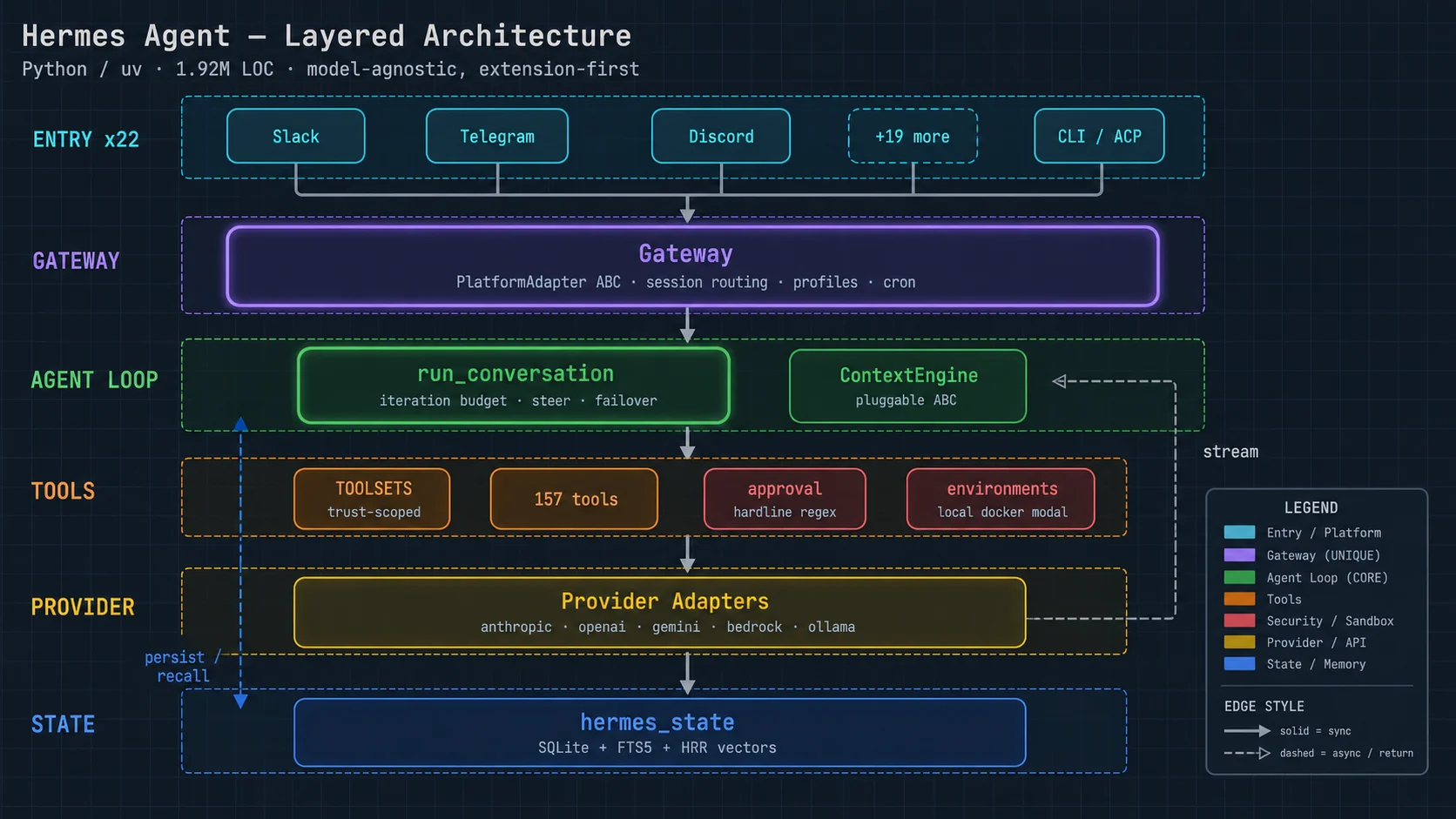
0.5 Chapter Index
| Ch. | Title | What's in it |
|---|---|---|
| 1 | Gateway Layer | Always-on process, 22-platform adapter abstraction, declarative capabilities, delivery ledger, restart guard |
| 2 | Identity and Session Routing | Profile multi-identity, four-level routing, SOUL.md persona files, cross-platform session continuity |
| 3 | Main Loop | ★ Budget-driven loop, grace calls, mid-turn interjection, per-turn prologue |
| 4 | Tool System | TOOLSETS exposure policy, central dispatch, argument coercion layer, error sanitization |
| 5 | Approval and Safety Red Lines | ★ 12 hard red lines, command-position anchoring, quote masking, de-obfuscation, path normalization |
| 6 | Execution Environments | 7 pluggable environments, and the audit finding that local runs unsandboxed by default |
| 7 | Context Engine | ★ Abstract base class, the two verbs select and compress, the cache contract |
| 8 | Memory System | ★ HRR holographic memory, SQLite + FTS5, trust-score decay, 8 pluggable backends |
| 9 | Plugin System | 3 discovery sources, the distinction between stackable capabilities and mutually exclusive policies |
| 10 | Delegation and Kanban | Subagents, live intervention (interject/abort/pause), kanban collaboration, heartbeats |
| 11 | Provider Adapters | A dozen-plus backends, credential pool failover, per-provider cache breakpoints |
| 12 | Scheduled Tasks | Autonomous triggering, failure-streak alerts, incident records, injection protection |
| 13 | Skill System | 81 skills, progressive disclosure, usage records, the self-improvement loop |
1 · The Gateway Layer
gateway/: 99 files, including run.py, a single 1.55 MB file — the largest module in the whole project. This chapter is about how one always-on process lets 22 chat apps reach the same agent.
1.1 The Problem It Solves
Start with what happens without a gateway. Say you want the agent to support two platforms, Slack and Telegram:
The gateway is the layer that pulls all of that shared logic out. It is a background process that never shuts down, connected to every platform at once, and it is responsible for:
- Normalizing the wildly different message formats of each platform into a uniform event object
- Session routing — deciding which conversation a message belongs to
- User authorization
- Dispatching slash commands
- Driving the clock for scheduled tasks
- Managing the cache of agent instances (the same session reuses the same instance)
- Sending replies out according to each platform's rules
1.2 The Platform Adapter Abstract Base Class
gateway/platforms/base.py, 333 KB. This is the “wall-socket standard” — it specifies what any platform must provide in order to plug in.
The core idea: turn the differences into “capability query methods”
class BasePlatformAdapter(ABC):
# —— message length limits ——
def max_message_length_for_chat(self, chat_id: str) -> int
def message_len_fn(self) -> Callable[[str], int]
def message_len_fn_for_chat(self, chat_id: str) -> Callable[[str], int]
# —— streaming capabilities ——
def supports_draft_streaming(self, ...) -> bool
def prefers_fresh_final_streaming(self, ...) -> bool
def streaming_overflow_limit(self) -> Optional[int]
async def send_draft(self, ...)
# —— permission model ——
def enforces_own_access_policy(self) -> bool
def authorization_is_upstream(self) -> bool
# —— rendering ——
def render_message_event(self, event, sink) -> None
def format_tool_event(self, event, *, mode: str = "all", ...) -> str
def format_tool_preview(self, preview: "ToolPreview") -> str
def set_status_text(self, chat_id: str, text: Optional[str]) -> Nonehermes-agent/gateway/platforms/base.py
Compare the two styles:
# Style A: branch on the platform in the main flow
if platform == 'slack':
max_len = 40000
elif platform == 'discord':
max_len = 2000
elif platform == 'telegram':
max_len = 4096
elif platform == 'sms':
max_len = 160
# ... 22 branches, and checks like this scattered across dozens of places
# Style B: ask the adapter
max_len = adapter.max_message_length_for_chat(chat_id)The problem with Style A isn't that it's ugly. It's that “adding a platform means editing dozens of places.” And you don't know which places — you find them by grep and by luck.
Under Style B, adding a platform = implementing one set of capability declarations. Not a single line of the main flow changes. And the abstract base class forces you to implement every required method; miss one and it errors out immediately.
This is the fundamental reason this layer can carry 22 platforms.
How big are the differences being abstracted away?
| Capability | How the platforms actually differ |
|---|---|
Can it edit a sent message?supports_draft_streaming |
Slack / Telegram / Discord: yes. So the same message can be updated in a stream, and the user watches the text grow. SMS: no. It can only send new messages — streaming is simply not possible; you wait for the full response and send it in one go. |
Does it prefer a fresh final message?prefers_fresh_final_streaming |
On some platforms, editing a message fires a notification or bumps the message to the top, which is a bad experience. Those platforms would rather “use a draft while streaming, then send the final result as a new message.” |
Per-message length capmax_message_length_for_chat |
Discord 2,000 / Telegram 4,096 / SMS 160 / Slack roughly 40,000. Note that this method takes a chat_id argument — because different channels on the same platform can have different limits (enterprise vs. free tier, for instance). |
How length is countedmessage_len_fn |
Subtler: the very definition of “length” differs by platform. Some count characters, some count UTF-16 code units, some count an emoji as several. So it returns a counting function, not a number. |
Does the platform manage permissions itself?enforces_own_access_policy |
WeCom / Feishu: they have a full enterprise permission system; anyone who can get into the group is, by definition, authorized. IRC: no concept of permissions at all. Anyone can send a message, so the agent must do authorization itself. |
Is authorization upstream?authorization_is_upstream |
Some integration paths (through an enterprise gateway proxy, say) have already authenticated the identity upstream, and the agent shouldn't ask again. |
1.3 Normalizing Message Events
Every platform has a completely different message format. The gateway unifies them into one event object:
class MessageType(Enum): ...
class ProcessingOutcome(Enum): ...
class MessageEvent:
...
def is_command(self) -> bool # is this a slash command?
def get_command(self) -> Optional[str] # command name
def get_command_args(self) -> str # command arguments
class CachedMedia:
def context_note(self) -> str # context note for an attachment
class TextDebounceState: ... # ★ text debouncing
class SendResult: ...
class EphemeralReply(str): # ★ a temporary reply with an expiry
def __new__(cls, text: str, ttl_seconds: Optional[int] = None): ...
def text(self) -> str: ...Two classes worth calling out
TextDebounceState handles this scenario:
EphemeralReply is a class that inherits from str and carries an expiry time. It is for messages that “should disappear once said” — status hints like “Thinking…”. On platforms that support it, these messages delete themselves after a while and don't clutter the chat history.
Inheriting from str is a very practical design: every piece of code that already handles strings keeps working unchanged; only the code that cares about expiry checks whether it is an EphemeralReply.
1.4 The Defensive Mechanisms in the Gateway Main Loop
The function names in run.py are, on their own, a checklist of “what goes wrong for a long-running process”:
① Hygiene cooldown: stop retrying failed compaction
def _hygiene_cooldown_for_failure(...)
def _reset_hygiene_failure_streak(gateway, session_key: str) -> None
def hygiene_compaction_recovered(...)
def _record_hygiene_cooldown(...)“Hygiene” here means the automatic context tidying done in the background. If compaction keeps failing for a session, give it a cooldown period rather than trying again and again — otherwise it burns resources continuously and fails continuously.
The name _reset_hygiene_failure_streak tells you it tracks a count of consecutive failures, reset to zero on the first success. This is the same idea as the idempotency lock in Chapter 3.
② Recognizing transient network errors
def _is_transient_network_error(exc: BaseException) -> boolA long-running process has to tell “the network hiccuped” apart from “something is actually broken.” The former should retry silently; the latter should alert. If you don't distinguish them, users drown in meaningless alerts about network blips and eventually mute all alerts.
③ Redacting secrets from user-visible text
def _redact_gateway_user_facing_secrets(text: str) -> str
def _redact_approval_command(cmd: "str | None") -> strThe gateway sends some internal information into the chat window (error messages, approval requests). That text may carry API keys, tokens, and passwords. And a chat window is visible to many people, searchable, and archived. So it must be redacted before it goes out.
Note that there are two redaction functions: one for general text, one specifically for “the command awaiting approval.” Secrets in a command take different shapes (in an environment variable assignment, in an argument, in a pipeline).
④ Making provider errors user-friendly
def _gateway_provider_error_reply(text: str) -> str
def _looks_like_gateway_provider_error(text: str) -> bool
def _sanitize_gateway_final_response(platform: Any, text: str) -> strError messages from model services are usually written for developers (stack traces, internal error codes, request IDs). Sent straight into a chat window, they mean nothing to the user. So they have to be recognized and translated into plain language.
⑤ Restart guard
gateway/restart.py
gateway/restart_loop_guard.py ← ★ restart storm protectionA restart storm is the classic failure of a long-running process: the process crashes → auto-restarts → crashes again on startup → restarts again → forever. Dozens of restarts per second, logs flooded, CPU pinned.
The usual guard: record recent restart counts and intervals, and if there are too many restarts in a short window, stop auto-restarting and stay down — so a human takes a look.
⑥ Memory monitoring and graceful drain
gateway/memory_monitor.py memory usage monitoring
gateway/agent_cache_pressure.py agent cache pressure
gateway/drain_control.py ★ graceful drain
gateway/disk_status.py disk statusAgent cache pressure: the gateway caches agent instances (the same session reuses the same one). But every instance holds the full message history — a few dozen active sessions can eat several GB of memory. So the pressure has to be monitored, and inactive instances evicted when necessary.
Graceful drain: when the gateway needs to shut down, you can't just kill it — messages currently being processed would be lost. The right way is “stop accepting new messages, finish what's in hand, then exit.”
⑦ Delivery ledger
gateway/delivery.py
gateway/delivery_ledger.py ← ★ delivery ledger
gateway/rich_sent_store.py
gateway/message_timestamps.py
gateway/dead_targets.py ← dead targets (a deleted channel, say)The delivery ledger records “which reply has already been sent where.” It guards against duplicate delivery: on a network timeout you don't know whether the message went out, and a retry could make the user see it twice. With a ledger, you can tell.
Dead targets covers the cases where the channel the agent wants to reply to has been deleted, the bot has been kicked from the group, or the user has blocked it. These deliveries will fail forever, and they must be recognized and retries stopped, or the retry queue grows without bound.
1.5 Status Messages and Progress Feedback
def _status_template_to_regex(template: str) -> str
def _gateway_compression_progress_notices_enabled() -> bool
def _prepare_gateway_status_message(platform, event_type: str, message: str) -> Optional[str]
async def _send_or_update_status_coro(adapter, chat_id, status_key, content, metadata)
def render_notice_line(notice) -> strDuring a long task the agent needs to tell the user “I'm still working.” But doing that inside a chat app is delicate:
- Too many status messages → spam
- None → the user thinks it died
- Updating by editing the same message → only works on platforms that support editing
The function _status_template_to_regex deserves a note: it converts a status-message template into a regular expression. The likely purpose is “recognize which messages in the chat history are status messages I sent earlier,” so they can be updated or deleted — because the message IDs returned by the platform API may already be lost, and matching on content is the only way to find them.
1.6 Interruption and Recovery
def _is_fresh_gateway_interruption(...)
def build_resume_recovery_note(...)
def _prepare_resume_pending_message(...)
def _build_replay_entry(...)
def _startup_restore_drain_timeout_secs() -> float
def _auto_continue_freshness_window() -> floatThis group of functions handles: after the gateway restarts, what happens to the sessions that were “halfway through”?
This group of functions is where the essential difference between “always-on” and “command-line tool” lives.
When a command-line tool crashes, it crashes; the user runs it again. When a long-running process crashes, it has to work out on its own “where was I, should I continue, should I tell the user” — and the only evidence it has is the state on disk.
None of this logic shows up on an architecture diagram, but it accounts for a substantial share of the gateway module.
1.7 Built-in Gateway Hooks
gateway/hooks.py
gateway/builtin_hooks/The gateway layer has its own hook system, letting plugins insert logic at the key points where messages enter and leave. Together with the plugin system in Chapter 9, this gives you the ability to “extend gateway behavior without changing core code.”
1.8 What This Layer Costs
A single 1.55 MB file is the most visible cost of this layer. It isn't a design flaw; it is the inevitable result of the combinatorial explosion of “22 platforms × every platform's edge cases.”
You can tell from the function names what's packed into this file: cooldown policy, error classification, redaction, status rendering, timestamp handling, approval forwarding, progress-thread parsing, per-platform display config, Telegram-specific mention format conversion (_telegramize_command_mentions)…
Each one is small, but together they add up to 1.55 MB. And most of them can't be abstracted away — because what they are doing, fundamentally, is handling the irregularity of the outside world.
2 · Identity and Session Routing
This chapter covers two related but distinct things: which “agent identity” a message belongs to, and which “conversation” it belongs to.
2.1 Profiles: One Process, Many Identities
In Hermes, a “Profile” is a complete agent identity. The first sentence of the docs defines it clearly:
“Allows a single Hermes instance to route specific Discord guilds/channels/threads to different profiles — each with their own model, tools, memory, and persona.”
In plain terms: one Hermes instance can send particular Discord servers / channels / threads to different identities — and each identity has its own model, tools, memory, and persona.
A Profile owns its own:
| Component | Description |
|---|---|
config.yaml | Its own configuration: which model, which toolsets are enabled, what the context thresholds are |
SOUL.md | The persona and code-of-conduct file. What style this identity has, what principles it follows |
MEMORY.md / USER.md | This identity's long-term memory and its understanding of the user |
memory_store.db | A separate SQLite memory database |
| Gateway process | Can have its own gateway instance |
| Scheduled tasks | Its own task list |
Typical scenarios:
- A company Discord server: the engineering channel wants an identity that reads code and can run commands; the support channel wants one that only reads docs and speaks politely. They must never share memory — the support-channel agent should know nothing about internal engineering discussions.
- Personal use: one identity for work (serious, with code permissions), another for life (relaxed, with only calendar and search).
- Cost control: important channels get the expensive, strong model; chit-chat channels get the cheap, small one.
The key phrase is “one process.” If every identity had to run as its own process, memory usage, deployment complexity, and coordinating scheduled tasks would all become problems.
2.2 Four-Level Routing and the “Specificity” Score
Routing rules live in the config file:
gateway:
profile_routes:
- name: server-default # rule name
platform: discord
guild_id: "SERVER_ID"
profile: server-profile # which identity to route to
- name: special-channel
platform: discord
guild_id: "SERVER_ID"
chat_id: "CHANNEL_ID"
profile: channel-profile
- name: thread-route
platform: discord
chat_id: "CHANNEL_ID"
thread_id: "THREAD_ID"
profile: thread-profileThe specificity score
@dataclass(frozen=True)
class ProfileRoute:
name: str
platform: str
profile: str
guild_id: Optional[str] = None # server
chat_id: Optional[str] = None # channel
thread_id: Optional[str] = None # thread
enabled: bool = True
@property
def specificity(self) -> int:
"""Higher value = more specific match."""
s = 0
if self.guild_id: s += 2 # server weight 2
if self.chat_id: s += 4 # channel weight 4
if self.thread_id: s += 8 # thread weight 8
return shermes-agent/gateway/profile_routing.py
The score uses binary bit weights (2, 4, 8), so the four priority levels line up exactly with the table in the docs:
| Priority | Match condition | Specificity | Meaning |
|---|---|---|---|
| 1 | platform + channel + thread | 14 = 2+4+8 | Pinned to one specific thread |
| 2 | platform + channel | 6 = 2+4 | The whole channel |
| 3 | platform + server | 2 | The whole server |
| 4 | nothing matches | — | Fall back to the default identity |
(Strictly speaking the score is only a sort key; the actual priority 14 > 6 > 2 falls out naturally from the bit weights. The advantage of 2/4/8 over 1/2/3 is that no combination produces a duplicate score, so the ordering is always deterministic.)
Matching is conjunctive
def matches(self, platform, guild_id=None, chat_id=None,
thread_id=None, parent_chat_id=None) -> bool:
if not self.enabled: return False
if self.platform != platform: return False
if self.thread_id and self.thread_id != thread_id: return False
if self.chat_id and self.chat_id != chat_id \
and self.chat_id != parent_chat_id: return False # ★
if self.guild_id and self.guild_id != guild_id: return False
return TrueThe docs spell out the semantics:
“All configured discriminators are matched conjunctively (AND): every discriminator that the route declares must hold. …A route declaring both guild_id and chat_id requires both to match (a chat match alone does not satisfy a guild constraint).”
In plain terms: every configured condition is ANDed together: each condition a route declares must hold. …A route that declares both a server and a channel requires both to match (matching the channel alone does not satisfy the server constraint).
Parent-chain matching: Discord forums and threads
That parent_chat_id branch handles a hierarchy specific to Discord:
This detail is an example of “the abstraction has to follow the shape of the real world.”
With a flat “exact channel ID match” only, users would run into a deeply confusing behavior: talking in the channel gets one identity; open a thread in that same channel and you're suddenly talking to the default identity. In the user's mental model, the thread obviously belongs to the channel.
When the abstraction and the user's mental model disagree, the user calls it a bug — even if the code works exactly as designed.
2.3 When an Explicit Route Is Rejected
class ProfileRouteRejected(RuntimeError):
"""An explicit route matched a profile this gateway does not serve."""In other words: an explicit route matched an identity that “this gateway doesn't serve.”
The scenario: you can run several gateway processes, each serving only a subset of identities (for resource isolation, say). A message may then match an identity that “isn't mine” — that's not a misconfiguration; the message just belongs to a different gateway.
Using a dedicated exception type rather than “silently fall back to the default identity” is the right call — a silent fallback would let the wrong identity handle the message, and the user would have a hard time noticing.
2.4 SOUL.md: The Persona File
Each identity has a SOUL.md. Its relationship to the system prompt looks like this:
This layering is the same kind of thing as CLAUDE.md in Claude Code, with one important difference: Hermes splits “persona,” “memory,” and “understanding of the user” into three separate files.
| File | Who writes it | Nature of the content |
|---|---|---|
SOUL.md | A human | Identity definition. Rarely changes; changes are deliberate |
MEMORY.md | The agent itself | Facts it has learned. Grows continuously |
USER.md | The agent itself | Its model of the user. Continuously revised |
This split is necessary for “self-improvement.”
If persona and memory were mixed in one file, the agent could alter the persona definition while writing memory — and the persona is something the agent should not modify on its own.
Split apart: the agent only writes to MEMORY.md and USER.md; SOUL.md is read-only. “The part that may modify itself” and “the part that may not” now have a physical boundary between them.
2.5 Session Routing: Continuity Across Platforms
Identity routing decides “which persona to use”; session routing decides “which conversation to continue.”
This is one of the gateway's most valuable capabilities: you can be halfway through a conversation on Slack at your desk, walk out the door, switch to Telegram on your phone, and pick up right where you left off, with the conversation context fully intact.
How it does that
The related modules:
gateway/channel_directory.py channel directory
gateway/pairing.py ★ pairing (links accounts on different platforms to the same user)
gateway/mirror.py mirroring
gateway/profile_routing.py identity routingpairing.py is the foundation of this mechanism: the system needs to know that “@alice on Slack” and “alice_w on Telegram” are the same person. The link is usually established with something like a one-time verification code.
2.6 Caching Agent Instances
The gateway caches AIAgent instances, reusing the same one for the same session. That has two consequences:
The upside: state carries over naturally
Message history, the context engine's bookkeeping, and compaction counters all live in the instance; nothing has to be rebuilt from disk every time.
The cost: the risk of state leaking across turns
The top of the main loop has a block of code dedicated to this, and the comment says it plainly:
“The gateway caches agents across user turns. Compression state is per-turn: carrying a prior in-place boundary forward would make a later uncompressed result look like a compacted transcript to gateway writers.”
In plain terms: the gateway keeps agents cached across user turns, but compaction state belongs to a single turn. If the in-place boundary from the previous turn were carried forward, a later uncompressed result would look, to the gateway's writers, like a transcript that had already been compacted.
There is another block that handles hot config reloads:
“Adopt any ~/.hermes/.env credential/base-url edits made since the last turn — a Settings save updates .env but not this worker's client, which was built at agent init. No-op when .env is unchanged.”
In plain terms: pick up any credential or base-URL edits made since the last turn — saving in the Settings UI updates the .env file, but not this worker process's client object, which was built when the agent was initialized. If .env hasn't changed, this step does nothing.
This is a problem unique to long-running processes: the user changes an API key in the Settings UI and expects it to take effect immediately. But the agent instance was created hours ago, and the client object it holds is still using the old key. So the start of every turn checks whether the config file has changed.
Once you stack “always-on + multiple entry points + multiple identities,” you get an entire class of problems that a command-line tool never faces:
· Should state be cleared between turns? Which parts cleared, which kept?
· How do config changes get hot-reloaded?
· If the same user comes in through different entry points, is it the same conversation?
· Which identity should handle a given message? What if the rules conflict?
· After a process restart, how do half-finished sessions recover?
The answers to these questions make up the vast majority of the 99 files in gateway/.
3 · The Main Loop ★
agent/conversation_loop.py, 8,676 lines. The core function, run_conversation, starts at line 1,834.
3.1 The Loop Entry: A Triple Budget Gate
while (api_call_count < agent.max_iterations # call count under the hard cap
and agent.iteration_budget.remaining > 0) # iteration budget still has balance
or agent._budget_grace_call: # or: one "grace call" lefthermes-agent/agent/conversation_loop.py:2029
What each of the three conditions does:
| Condition | Purpose |
|---|---|
api_call_count < max_iterations | A hard cap on the number of calls. Prevents runaway loops |
iteration_budget.remaining > 0 | A configurable iteration budget. More flexible than the cap; can be allotted by task importance |
_budget_grace_call | The grace call. When the budget runs out, don't cut off hard; give it one more chance |
How the grace call is implemented
if agent._budget_grace_call:
agent._budget_grace_call = False # ★ consume the flag; the next iteration must exit
elif not agent.iteration_budget.consume(): # try to deduct one unit of budget; nothing left
_turn_exit_reason = "budget_exhausted"
if not agent.quiet_mode:
agent._safe_print(f"\n⚠️ Iteration budget exhausted "
f"({agent.iteration_budget.used}/{agent.iteration_budget.max_total} "
f"iterations used)")
breakHard cutoff: the budget hits the line → immediate break → the user sees a half-finished result and a “budget exhausted” message.
Soft landing: the budget hits the line → one more call (and the model knows it's time to wrap up) → the user sees “I've finished A and B, C is one step from done, here's where things stand…”.
Same cost ceiling, a very different experience. And that summary is extremely useful for deciding what the user does next.
3.2 Per-Turn Preparation: build_turn_context
Before the loop starts there is a long “per-turn prologue,” which the source pulls out into agent/turn_context.py:
“All once-per-turn setup — stdio guarding, retry-counter resets, user message sanitization, todo/nudge hydration, system-prompt restore-or-build, preflight compression, the pre_llm_call plugin hook, external-memory prefetch, and crash-resilience persistence — lives in build_turn_context. It mutates agent exactly as the inline code did and returns the locals the loop below reads back.”
In plain terms: everything that happens exactly once per turn — guarding stdio, resetting retry counters, sanitizing the user message, hydrating todos and nudges, restoring or building the system prompt, pre-flight compaction, the pre_llm_call plugin hook, prefetching external memory, and persisting for crash recovery — lives in build_turn_context. It modifies the agent object exactly the way the old inline code did, and returns the local variables the loop below reads.
Taking those nine items one at a time:
| Preparation step | Why it's needed |
|---|---|
| Stdio guarding | Keeps output from tool execution from polluting the agent's own output stream. In the terminal UI this would garble the display |
| Retry-counter resets | A new turn begins; the previous turn's retry count goes back to zero |
| User message sanitization | Cleans anything out of the user's input that could interfere with the model |
| Todo and nudge hydration | Injects the todo list and “time to do X” reminders into the context |
| System prompt restore-or-build | Reuse it if cached (protecting the prompt cache); otherwise reassemble it |
| Pre-flight compaction | Roughly estimate the token count before sending; compact first if it's over |
pre_llm_call plugin hook | Lets plugins insert content before the model is called |
| External memory prefetch | Pull relevant content from the memory service ahead of time (see Chapter 8) |
| Crash-resilience persistence | Write state to disk first, so it can recover even if the process is killed |
“Restore or build” for the system prompt
def _restore_or_build_system_prompt(agent, system_message, conversation_history)
def _stored_prompt_matches_runtime(agent, prompt: str) -> bool
def _ensure_cached_system_prompt_static(agent, system_message=None) -> NoneThe existence of these three functions tells you: the system prompt is cached and reused across turns, and there is a check that “verifies it still matches the current runtime configuration.”
Why verify? Because the runtime configuration may have changed — the user switched models, enabled a new toolset, edited SOUL.md. Then the cached prompt is stale and must be rebuilt. But if nothing changed, it must not be rebuilt — rebuilding could produce different bytes and break the prompt cache.
3.3 Mid-Turn Interjection: /steer
This is one of Hermes's distinctive capabilities: while the model is thinking, the user can slip in a line, and that line takes effect within the current turn.
Two hard parts
| Hard part | Why it's hard |
|---|---|
| Can't break role alternation | The API requires messages to alternate “user → model → user → model.” If the model is waiting on a tool result and you insert a user message, you break the “tool call → tool result” pairing and the request gets rejected |
| Can't break the prompt cache | Inserting a new message into the middle of the conversation = changing the middle of the context = every cached byte from the insertion point onward is invalidated |
The solution: append to the end of the most recent tool-result message
_pre_api_steer = agent._drain_pending_steer() # take the pending interjection
if _pre_api_steer:
_injected = False
for _si in range(len(messages) - 1, -1, -1): # search backward from the last message
_sm = messages[_si]
if isinstance(_sm, dict) and _sm.get("role") == "tool": # found the most recent tool message
from agent.prompt_builder import format_steer_marker
marker = format_steer_marker(_pre_api_steer)
existing = _sm.get("content", "")
if isinstance(existing, str):
_sm["content"] = existing + marker # ★ append; don't add a new message
else:
# multimodal content blocks — append a text block
try:
blocks = list(existing) if existing else []
blocks.append({"type": "text", "text": marker})
_sm["content"] = blocks
except Exception:
pass
_injected = True
break
if not _injected:
# no tool message yet (first iteration) — put it back in the queue
# and inject it when the next batch of tool results appears.
# Injecting a user message would break role alternation, and there's no tool output to ride on yet
agent._pending_steer = _pre_api_steerhermes-agent/agent/conversation_loop.py · draining interjections before the API call
Stuffing a new message into the conversation = breaking the cache prefix + possibly breaking role alternation.
Appending to “the end of the last message” = only the final short segment of the cache is invalidated; everything before it still hits.
This “tail of the most recent tool-result message” slot is reused at least three times in Hermes:
· /steer, the user's mid-turn interjection
· The “please start wrapping up” reminder when the wall-clock budget hits 80% (next section)
· Todo-item hints
Reserve one fixed injection point and route every out-of-band signal through it — then you only have to guarantee cache safety in one place, instead of re-thinking it every time you add a feature.
And a stronger one: redirect
_redirect_text = agent._drain_pending_redirect()
if _redirect_text:
_apply_active_turn_redirect(agent, messages, _redirect_text)
if isinstance(original_user_message, str):
original_user_message = (
f"{original_user_message}\n\n"
f"User correction during the turn: {_redirect_text}" # the user's mid-turn correction
)
agent._persist_session(messages, conversation_history)A “redirect” is stronger than an “interjection”: it modifies the record of the “original user message,” attaching the correction to it. That way, even if compaction happens later, the correction survives in the material the summary is built from — because it has become part of the user's request.
3.4 The Wall-Clock Budget Wrap-Up Reminder
if getattr(agent, "run_budget_seconds", None):
_maybe_inject_run_budget_wrapup(agent, messages)The function's comment explains the mechanism: one-shot — when a run budget (--run-budget) is active and 80% of it has been consumed, remind the model to start wrapping up and deliver with the state it already has. Uses the same cache-safe channel as /steer (appended to the latest tool result); fully dormant when no budget is set.
Note that this is a “time budget,” not a “token budget.”
The two guard against different problems:
· The token budget guards against spending too much money
· The time budget guards against making the user wait too long
For an agent running inside a chat app, the user's patience is finite. Ten minutes with no reply and the user has walked away. So “remind it to wrap up at 80%” is far more meaningful than “cut it off at 100%.”
3.5 The Interrupt Check
if agent._interrupt_requested:
interrupted = True
_turn_exit_reason = "interrupted_by_user"
if not agent.quiet_mode:
agent._safe_print("\n⚡ Breaking out of tool loop due to interrupt...")
breakHermes uses flag polling: an interrupt request sets a boolean flag, and the loop checks it once at the top of each iteration.
There is a finer-grained interrupt type too — the input budget of a review task running out:
if _review_input_budget_exhausted(agent):
_turn_exit_reason = "review_input_budget_exhausted"
if not agent.quiet_mode:
agent._safe_print(
f"\n⏹️ Review input budget exhausted "
f"({int(agent.session_input_tokens):,} tokens) — stopping "
f"the review tool loop before the next provider call.")
breakThe comment explains where it fits: “An aggregate input budget for detached background review tasks: compaction limits a single request, while this limits the whole review task. It fires between iterations — the request that crossed the budget line has already completed (its tool writes have landed), and then the tool loop stops before the next model call, matching how the iteration budget exits.”
The choice of “exit between iterations” is deliberate and careful.
Don't exit mid-request — that leaves an unfinished tool call behind (Chapter 4 covers this problem).
Don't exit mid-tool-execution — that leaves a half-written file behind.
Exiting “after one iteration fully completes and before the next begins” is the only moment that guarantees consistent state.
3.6 The Step Callback: An Observation Point for the Gateway
if agent.step_callback is not None:
try:
prev_tools = []
# search backward for the most recent model message that carried tool calls
for _idx, _m in enumerate(reversed(messages)):
if _m.get("role") == "assistant" and _m.get("tool_calls"):
_fwd_start = len(messages) - _idx
_results_by_id = {}
# collect all the tool results that immediately follow it
for _tm in messages[_fwd_start:]:
if _tm.get("role") != "tool": break
_tcid = _tm.get("tool_call_id")
if _tcid: _results_by_id[_tcid] = _tm.get("content", "")
prev_tools = [
{ "name": tc["function"]["name"],
"result": _results_by_id.get(tc.get("id")),
"arguments": tc["function"].get("arguments") }
for tc in _m["tool_calls"] if isinstance(tc, dict)
]
break
agent.step_callback(api_call_count, prev_tools)
except Exception as _step_err:
logger.debug("step_callback error (iteration %s): %s", api_call_count, _step_err)This callback lets the gateway know in real time “which step the agent is on, which tools the last step used, and what the results were,” so it can push progress to the chat window.
Notice the whole block is wrapped in try/except, and a failure is logged only at debug level. That is correct: observation code must never affect the main flow. If step_callback throws because of a network problem, the agent should not stop working over it.
3.7 Other State Inside the Loop
The long comment at the top of the loop reveals the state maintained across iterations:
| State | Purpose |
|---|---|
compression_attempts |
Compaction attempt counter. From the comment: “A resolved per-turn cap on compaction attempts, shared by everything that consumes it: the pre-API pressure gate, the overflow/413 retry handler, and the post-tool-call compaction gate. The counter is a backstop for consecutive ‘unverified/ineffective’ attempts: a completed compaction only re-arms it once a subsequent API response reports the prompt is back under the threshold.” Config key compression.max_attempts, default 3 |
_outer_loop_errors |
Total outer-loop exceptions this turn, capped by _MAX_OUTER_LOOP_ERRORS |
_persistence_failed_persistence_failure_cause |
Persistence failure flag and cause (locked lock contention / disk disk / unknown). Reset every turn so the previous turn's diagnosis doesn't leak into this one |
_pending_verification_answer_response_was_previewed |
An answer held back by the verification gate, and whether it has already been streamed to the user as interim content |
| MoA bootstrap retention | If pre-API compaction fires after the “multi-agent advisors” have produced output, keep those interim outputs and re-attach them to the compacted transcript on the next iteration — avoiding a second advisor fan-out |
| Credential refresh count | See Chapter 11. Prevents the spin where “continuous 401s make a single-entry credential pool refresh ‘successfully’ forever” |
_turn_usage |
This turn's usage, forwarded to the context engine's on_turn_complete() hook. None if no response was reached, so the hook receives None rather than stale data from the previous turn |
That “re-arming” mechanism deserves a closer look
This is much stricter than “it compacted, so it counts,” and it is necessary.
Because compaction can be ineffective: if the oversized content is all inside the “protected window” (say, one of the last 6 messages contains a huge file), compacting away the earlier part solves nothing.
Without verification, the system falls into the loop “compact → still over → compact again → nothing left to compact → still over.” With a counter that only re-arms after verification, it gives up and reports an error after 3 attempts instead of trying forever.
3.8 Why the Loop Exited
The values of _turn_exit_reason we've already seen in the code:
| Exit reason | Meaning |
|---|---|
interrupted_by_user | Interrupted by the user |
budget_exhausted | Iteration budget exhausted |
review_input_budget_exhausted | The review task's aggregate input budget exhausted |
Like the step callback in section 3.6, this field exists purely for observability — it plays no part in business logic, but it turns “why did this agent stop” into a data field you can query directly, instead of something you infer by digging through logs.
3.9 An Optional Bypass: The Codex App Server Runtime
# Optional opt-in runtime: if api_mode == codex_app_server,
# hand this turn to the codex app server subprocess (terminal operations, file operations,
# and patching all happen inside Codex). The default Hermes path is bypassed entirely.This is a very thorough extension point: the entire main loop can be taken over by an external subprocess.
Its existence reveals a Hermes stance: not even the “agent loop” itself has to be implemented in-house. If a user wants a different agent runtime (here, OpenAI's Codex), Hermes can shrink down to a shell of “gateway + session management + memory.”
4 · The Tool System
162 tool files, plus a 39 KB exposure-policy file. This chapter is about how tools are organized, how they are exposed, and how call arguments get coerced.
4.1 The Most Important Design Decision: Implementation Separated from Exposure
The tools/ directory holds 157 tools' “how to do it”; toolsets.py holds “in which situations they should be brought out.”
These two things are completely decoupled — this is the one Hermes design most worth lifting straight into your own project.
The core tool list
# The tool list shared by the CLI and every messaging platform.
# Change it here and every platform is updated at once.
_HERMES_CORE_TOOLS = [
# web
"web_search", "web_extract",
# terminal and process management
"terminal", "process",
# Note: desktop-GUI capabilities (read_terminal, open_preview, etc.)
# are deliberately not listed here, for the same reason as the project tools below:
# they only make sense where a graphical renderer can respond. They live in the desktop_ui
# toolset and are enabled solely by the GUI gateway for sessions whose SOURCE is the desktop app —
# never keyed on a process env var, which is blind to "a desktop client talking to a remote backend."
# file operations
"read_file", "write_file", "patch", "search_files",
# vision and image generation
"vision_analyze", "image_generate",
# skills
"skills_list", "skill_view", "skill_manage",
# browser automation
"browser_navigate", "browser_snapshot", "browser_click",
"browser_type", "browser_scroll", "browser_back",
"browser_press", "browser_get_images",
"browser_vision", "browser_console", "browser_cdp", "browser_dialog",
"browser_exec", # replaces the other browser tools when browser.backend is "browser-use"
# text-to-speech
"text_to_speech",
# planning and memory
"todo", "memory",
# session history search
"session_search",
# clarifying questions
"clarify",
# code execution and delegation
"execute_code", "delegate_task",
# scheduled tasks
"cronjob",
# smart home (enabled via check_fn, which looks for HASS_TOKEN)
"ha_list_entities", "ha_get_state", "ha_list_services", "ha_call_service",
# kanban multi-agent collaboration — only enters the schema when the agent was spawned
# as a kanban worker (HERMES_KANBAN_TASK env var set), or the current profile has explicitly
# enabled the kanban toolset. Controlled via check_fn.
"kanban_show", "kanban_list", "kanban_complete", "kanban_block",
"kanban_request_review", "kanban_request_changes", "kanban_heartbeat",
"kanban_comment", "kanban_create", "kanban_link", "kanban_unblock",
"kanban_attach", "kanban_attach_url", "kanban_attachments",
# computer use (macOS; check_fn verifies cua-driver is installed)
"computer_use",
]hermes-agent/toolsets.py
The design principles those two comments reveal
That sentence in the comment is worth reading word for word:
“…enabled solely by the GUI gateway for a session whose SOURCE is the desktop app — never keyed on a process env var, which is blind to a desktop client talking to a remote/cloud backend.”
In plain terms: only the GUI gateway turns these on, and only for sessions that originated from the desktop app — never based on a process environment variable, because that can't see the case where “a desktop client is connected to a remote/cloud backend.”
Unpacking the trap: desktop-app tools (such as “open a preview window”) need a graphical UI to respond. The most intuitive check is an environment variable: “am I running in a desktop environment?”
But in Hermes's deployment shapes, the desktop client may be connected to an agent on a cloud server. That server has no GUI; the environment variable says “not a desktop environment” — yet the user really did send the message from the desktop app and really does need those tools.
The correct basis for the decision is “which entry point did this message come in through,” and only the gateway knows that.
Narrowing the trust boundary: the webhook toolset
# Webhook events may originate from untrusted third-party content (for example,
# pull request titles or comments on a public repository). The default webhook toolset is
# deliberately kept narrow so prompt injection can't trigger local file I/O or system command execution.
_HERMES_WEBHOOK_SAFE_TOOLS = [
"web_search", # web search (read-only)
"web_extract", # extract web page content (read-only)
"vision_analyze", # analyze images (read-only)
"clarify", # ask the user a question (no side effects)
]Compare what got excluded from the core list: terminal (runs commands), write_file (writes files), patch (edits files), execute_code (runs code), delegate_task (spawns subagents) — every one of them has side effects.
What the four that remain have in common: even if the model is completely hijacked, the worst it can do is “search for some irrelevant things.”
This is the pattern of “configuring the tool surface by trust boundary.” Safety isn't achieved by writing “please don't run dangerous commands” in the prompt — the model cannot call a tool it doesn't know exists.
4.2 Composing and Resolving Toolsets
TOOLSETS = {
"web": {
"description": "Web research and content extraction tools",
"tools": ["web_search", "web_extract"],
"includes": [] # ★ can include other toolsets
},
"search": {
"description": "Web search only (no content extraction/scraping)",
"tools": ["web_search"],
"includes": []
},
"vision": { "tools": ["vision_analyze"], ... },
"video": { "description": "…(opt-in, not in the default toolsets)",
"tools": ["video_analyze"], ... },
"image_gen": { "tools": ["image_generate"], ... },
...
}Each toolset has three fields: a description (for humans), a tool list, and other toolsets it includes.
The resolution functions
def get_toolset(name: str, *, include_registry: bool = True) -> Optional[Dict]
def bundle_non_core_tools(toolset_name: str) -> Set[str]
def resolve_toolset(name: str, visited: Set[str] = None, *,
include_registry: bool = True) -> List[str] # ★ with cycle detection
def resolve_multiple_toolsets(toolset_names: List[str]) -> List[str]
def _get_plugin_toolset_names() -> Set[str] # toolsets provided by plugins
def _get_registry_toolset_aliases() -> Dict[str, str] # aliases
def get_all_toolsets() -> Dict[str, Dict[str, Any]]
def get_toolset_names() -> List[str]
def validate_toolset(name: str) -> bool
def create_custom_toolset(...)
def get_toolset_info(name: str) -> Dict[str, Any]The visited parameter of resolve_toolset is cycle detection: toolset A includes B, B includes A, infinite recursion. A “visited set” prevents it.
The existence of bundle_non_core_tools tells you that the system needs to distinguish “core tools” from “add-on tools” — presumably so they can be treated differently when computing token cost or making exposure decisions.
Toolsets from three sources
The function names show that toolsets come from three places:
- Built-in — hard-coded in the
TOOLSETSdictionary - Plugin-provided —
_get_plugin_toolset_names() - The registry — controlled by the
include_registryparameter, with alias support via_get_registry_toolset_aliases()
4.3 Central Tool Dispatch
Hermes has no Tool class abstraction; every tool call goes through the same function:
def handle_function_call(...) # model_tools.py, line 1240The registry machinery that goes with it:
TOOL_TO_TOOLSET_MAP: Dict[str, str] = registry.get_tool_to_toolset_map()
TOOLSET_REQUIREMENTS: Dict[str, dict] = registry.get_toolset_requirements()
def get_all_tool_names() -> List[str]
def get_toolset_for_tool(tool_name: str) -> Optional[str]
def get_available_toolsets() -> Dict[str, dict]
def check_toolset_requirements() -> Dict[str, bool] # ★ dependency check
def check_tool_availability(quiet: bool = False) -> Tuple[List[str], List[dict]]TOOLSET_REQUIREMENTS is an important mechanism: some tools need external conditions to work.
| Tool | Requirement |
|---|---|
| Smart home tools | The HASS_TOKEN environment variable (a Home Assistant access token) |
| Computer use | The cua-driver driver is installed, and only on macOS |
| Kanban tools | The HERMES_KANBAN_TASK environment variable, or explicitly enabled in the profile config |
| Browser tools | The matching browser-automation backend is installed |
The comments in the core list say these are “controlled via check_fn” — meaning each tool can supply a check function that decides at runtime whether it is available. Unavailable tools never enter the model's tool list, so they cost no tokens and can't be called only to fail.
4.4 The Argument Coercion Layer
This layer is unique to Hermes, and extremely practical:
def coerce_tool_args(tool_name: str, args: Dict[str, Any]) -> Dict[str, Any] # line 845
def _schema_accepts_kind(schema: Any, kind: str) -> bool # 953
def _normalize_json_strings_for_schema(value: Any, schema: Any) -> Any # 974
def _coerce_value(value: str, expected_type, schema: dict | None = None) # 1051
def _schema_allows_null(schema: dict | None) -> bool # 1080
def _coerce_json(value: str, expected_python_type: type) # 1104
def _coerce_number(value: str, integer_only: bool = False) # 1135
def _coerce_boolean(value: str) # 1153
def _canonicalize_tool_call_arguments(arg_str: str) -> str # 1293hermes-agent/model_tools.py
Why this layer is needed
Because Hermes is not tied to a model provider.
Strong models emit tool arguments with mostly reliable types — ask for a number, get a number. But Hermes has to support Qwen, DeepSeek, and all sorts of small models running on the user's own machine. These models frequently produce:
| What the model emits | What the tool expects |
|---|---|
"true" (a string) | true (a boolean) |
"5" (a string) | 5 (a number) |
"{\"a\": 1}" (a JSON string) | {"a": 1} (an object) |
"null" (a string) | None |
| JSON wrapped in Markdown code fences | Bare JSON |
Without coercion — just a format error — the tool-call success rate on weak models collapses, and those weak models are exactly what underpins the “run locally, pay nothing” selling point.
This is the hidden cost of being “model-agnostic.” It doesn't show up on the architecture diagram; it shows up as a few hundred lines of defensive code.
Coercion follows the schema; it is not blind conversion
Look at the signature: _coerce_value(value, expected_type, schema) — it receives the target schema. So coercion has a basis:
_schema_accepts_kind(schema, kind)— first ask “does this schema accept this kind of value?”_schema_allows_null(schema)— “is null allowed?”, which decides whether"null"becomesNone_normalize_json_strings_for_schema(value, schema)— recursively handle JSON strings inside nested structures, guided by the schema
Blind conversion (say, “every string that looks like a number becomes a number”) would introduce new bugs — a version number "1.20" that should stay a string would become the number 1.2. Deciding by schema avoids that.
4.5 Sanitizing Tool Error Messages
_TOOL_ERROR_ROLE_TAG_RE = re.compile(...) # strip forged role tags
_TOOL_ERROR_FENCE_OPEN_RE = re.compile(r'^\s*```(?:json|xml|html|markdown)?\s*',
re.MULTILINE)
_TOOL_ERROR_FENCE_CLOSE_RE = re.compile(r'\s*```\s*$', re.MULTILINE)
_TOOL_ERROR_CDATA_RE = re.compile(r'<!\[CDATA\[.*?\]\]>', re.DOTALL)
def _sanitize_tool_error(error_msg: str) -> str: ...What attack this defends against
The four regexes each handle one kind of carrier:
| Regex | What it strips |
|---|---|
_TOOL_ERROR_ROLE_TAG_RE | Forged role tags (</system>, <user>, and the like) |
_TOOL_ERROR_FENCE_OPEN/CLOSE_RE | Markdown code fences — an attacker can use one to “close” the current code block so the text that follows is treated as body text |
_TOOL_ERROR_CDATA_RE | XML CDATA sections — another structure content can hide in |
What this class of attack surface has in common: it travels the exception path, so normal functional tests never cover it. Your tests verify “the tool behaves correctly when it succeeds,” but rarely verify “what's in the error message when the tool fails.”
It's worth a dedicated sweep of your own project: list every path that feeds external data back into the model's context. Tool results, error messages, log contents, exception traces — each one is a potential injection entry point.
4.6 Observing Tool Results, and Hooks
def suppress_post_tool_call_hook() # context manager: temporarily disable the hook
def _tool_result_observer_fields(...)
def _emit_post_tool_call_hook(...)suppress_post_tool_call_hook() is a context manager. Its purpose: certain internal tool calls should not fire the user's hooks.
For example: the agent calls some tool internally in order to do compaction. That isn't part of the user's task, and it shouldn't fire the user-configured “log something after every tool call” hook — otherwise the log drowns in internal operations.
4.7 Recognizing a Delegation Context
def _is_delegated_child_context() -> bool # am I a delegated subagent?
def _is_dispatcher_owned_worker() -> bool # am I a worker owned by the dispatcher?
def _get_tool_loop() # get the event loop for tool execution
def _get_worker_loop() # get the worker's event loop
def _run_async(coro) # run a coroutine on the correct event loopThis group of functions deals with a practical problem in Python async programming: subagents may run on different event loops (even different threads). When a tool executes, it has to find the right loop to schedule its coroutine on, or it throws “event loop is closed” or deadlocks.
_is_delegated_child_context() also has a business purpose: a subagent needs to know it is a subagent, so it can apply different behavior (an auto-approval policy, for instance; see Chapter 10).
4.8 Caching Tool Definitions
_TOOL_DEFS_CACHE_MAX = 8
def _clear_tool_defs_cache() -> None
def get_tool_definitions(...) # line 323, cached
def _compute_tool_definitions(...) # line 417, the actual computation
def _resolve_active_context_length() -> intTool definitions (the list of tools and parameter descriptions sent to the model) are cached, up to 8 copies.
Why multiple copies? Because different situations use different toolsets: one for the main agent, one for subagents, one for kanban workers, one for webhooks… and computing each one means walking every tool, parsing schemas, and checking requirements, which isn't cheap.
The appearance of _resolve_active_context_length() here suggests that generating tool definitions may depend on the size of the context window — presumably trimming some tools or shortening descriptions when the window is small.
5 · Approval and Safety Red Lines ★
tools/approval.py, 5,802 lines. This is the single file in the whole project with the densest adversarial thinking.
5.1 The Overall Structure
5.2 The 12 Hard Red Lines
HARDLINE_PATTERNS = [
# rm recursively deleting the root filesystem or a protected root directory
(_RM_FLAG_PREFIX + _hardline_rm_path(r'/(?:(?:\.\.?)?/)*(?:\.\.?)?\**|/ \*'),
"recursive delete of root filesystem"),
(_RM_FLAG_PREFIX + _hardline_rm_path(_HARDLINE_SYSTEM_DIRS),
"recursive delete of system directory"),
(_RM_FLAG_PREFIX + _hardline_rm_path(r'(?:~|\$\{?HOME\}?)(?:/?|/\*)?'),
"recursive delete of home directory"),
# formatting a filesystem
(_CMDPOS + r'mkfs(\.[a-z0-9]+)?\b', "format filesystem (mkfs)"),
# writing straight to a raw disk device
(_CMDPOS + r'dd\b[^\n]*\bof=/dev/(sd|nvme|hd|mmcblk|vd|xvd)[a-z0-9]*',
"dd to raw block device"),
(r'>\s*/dev/(sd|nvme|hd|mmcblk|vd|xvd)[a-z0-9]*\b',
"redirect to raw block device"),
# fork bomb: a process that replicates itself endlessly and locks up the machine
(r':\(\)\s*\{\s*:\s*\|\s*:\s*&\s*\}\s*;\s*:', "fork bomb"),
# killing every process on the system
(_CMDPOS + r'kill\s+(-[^\s]+\s+)*-1\b', "kill all processes"),
# shutdown / reboot (four spellings)
(_CMDPOS + r'(shutdown|reboot|halt|poweroff)\b', "system shutdown/reboot"),
(_CMDPOS + r'init\s+[06]\b', "init 0/6"),
(_CMDPOS + r'systemctl\s+(poweroff|reboot|halt|kexec)\b', "systemctl poweroff/reboot"),
(_CMDPOS + r'telinit\s+[06]\b', "telinit 0/6"),
]
_HARDLINE_SYSTEM_DIRS = (
r'/home|/home/\*|/root|/root/\*|/etc|/etc/\*|/usr|/usr/\*|'
r'/var|/var/\*|/bin|/bin/\*|/sbin|/sbin/\*|/boot|/boot/\*|/lib|/lib/\*'
)hermes-agent/tools/approval.py
“Unconditional” means: nothing the user configures matters; these commands will never be executed.
5.3 The Real Difficulty: Telling “Command” from “Data”
A real incident
The most naive implementation is if "rm -rf /" in command: block. A source comment records the problem it caused:
“…so the rule fires only when rm is an actual command word — not when the literal string "rm -rf /" appears as DATA inside another command's argument, e.g. gh pr create --title "block rm -rf / spellings" or git commit -m "…rm -rf /…". Those tripped the unconditional floor and could not run at all before the anchor.”
In plain terms: …so the rule only fires when rm is actually in the “command word” position — not when the string "rm -rf /" shows up as data inside another command's argument, such as gh pr create --title "block rm -rf / spellings" (creating a pull request whose title contains that text) or git commit -m "…rm -rf /…". Before the position anchor was added, those commands hit the unconditional red line and could not run at all.
In other words: you couldn't make a commit whose message contained "rm -rf /".
The solution: command-position anchoring
_CMDPOS = (
# start of line / after a command separator / after a subshell opener / after a sudo|env|exec wrapper
...
)
# rm plus its flag group, shared by the three rm rules. Kept as plain string concatenation
# (rather than an f-string) so the regex's backslashes never appear inside an f-string
# replacement field — which is unsupported on Python 3.11.
_RM_FLAG_PREFIX = _CMDPOS + r'rm\s+(-[^\s]*\s+)*'_CMDPOS matches only in these positions:
| Position | Example |
|---|---|
| Start of line | rm -rf / |
| After a command separator | cd /tmp; rm -rf / · make && rm -rf / · a || rm -rf / · x | rm -rf / |
| After a subshell opener | $(rm -rf /) · wrapped in backticks |
| After a wrapper command | sudo rm -rf / · env X=1 rm -rf / · exec rm -rf / |
In --title "block rm -rf / spellings", what precedes rm is a space and a quote, which is none of the positions above — so there's no match, and the command runs normally.
Path normalization: which spellings actually mean the root directory
The regex in that root-directory rule is /(?:(?:\.\.?)?/)*(?:\.\.?)?\**|/ \*, and the comment explains its design:
“The path token matches any root-anchored path whose components collapse back to "/" in the shell: a bare "/", repeated slashes ("//"), and "."/".." current/parent segments ("/.", "/./", "/..", "/../..") all resolve to root, optionally followed by a trailing glob ("/*", "//*"). Each inter-slash segment must be exactly "." or "..", so a longer dot run or any real name is a literal directory, NOT root — "/tmp", "/home", "/.ssh", "/.config" and even "/..." (a dir literally named "...") fall through…”
In plain terms: this path token matches any root-anchored path that “collapses back to the root directory in the shell”: a bare "/", doubled slashes "//", and current/parent segments like "." / ".." ("/.", "/./", "/..", "/../..") all resolve to root, optionally followed by a glob ("/*", "//*"). Every segment between two slashes must be exactly "." or "..", so a longer run of dots, or any real name, is a literal directory and not root — "/tmp", "/home", "/.ssh", "/.config", and even "/..." (a directory genuinely named “...”) fall through to the more lenient rules…
| Treated as root (blocked) | Not treated as root (passed on to the soft rules) |
|---|---|
/ · // · /. · /./ · /.. · /../../* · //* · / * (the shell sees two arguments)quoted "/", "$HOME", ${HOME} |
/tmp · /home · /.ssh · /.config/... (a directory genuinely named “...”) |
The comment also notes: “the explicit "/ \*" branch preserves the ‘slash-space-glob’ spelling (rm -rf / *, which the shell sees as two arguments: / and the glob *)” — a classic slip-of-the-finger disaster (you meant to delete /tmp/* and typed one extra space).
5.4 Quote Masking: But Leave a Way In for “the Part That Really Executes”
Two of the red-line rules have no command name to anchor on — the redirect > /dev/sda and the fork bomb's function definition are effective at any position on the command line.
_QUOTE_MASKED_HARDLINE_DESCRIPTIONS = frozenset({
"redirect to raw block device",
"fork bomb",
})
HARDLINE_PATTERNS_COMPILED = [
(re.compile(pattern, _RE_FLAGS),
description,
description in _QUOTE_MASKED_HARDLINE_DESCRIPTIONS) # ★ third field: whether to mask
for pattern, description in HARDLINE_PATTERNS
]The exact semantics of the masking function
def _mask_quoted_prose(command: str) -> str:
"""Blank out quoted string CONTENT for positionless hardline matching.
Detection-only rewrite used by the quote-masked hardline rules
(redirect-to-block-device, fork bomb): text inside single or double
quotes is data the shell passes as an argument, so `echo "cat f >
/dev/sda"` must not trip the unconditional floor. Structure is
preserved: the quote characters themselves stay, and inside double
quotes `$(...)` command substitutions and backtick spans are kept RAW
because the shell really executes them (`echo "$(cat f > /dev/sda)"`
remains a true positive). Unquoted text is untouched.
"""In plain terms: for the positionless red-line rules, blank out the content inside quotes. This is a rewrite used only for detection… quoted text is data the shell passes as an argument, so echo "cat f > /dev/sda" must not hit the unconditional red line. Structure is preserved: the quote characters themselves stay, and inside double quotes, $(...) command substitutions and backtick spans are left unmasked, because the shell really does execute them. Unquoted text is untouched.
| Command | Block it? | Why |
|---|---|---|
cat f > /dev/sda | Block | It really is writing to a disk device |
echo "cat f > /dev/sda" | Allow | What's in the quotes is data; it just prints some text |
echo "$(cat f > /dev/sda)" | Block | It's inside quotes, but the shell really executes $(...) |
What this passage shows is precise modeling of shell semantics, not simple string handling.
Whoever wrote this had to know exactly: the difference between single and double quotes, which constructs get expanded inside double quotes, the two spellings of command substitution, and how they behave when nested.
You can't look up “how to write the safety check” for this kind of knowledge in any docs — you can only work backward from “how the shell actually parses.”
5.5 Quoting Is Not a Bypass
_SHELL_CARRIER_NAMES = frozenset({
"eval", "sh", "bash", "zsh", "ksh", "dash", "source", ".",
})
def _contains_shell_carrier(command: str) -> bool:
"""Return whether any command-position word is a shell-carrying command."""
for _, _, word in _iter_shell_command_word_spans(command):
name = os.path.basename(
_deobfuscate_shell_word_for_detection(word) # ★ de-obfuscation
).lower()
if name in _SHELL_CARRIER_NAMES:
return True
return FalseThe logic: if the command contains something like sh -c "...", bash -c "...", or eval "..." — a command that “hands quoted content to another shell to execute” — then what's inside the quotes is code, not prose. The masking rule is switched off entirely, and the raw string must be scanned.
The comment sums it up in one line: “quoting is not a bypass”.
Three layers of defense, stacked
And de-obfuscation
_deobfuscate_shell_word_for_detection handles spellings like these:
| What the attacker writes | What the shell actually parses |
|---|---|
b''ash -c '...' | bash -c '...' (the empty-string concatenation disappears) |
ba\sh -c '...' | bash -c '...' (a backslash escaping an ordinary character) |
"bash" -c '...' | bash -c '...' |
/bin/bash -c '...' | os.path.basename extracts bash |
5.6 Sensitive Paths and Write Targets
Beyond dangerous commands, there is a set of patterns for writes to sensitive files:
_SSH_SENSITIVE_PATH = r'(?:~|\$home|\$\{home\})/\.ssh(?:/|$)'
_HERMES_ENV_PATH = ... # ~/.hermes/.env (the agent's own credentials)
_HERMES_CONFIG_PATH = ... # ~/.hermes/config.yaml (the agent's own configuration)
_PROJECT_ENV_PATH = r'(?:(?:/|\.{1,2}/)?(?:[^\s/"\'`]+/)*\.env(?:\.[^/\s"\'`]+)*)'
_PROJECT_CONFIG_PATH = r'(?:(?:/|\.{1,2}/)?(?:[^\s/"\'`]+/)*config\.yaml)'
_SHELL_RC_FILES = (...) # .bashrc / .zshrc and other shell startup scripts
_CREDENTIAL_FILES = (...)
_MACOS_PRIVATE_SYSTEM_PATH = r'/private/(?:etc|var|tmp|home)/'
_SYSTEM_CONFIG_PATH = (...)
_SENSITIVE_WRITE_TARGET = (...)
_USER_SENSITIVE_WRITE_TARGET = (...)
_PROJECT_SENSITIVE_WRITE_TARGET = rf'(?:{_PROJECT_ENV_PATH}|{_PROJECT_CONFIG_PATH})'
_COMMAND_TAIL = r'(?:\s*(?:&&|\|\||;).*)?$'
_WRITE_TARGET_BOUNDARY = r'(?=[\s;&|<>"\']|$)'_HERMES_ENV_PATH and _HERMES_CONFIG_PATHThese two protect the agent's own configuration and credential files.
Why must they be protected? Because if the agent can change its own configuration, it can change its own safety settings — switch the approval mode to “auto-approve everything,” turn off the red-line rules, or swap the API key for the attacker's.
A system that can modify its own permission configuration has no permission configuration. This boundary has to be hard.
Two other regexes deserve attention:
_COMMAND_TAIL— matches the case where “more commands follow this one” (&&,||,;). Prevents spellings likeecho ok && rm -rf /that hide the dangerous command at the end._WRITE_TARGET_BOUNDARY— a lookahead assertion requiring the write target to be followed by whitespace, a separator, or end of line. Prevents.envfrom falsely matching a different file like.envrc.
5.7 The sudo Stdin Guard
_SUDO_STDIN_RE = re.compile(...)
def _check_sudo_stdin_guard(command: str) -> tuple: ...
def _sudo_stdin_block_result(description: str) -> dict: ...This defends against spellings like echo PASSWORD | sudo -S DANGEROUS_COMMAND — sudo -S means “read the password from standard input,” so the password can be piped in, bypassing the interactive password prompt entirely.
And the interactive password prompt was supposed to be the last human gate. Bypassing it means the agent can run arbitrary privileged commands without the user ever knowing.
5.8 Performance: Why Precompile
# Building these at module load eliminates the ~2.6 ms cold-cache re.compile fan-out
# on each process's first terminal() call
# (12 HARDLINE + 47 DANGEROUS patterns, any of which can be evicted from Python's
# 512-entry re._cache by unrelated regex work elsewhere in the program).
_RE_FLAGS = re.IGNORECASE | re.DOTALL
HARDLINE_PATTERNS_COMPILED = [...]Two layers of problem:
- First-compile cost — 59 regexes compiled on first use, about 2.6 milliseconds
- Cache eviction — Python's built-in regex cache holds only 512 entries. Whenever the rest of the program gets busy (log formatting, text processing), these safety regexes get evicted, causing repeated recompilation
Precompiled into module-level constants, both problems disappear.
5.9 Retaining Blocked Commands
def _save_blocked_payload(command: str) -> Optional[str]: ...
def _hardline_block_result(description: str, command: str = "") -> dict: ...
def _user_deny_block_result(pattern: str) -> dict: ..._save_blocked_payload stores the commands that got blocked. Two uses:
- Forensics — if an attack really happened, you can trace what the attacker tried to execute
- False-positive analysis — if a user complains “a normal command got blocked,” you can see exactly which rule matched what
5.10 Smart Approval: An Optional Model Judgment
def _prepare_smart_approval_observer(...)
def _observe_smart_approval_verdict(payload: dict | None, verdict: str) -> None
def _fire_approval_hook(hook_name: str, **kwargs) -> NoneBeyond the deterministic rules, Hermes has an optional “smart approval” — using a model to judge whether an operation is safe.
Note the words observer and verdict in the function names: the mechanism is designed to be observable, and every verdict is recorded. That is what makes it possible to evaluate “how accurate is smart approval, and what did it get wrong.”
5.11 Context Awareness: Different Situations, Different Policies
def set_hermes_interactive_context(interactive: bool) -> contextvars.Token
def reset_hermes_interactive_context(token: contextvars.Token) -> None
def _is_interactive_cli() -> bool
def _is_cron_approval_context() -> bool
def _is_single_query_approval_context() -> bool
def _is_gateway_approval_context() -> bool
def _get_session_platform() -> str
def _resolve_cli_approval_callback(approval_callback=None)
def _should_fall_through_to_cli_approval(...)
def set_current_session_key(session_key: str) -> contextvars.Token[str]
def get_current_session_key(default: str = "default") -> str
def set_current_observability_context(...)This uses Python's contextvars — a variable mechanism that “propagates automatically through an async call chain, with each coroutine isolated from the others.”
Why it has to be contextvars and not a global variable:
A gateway process may have dozens of sessions running at once. If a global variable held “is this interactive right now,” session A (a terminal session) and session B (a scheduled task) would overwrite each other — and the scheduled task would pop up a confirmation prompt nobody will ever see, then hang forever.
contextvars guarantees each async task sees its own value. It is the correct tool for “context-dependent decisions” in a concurrent environment.
And the policy differences across situations are:
| Situation | Can it prompt for confirmation? | Policy |
|---|---|---|
| Interactive CLI | Yes | Dangerous operations prompt a human |
| Gateway (chat platform) | Yes, via chat messages | Send the approval request to the chat window and wait for the user's reply |
| Scheduled task | No (nobody is present) | Either decide automatically by preset rules, or refuse outright |
| One-off query | Depends on the caller | — |
5.12 Where This Layer Sits: Outermost, and Thinnest
5,802 lines of adversarial code can stop commands that are “obviously a disaster at a glance.”
It cannot stop:
· A carefully constructed command that is syntactically harmless and semantically harmful
· Damage achieved by combining legitimate tools (first read_file to read a key, then web_extract to send it out)
· Exploiting a vulnerability in some specific program
The real boundary is isolation, not pattern matching. The next chapter covers execution environments.
6 · Execution Environments
tools/environments/, 12 files. This chapter is about where tools actually run — which is the only truly hard boundary in the defense-in-depth stack.
6.1 Seven Environments to Choose From
| Environment | Size | Degree of isolation and purpose |
|---|---|---|
local.pyLocal |
91.9 KB | The default. ⚠️ No sandbox. Commands are handed straight to the host machine's shell. Fastest, but the agent has exactly the same permissions you do |
docker.pyContainer |
91.2 KB | Runs inside a Docker container. Filesystem, processes, and network are all isolated. The most common production choice |
modal.pymanaged_modal.py |
16.9 + 9.7 KB | Modal cloud sandbox. Starts on demand, costs nothing while idle. Suited to setups where “the agent is asleep most of the time” |
vercel_sandbox.py |
21.0 KB | Vercel's sandbox service |
daytona.py |
9.8 KB | Daytona remote development environments |
singularity.py |
10.0 KB | Singularity containers — common on high-performance computing clusters (university and research-lab GPU clusters usually don't grant Docker permissions, only Singularity) |
ssh.py |
17.1 KB | Executes on another host over SSH |
Plus two supporting modules: base.py (68.3 KB, the abstract base class and shared logic) and file_sync.py (20.2 KB, file synchronization between the host and the environment).
6.2 One Thing That Has to Be Said Plainly
The audit examined about 364,000 lines of code. Its conclusion: no malicious code, backdoors, or hidden data exfiltration were found.
But it also reported 4 “critical” and 9 “high” severity architectural issues. The number one issue:
Under the default local backend, the terminal tool hands commands directly to the system shell, with no sandbox and no allowlist. In other words: a default install hands the model a real, fully privileged terminal.
The 5,802 lines of red-line code from the previous chapter cannot substitute for this layer. They stop commands that are “obviously a disaster at a glance”; they cannot stop a carefully constructed one, or damage achieved by combining legitimate tools.
6.3 Shared Logic in the Abstract Base Class
base.py is 68.3 KB — it isn't just an interface definition; it also contains the implementation shared by every environment.
A dedicated exception for connection-class failures
class EnvironmentConnectionError(RuntimeError):
"""Infrastructure/connection-class failure of a terminal backend."""
def __init__(self, reason: str, *, retry_hint: str = ""):
...Why a separate exception type? Because two kinds of failure need to be told apart:
| Kind of failure | How to handle it |
|---|---|
| The command itself failed (compile error, file not found) | Return the error to the model and let it work something out. This is the normal workflow |
| The environment connection failed (container not started, SSH dropped, cloud sandbox timed out) | Not the model's problem. Retry, or tell the user to check the infrastructure |
Without the distinction, the model receives “connection failed” and tries to “fix” it — but there's nothing it can do, and it just burns a few rounds of attempts. The retry_hint field shows that the exception also carries information about “how to retry.”
The bounded output collector
class _BoundedOutputCollector:
"""Retain a bounded 40/60 head-tail window of streamed text."""
def __init__(self, max_chars: int, spill_path: "Path | None" = None): ...
def _maybe_spill(self, text: str) -> None:
"""Tee ``text`` to the spill file (opened lazily on first overflow)."""
def close_spill(self) -> "str | None":
"""Close the spill file and return its path if it was used."""
def buffered_chars(self) -> int
def total_chars(self) -> int
def append(self, text: str) -> None
def render(self, *, suffix: str = "") -> str:
"""Render within ``max_chars``, preserving a required status suffix."""A single command can produce hundreds of thousands of lines (running a large project's test suite, say). All of that cannot go into the context.
The naive approaches: keep only the first N lines, or only the last N lines. Both have problems:
- Keep only the head → you lose the most important part, the error summary and exit code (usually at the end)
- Keep only the tail → you lose which step things started going wrong at (that's at the beginning)
The head-tail window: keep the first 40% and the last 60%, and elide the middle. The key information at both ends survives.
And the split is asymmetric (40/60 rather than 50/50) — because the tail is usually denser in information (error roll-ups, failure lists, exit status).
The design of _maybe_spill is also very practical: the full output beyond the window is written to a file, and the file is “opened lazily on the first overflow.” Most command output is short and never overflows — so no file I/O happens at all. When it really does overflow, the model gets the file path and can read the whole thing.
The “preserving a required status suffix” in render(suffix=...) also deserves attention: however the output is truncated, status information like “what was the command's exit code” must survive. It can't get cut off just because the output was too long.
The activity callback: a heartbeat for long commands
def set_activity_callback(cb: Callable[[str], None] | None) -> None:
"""Register a callback that _wait_for_process fires periodically."""
def get_activity_callback() -> Callable[[str], None] | None:
"""Return the thread-local activity callback…"""
def touch_activity_if_due(...):
"""Fire the activity callback at most once every ``state['interval']`` seconds."""A command may run for minutes (compiling, testing, downloading). During that time:
- The user needs to know “still running, not dead”
- The gateway needs to update the status message in the chat window
- But not every second — that spams the channel and trips the platform's rate limits
touch_activity_if_due is the throttle: fire the callback at most once every N seconds. And it is thread-local — because several tools may be executing in parallel on different threads, and each needs its own callback.
The sandbox directory
def get_sandbox_dir() -> Path:
"""Return the host-side root for all sandbox storage (Docker workspaces, …)"""All host-side sandbox storage lives under one root directory. That gives cleanup, backup, and disk-quota management a single entry point.
6.4 File Synchronization
file_sync.py (20.2 KB) solves a problem that is bound to come up: if tools execute inside a container or on a remote host, where are the files they read and write?
The existence of this layer explains why isolation has a cost: not just “containers are slow to start,” but ongoing file-sync overhead and consistency problems. That is also why local mode is the default — it's the fastest and simplest, at the price of no isolation.
6.5 When the Environment Is Chosen
The environment is configured per session/identity, not per tool call. There's a reason for that granularity:
- If the environment switched per call, a sequence like “write a file, then read it” would break across environments
- And every switch carries startup overhead
So the more sensible pattern is: high-trust situations (your own terminal) run local; low-trust situations (public webhooks, multi-user group chats) run in a container. And that judgment is the same axis as the toolset exposure in Chapter 4 — the trust boundary.
| Trust level | Toolset (Chapter 4) | Execution environment (this chapter) |
|---|---|---|
| High Your own terminal | The full core toolset | Local (fast) |
| Medium Team group chat | Core tools, possibly minus a few | Docker container |
| Low Public webhook | Only the 4 read-only tools | Container (no exceptions, even though the tools are already safe) |
The two layers multiply; they are not an either/or. Narrowing the toolset shrinks the attack surface; execution isolation limits the consequences of an attack. Neither layer is enough on its own.
7 · The Context Engine ★
agent/context_engine.py, 490 lines. This file does no actual work — it only defines a contract. But it is the most concentrated expression of Hermes's architectural stance.
7.1 What It Defines
The note at the top of the file: “A context engine controls how conversation context is managed when approaching the model's token limit. The built-in ContextCompressor is the default implementation. Third-party engines (e.g. LCM) can replace it via the plugin system or by being placed in the plugins/context_engine/<name>/ directory. Selection is config-driven: context.engine in config.yaml. Default is "compressor". Only one engine is active.”
In plain terms: the context engine controls how conversation context gets managed as you approach the model's token limit. The built-in ContextCompressor is the default. A third-party engine can replace it through the plugin system, or by being dropped into the plugins/context_engine/<name>/ directory. The choice is config-driven: context.engine in config.yaml, defaulting to "compressor". Only one engine is active at a time.
“Only one engine is active” is the important sentence — it classifies the context engine as a “mutually exclusive strategy” rather than a “stackable capability.” Chapter 9 explains why this distinction has to be made at the plugin-system level.
7.2 Lifecycle
"""
Lifecycle:
1. Engine is instantiated and registered (plugin register() or default)
2. on_session_start() called when a conversation begins
3. update_from_response() called after each API response with usage data
4. should_compress() checked after each turn
5. compress() called when should_compress() returns True
6. on_session_end() called at real session boundaries (CLI exit, /reset,
gateway session expiry) — NOT per-turn
"""Note the phrase “NOT per-turn” in step 6. This is an easy thing to get wrong:
7.3 The Three Methods You Must Implement
class ContextEngine(ABC):
@property
@abstractmethod
def name(self) -> str:
"""Short identifier (e.g. 'compressor', 'lcm')."""
@abstractmethod
def update_from_response(self, usage: Dict[str, Any]) -> None:
"""Update tracked token usage from an API response."""
@abstractmethod
def should_compress(self, prompt_tokens: int = None) -> bool:
"""Return True if compaction should fire this turn."""
@abstractmethod
def compress(self, messages, current_tokens=None, focus_topic=None,
force=False, memory_context="") -> List[Dict[str, Any]]:
"""Compact the message list and return the new message list."""Backward-compatible design of the usage dict
“Called after every LLM call with a normalized usage dict. The legacy keys prompt_tokens, completion_tokens, and total_tokens are always present. Newer hosts also include canonical buckets: input_tokens, output_tokens, cache_read_tokens, cache_write_tokens, and reasoning_tokens. Engines should treat those fields as optional for compatibility with older hosts.”
In plain terms: after every model call, a normalized usage dict is passed in. The three legacy keys are always there. Newer hosts also add the canonical buckets… and engines should treat those as optional so they stay compatible with older hosts.
This is a textbook example of “interface evolution”: old fields are never removed (so old engines keep running), new fields are optional (so new engines can use the finer-grained data), and the compatibility contract is spelled out explicitly in the docs.
Each of compress's four optional parameters has a job
| Parameter | Purpose |
|---|---|
focus_topic | Comes from the user manually running /compress <topic>. Engines that support guided compaction should preferentially keep information related to this topic. Engines that don't support it can simply ignore it |
force | Whether a user-initiated compaction should bypass the engine's own cooldown. Engines with no cooldown mechanism can ignore it |
memory_context | Text returned by memory providers before compaction. Summarizing engines should fold non-empty content into the handoff prompt |
current_tokens | The current token count (if the host knows it) |
The docs also spell out how parameter evolution is handled: “Older engines may omit this parameter; the host filters unsupported optional parameters by signature.” — the host uses reflection to inspect the engine method's signature and passes only the parameters it accepts. So adding a parameter never breaks an old engine.
7.4 The Sharpest Design Decision: select and compress Are Two Orthogonal Verbs
def select_context(
self,
request_messages: List[Dict[str, Any]],
*,
conversation_messages: List[Dict[str, Any]] = None,
incoming_message: Dict[str, Any] = None,
budget_tokens: int = 0,
) -> List[Dict[str, Any]]:
"""Optionally choose/replace the context for THIS request, pre-generation."""
return None # default: no-opcompress(): the context is too long → make it shorter.
select_context(): this turn belongs to a different context → swap that one in.
From the source: “This lets an engine select which context enters the prompt (retrieval, topic routing, role/branch switching) rather than shrink context that is already there. The two verbs are orthogonal.”
In plain terms: this lets the engine “choose” which context goes into the prompt (retrieval, topic routing, role/branch switching) instead of “shrinking” the context that is already there. The two verbs are orthogonal.
This interface was forced into existence by real misuse
“Without this hook, engines that need per-turn access to the message list have to force should_compress() to return True so that compress() is invoked every turn purely as a callback — which conflates selection with compression and degrades behaviour when the engine's backend is unavailable.”
In plain terms: without this hook, engines that need the message list every turn have no choice but to force should_compress() to always return True, so that compress() gets called every turn purely as a callback. That conflates “selection” with “compression,” and it behaves badly when the engine's backend is unavailable.
Reconstructing the story:
The key constraint: request-only
“The returned list is request-only: it replaces the messages sent to the provider for this single call and MUST NOT be treated as persisted transcript state. The conversation history in the session DB is left untouched, so nothing leaks across turns.”
In plain terms: the returned list applies to this request only: it replaces the messages sent to the provider for this one call, and must never be treated as persisted transcript state. The conversation history in the session DB is untouched, so nothing leaks across turns.
This constraint contains the risk: even if the engine picks the wrong context, the damage is limited to the quality of this one answer. It never pollutes the permanent record.
The cache contract is spelled out more clearly than anything else
“Ordering / cache contract: the host runs this hook before prompt cache-control and before every request sanitizer (orphaned-tool cleanup, thinking-only/role normalization, whitespace/JSON normalization). So (a) whatever the hook returns still passes through the same validation as any request — a malformed replacement cannot reach the provider — and (b) prompt-cache stability (an AGENTS.md invariant) is preserved: the default no-op leaves the request byte-identical, so cache behaviour is unchanged for the built-in compressor and any non-implementing engine.”
In plain terms: ordering and cache contract: the host runs this hook before “prompt cache-control” and before “every request sanitizer” (the sanitizers being: orphaned-tool cleanup, thinking-only-block and role normalization, whitespace and JSON normalization). Therefore: (a) whatever the hook returns still goes through exactly the same validation as any ordinary request — a malformed replacement cannot reach the provider; (b) prompt-cache stability is preserved: the default no-op leaves the request byte-for-byte identical.
Translated into a design principle: plugin hooks must run before every validator.
That way, garbage returned by a plugin still fails validation and never contaminates the model provider. This is the right posture for “not fully trusting plugins” — you give a third party the power to replace the entire context, but you keep the final gatekeeping for yourself.
The comment also mentions that this is “an AGENTS.md invariant” — meaning “prompt-cache stability” is an explicitly documented, cross-module architectural constraint in this project.
7.5 The Post-Turn Observation Hook
def on_turn_complete(self, messages, usage: Dict[str, Any] = None, **kwargs) -> None:
"""Observe a finished user turn (post-turn ingestion / observation)."""
return NoneThis is the mirror image of select_context(): selection happens before the request; observation happens after the turn.
“It lets an engine ingest, index, summarize, or update routing / topic / session state from what actually happened — so the next select_context() can act on it. …Together the two hooks remove the need to abuse should_compress() / compress() as a generic per-turn callback.”
In plain terms: it lets the engine ingest, index, summarize, or update its routing/topic/session state based on “what actually happened” — so the next select_context() can act on it. …Together, the two hooks remove any need to abuse should_compress()/compress() as a generic per-turn callback.
An honest note on coverage
“Coverage: this fires from the normal finalization seam. Some abnormal early-return paths in the loop (e.g. a content-policy block or a provider terminal failure) persist and return without routing through finalization, and therefore do not currently emit this hook. Treat it as a best-effort post-turn observation for completed turns, not a guaranteed callback for every possible early exit; unifying all terminal paths behind one finalization seam is a separate follow-up.”
In plain terms: coverage: this hook fires from the normal finalization seam. Some abnormal early-return paths in the loop (say, a content-policy block or a provider terminal failure) persist and return directly without going through finalization, so they currently don't emit this hook. Treat it as a “best-effort post-turn observation for completed turns,” not as “a guaranteed callback for every possible early exit.” Unifying all terminal paths behind a single finalization seam is separate follow-up work.
This comment deserves its own round of applause. It does three things you rarely see:
· It states outright where the interface is incomplete (some paths won't fire it)
· It names the specific paths (content-policy block, provider terminal failure)
· It says this is known technical debt with a plan (unifying the finalization seam is separate follow-up work)
For a third-party implementer, this is far more useful than a line like “this method is called at the end of every turn” — which leads people to write code that depends on being “guaranteed to be called,” and then hit bizarre state inconsistencies in production.
7.6 Other Optional Hooks
# Deterministic pruning, no model call
def prune_tool_results_only(self, messages, current_tokens=None) -> tuple[List, int]:
return messages, 0 # default: safe no-op
# Cheap preflight
def should_compress_preflight(self, messages) -> bool:
return False
def should_defer_preflight_to_real_usage(self, rough_tokens: int) -> bool:
return False
# Preflight guard for manual /compress
def has_content_to_compress(self, messages) -> bool:
return True
# Session lifecycle
def on_session_start(self, session_id: str, **kwargs) -> None
def on_session_end(self, session_id: str, messages) -> None
def on_session_reset(self) -> None
# ★ Engines can bring their own tools
def get_tool_schemas(self) -> List[Dict[str, Any]]:
return []
def handle_tool_call(self, name: str, args: Dict[str, Any], **kwargs) -> str
# Status display
def get_status(self) -> Dict[str, Any]
# Model switching
def update_model(self, model, context_length, base_url="", api_key="",
provider="", api_mode="") -> NonePruning without a model call: why it gets its own hook
“Runs on a low, cost-oriented trigger independent of should_compress so large-window engines can reclaim re-sent tool output long before full compaction would fire. …Default is a safe no-op… so the agent loop's post-tool-call prune path never raises AttributeError on them.”
In plain terms: it runs on a “low, cost-oriented” trigger that is independent of should_compress — so large-window engines can reclaim tool output that keeps getting re-sent, long before full compaction would ever fire. …The default is a safe no-op… so the agent loop's “prune after tool call” path never raises AttributeError on them.
The key is “an independent, low trigger.” With a model that has a one-million-token window, should_compress might not fire for dozens of turns — but that stale tool output is re-sent every turn and costs money every turn. So you need a cost-driven pruning trigger that has nothing to do with “will we overflow the window.”
Engines can bring their own tools
get_tool_schemas() / handle_tool_call() let an engine expose its own tools to the model. The example in the docs: the LCM engine can offer tools like lcm_grep, lcm_describe, and lcm_expand — that is, it lets the model actively search, describe, and expand context that has been folded away.
This is an imaginative design: context management goes from “something done automatically in the background” to “something the model can actively take part in.”
The model can say, “I remember we discussed the database design earlier — expand that part for me,” instead of passively accepting an already-compacted summary.
7.7 Default Parameter Values
threshold_percent: float = 0.75 # start compacting at 75% of the window
protect_first_n: int = 3 # protect the first 3 (beyond the system prompt)
protect_last_n: int = 6 # protect the last 6
emit_automatic_compaction_status: bool = True # notify the user on automatic compaction?The semantics of protect_first_n come with an evolution note:
“protect_first_n semantics (since PR #13754): count of non-system head messages always preserved verbatim, IN ADDITION to the system prompt which is always implicitly protected. Default 3 keeps the historical "system + first 3 non-system messages" head shape.”
In plain terms: protect_first_n semantics (since a particular change): the number of “non-system” head messages that are always preserved verbatim, and this is on top of the system prompt, which is always implicitly protected. The default of 3 keeps the historical “system prompt + first 3 non-system messages” head shape.
This comment exists because the semantics changed. protect_first_n=3 may once have meant “the first 3 including the system prompt”; it became “the first 3 beyond the system prompt.” If a change like that isn't written down, every third-party engine miscounts by one message.
7.8 Control Over User-Visible Status
def automatic_compaction_status_message(engine, *, phase: str,
default_message: str, **context) -> str | None:
"""Resolve host-visible status for an automatic compaction event.
Engines can suppress routine automatic status with
``emit_automatic_compaction_status = False`` or customize it by defining
``get_automatic_compaction_status_message(...)``. Empty strings and
``None`` mean "do not emit a lifecycle status".
"""The thinking here: different engines see “compaction” very differently.
- The built-in compressor: compaction is a big deal (lossy, irreversible), and the user should be told
- Some retrieval-style engine: reorganizing context is routine background maintenance, done every turn, and notifying the user would just be noise
And it is finely grained: “warnings, errors, and manual commands the user explicitly runs still notify” — only “routine automatic success” can be silenced.
7.9 Size Comparison of the Built-in Implementation
| File | Size | Nature |
|---|---|---|
agent/context_engine.py | 16 KB / 490 lines | Interface definition, zero implementation |
agent/context_compressor.py | 419 KB | The one built-in implementation |
agent/conversation_compression.py | — | Conversation-level compaction logic |
trajectory_compressor.py | 70 KB | Trajectory compression |
Related to agent/context_compressor.py | — | compaction_display.py, context_breakdown.py, context_references.py |
490 lines of interface, 419 KB of implementation — a ratio of roughly 1:26.
That ratio is itself a quantitative statement of Hermes's architectural stance: keep all the complexity of “how” inside the implementation, and keep the interface small enough that anyone can read it in half an hour and write their own implementation.
The cost is that the interface has to accommodate every possible implementation, hence the abundance of compatibility devices like “default safe no-op” and “the host filters parameters by signature.”
8 · The Memory System ★
This chapter covers how Hermes “remembers things across sessions.” It has three parts: a pluggable provider interface, a built-in holographic memory implementation, and a SQLite state layer.
8.1 The Memory Provider Interface
“Memory providers give the agent persistent recall across sessions. The MemoryManager enforces a one-external-provider limit to prevent tool schema bloat and conflicting memory backends.”
In plain terms: memory providers give the agent persistent recall across sessions. The MemoryManager enforces “only one external provider,” to prevent tool-schema bloat and memory backends that conflict with each other.
Two reasons behind the “only one” limit
| Reason | Explanation |
|---|---|
| Tool-schema bloat | Every memory provider can expose its own tools to the model (get_tool_schemas()). Install three and you get three sets of “search memory” and “write memory” tools — the model gets confused about which one to use, and every set eats resident tokens |
| Backend conflicts | Two providers each maintain their own model of “who the user is,” and the two may contradict each other. Which one do you write to? Which one do you believe when reading? There is no right answer |
So memory providers, like context engines, are a “mutually exclusive strategy” rather than a “stackable capability.” Chapter 9 develops this distinction.
Eight optional backends
plugins/memory/
├── holographic/ ★ built-in: HRR holographic memory (see 8.6)
├── honcho/ external service
├── hindsight/ external service
├── mem0/ external service
├── byterover/ external service
├── openviking/ external service
├── retaindb/ external service
├── supermemory/ external service
├── query_rewrite.py query rewriting (shared helper)
└── config_schema.py8.2 Lifecycle and Hooks
"""
Lifecycle (called by MemoryManager, wired in run_agent.py):
initialize() — connect, create resources, warm up
system_prompt_block() — static text for the system prompt
prefetch(query) — background recall before each turn
sync_turn(user, asst) — async write after each turn
get_tool_schemas() — tool schemas to expose to the model
handle_tool_call() — dispatch a tool call
shutdown() — clean exit
Optional hooks (override to opt in):
on_turn_start(turn, message, **kwargs) — per-turn clock tick, with runtime context
on_session_end(messages) — extraction at session end
on_session_switch(new_session_id, **kwargs) — mid-process session ID rotation
on_pre_compress(messages) -> str — ★ extraction before context compaction
on_memory_write(action, target, content, metadata=None)
— mirror writes to the built-in memory
on_delegation(task, result, **kwargs) — parent-side observation of subagent work
backup_paths() -> list[str] — extra on-disk paths to include in backups
"""hermes-agent/agent/memory_provider.py
Three hooks worth calling out
on_pre_compress(messages) -> str (pre-compaction extraction) is the single most important piece of the whole design:
on_delegation(task, result) (delegation observation) solves this problem: a subagent's work happens outside the parent's context (that is precisely the point of subagents; see chapter 10). But the subagent may have discovered facts worth remembering long-term. This hook lets the parent-side memory system observe the subtask's input and result.
backup_paths() (backup paths) is a very practical operational concern: the hermes backup command needs to know which extra on-disk locations a memory provider stores its data in before it can make a complete backup.
8.3 The Interface's Versioned Contract
# Version 1 is the historical, implicit contract every provider is already
# on: best-effort on_pre_compress() with the raw message list. Version 2 is
# the opt-in fail-closed checkpoint contract (normalized evidence handoff +
# strict-mode failure propagation).
PRE_COMPRESS_CHECKPOINT_API_VERSION = 2In plain terms: version 1 is the historical, implicit contract that every existing provider is already on: get the raw message list, do on_pre_compress on a best-effort basis. Version 2 is the opt-in “fail-closed” checkpoint contract (a normalized evidence handoff plus failure propagation in strict mode).
| Version 1 (best-effort) | Version 2 (fail-closed) | |
|---|---|---|
| Input | The raw message list; the provider parses it itself | A normalized evidence handoff — the host tidies up the format first |
| When extraction fails | Silently carries on; compaction proceeds as usual → the data is simply lost |
The failure propagates upward; in strict mode it blocks compaction → better not to compact than to lose data |
Why this upgrade was necessary: version 1 carries a risk of silent data loss — memory extraction fails (network trouble, a service outage), but compaction runs anyway, so the original text of those messages and the extraction result vanish at the same time. And nobody ever notices.
Version 2 turns that into an explicit failure: either extraction succeeds and then you compact, or you don't compact at all.
Using a “version-number constant” rather than changing the interface outright is what keeps old providers running. A provider declares which version it supports, and the host picks its calling convention accordingly.
8.4 The Trivial-Prompt Filter
This is a small but very practical optimization:
# Prompts that carry no semantic signal — trivial acknowledgements, greetings,
# slash commands, empty input. Single source of truth shared by the core
# per-turn prefetch gate and provider-side classifiers so the two can never
# drift apart.
TRIVIAL_PROMPT_RE = re.compile(
r'^(yes|no|ok|okay|sure|thanks|thank you|y|n|yep|nope|yeah|nah|'
r'hi|hey|hello|yo|sup|'
r'continue|go ahead|do it|proceed|got it|cool|nice|great|done|next|lgtm|k)'
r'[\s!?.:;,"\'~…—–()\[\]{}<>*&^%$#@!+=` ]*$',
re.IGNORECASE,
)
def is_trivial_prompt(text: Optional[str]) -> bool:
"""Callers use this to skip memory-provider prefetch/injection on turns
that carry no semantic signal — saving a blocking network round-trip
and preventing stale user-model context from derailing one-word replies."""
if not text: return True
stripped = text.strip()
if not stripped: return True
if stripped.startswith("/"): return True # slash command
return bool(TRIVIAL_PROMPT_RE.match(stripped))What it saves
When the user says something like “ok,” “thanks,” or “continue”:
- It saves one blocking network round-trip — retrieval from an external memory service goes over the network, typically a few hundred milliseconds
- It keeps a stale user model from derailing a one-word reply — the user just said “ok,” but you injected three paragraphs of their history into the context, and the model may inexplicably start talking about that material
The regex's anchoring design
“The alternation is anchored and may only be followed by whitespace or punctuation, so words that merely START with a trivial word ("k8s", "yolo", "note", "hindsight") do NOT match, while trailing-punctuation variants ("hi!", "hey.", "thanks :)", "done???") do.”
In plain terms: the alternation is anchored and may only be followed by whitespace or punctuation, so words that “merely begin with a trivial word” ("k8s", "yolo", "note", "hindsight") do not match, while variants with trailing punctuation ("hi!", "hey.", "thanks :)", "done???") do.
| Input | Verdict | Why |
|---|---|---|
ok / thanks :) / done??? | Trivial | The whole thing is one acknowledgement word plus punctuation |
k8s cluster setup | Not trivial | It starts with k, but what follows is a character, not punctuation |
note this down | Not trivial | Same idea: no is followed by te |
hindsight service | Not trivial | hi is followed by ndsight |
Note the “single source of truth” mentioned in the comment: this regex is shared by the core per-turn prefetch gate and the provider-side classifiers, “so the two can never drift apart.” If each kept its own copy, sooner or later you would get the inconsistency where “the core thinks it's trivial, the provider thinks it isn't.”
8.5 The Memory-Usage Indicator
INDICATOR_GLYPH = "🧠" # default glyph; providers can override with their own brand mark
# (Hindsight uses "👁️", for example)
@dataclass(frozen=True)
class RecallStatus:
"""Summary of what a provider's most recent prefetch injected this turn.
…so the agent can emit a deterministic, model-independent
"memory was used" indicator. ``count`` is the number of discrete
memories injected; ``0`` means content was injected but has no discrete
count (e.g. a synthesized reflect answer), which the indicator renders
generically rather than as "0 memories".
"""
provider_label: str
count: int
glyph: str = INDICATOR_GLYPHThe user needs to know, “did this answer draw on my history?” There are two ways to do it:
- Let the model say so itself — “based on our earlier conversation…” → unreliable. The model may forget to say it, or say it when no memory was used at all
- Have the system generate a deterministic indicator from “what was actually injected” → always accurate
The handling of the special case count == 0 is thoughtful too: some providers inject not “N discrete memories” but a single synthesized answer. Showing “0 memories” would mislead the user into thinking nothing was used, so it renders generically instead (say, “🧠 memory used” rather than “🧠 0 memories”).
8.6 The Built-in Holographic Memory
plugins/memory/holographic/, four files: holographic.py (the HRR math), store.py (SQLite storage), retrieval.py (retrieval), and __init__.py (the provider implementation).
What HRR is
“Holographic Reduced Representations (HRR) with phase encoding. HRRs are a vector symbolic architecture for encoding compositional structure into fixed-width distributed representations. This module uses phase vectors: each concept is a vector of angles in [0, 2π).”
In plain terms: Holographic Reduced Representations with phase encoding. HRR is a vector symbolic architecture for encoding “compositional structure” into fixed-width distributed representations. This module uses phase vectors: each concept is a vector of angles in the interval [0, 2π).
The two papers cited: Plate (1995) and Gayler (2004).
The three core operations
def bind(a, b): # bind = circular convolution = element-wise phase addition
return (a + b) % _TWO_PI
# Binds two concepts into one composite vector.
# The result resembles neither input (mathematically, "quasi-orthogonal")
def unbind(memory, key): # unbind = circular correlation = phase subtraction
return (memory - key) % _TWO_PI
# unbind(bind(a, b), a) ≈ b (up to superposition noise)
def bundle(*vectors): # bundle = superposition = circular mean of complex exponentials
complex_sum = np.sum([np.exp(1j * v) for v in vectors], axis=0)
return np.angle(complex_sum) % _TWO_PI
# The result resembles every input;
# holds O(√dim) items, degrades beyond that
def similarity(a, b): # similarity = phase cosine, range [-1, 1]
return float(np.mean(np.cos(a - b)))hermes-agent/plugins/memory/holographic/holographic.py
You don't need the math to understand what these are for:
- Bind glues a “key” and a “value” into one vector — say, binding “the user's editor” to “Vim”
- Unbind is the inverse: given a key, it recovers the corresponding value
- Bundle squeezes many memories into one vector, so a single vector can stand for a whole category
The source also explains why phase encoding was chosen: “Phase encoding is numerically stable, avoids the magnitude collapse of traditional complex-number HRRs, and maps cleanly to cosine similarity.” (That is, it holds up numerically, sidesteps the magnitude collapse of traditional complex-number HRRs, and maps neatly onto cosine similarity.)
The most notable engineering decision: SHA-256 instead of random numbers
def encode_atom(word: str, dim: int = 1024) -> "np.ndarray":
"""Deterministic phase vector via SHA-256 counter blocks.
Uses hashlib (not numpy RNG) for cross-platform reproducibility.
Algorithm:
- Generate enough SHA-256 blocks by hashing f"{word}:{i}" for i=0,1,2,...
- Concatenate digests, interpret as uint16 values via struct.unpack
- Scale to [0, 2π): phases = values * (2π / 65536)
- Truncate to dim elements
"""
values_per_block = 16 # each SHA-256 digest is 32 bytes = 16 uint16 values
blocks_needed = math.ceil(dim / values_per_block)
uint16_values = []
for i in range(blocks_needed):
digest = hashlib.sha256(f"{word}:{i}".encode()).digest()
uint16_values.extend(struct.unpack("<16H", digest))
phases = np.array(uint16_values[:dim], dtype=np.float64) * (_TWO_PI / 65536.0)
return phasesThe same word (say, "docker") encodes to exactly the same 1024-dimensional phase vector on any machine, any Python version, any process.
The upside:
· Vectors can be stored straight into a SQLite binary field
· They can be synced across machines
· It completely sidesteps the operational nightmare of “we swapped the embedding model, now recompute the entire database” — the biggest pain point of every memory scheme built on neural embeddings
The cost: it is bag-of-words-level symbolic composition with no semantic understanding whatsoever. The similarity between "docker" and "container" is close to 0, because they are two different strings and their hashes have nothing to do with each other.
So it must work alongside full-text search, not replace it. That is a clear-eyed positioning: use a zero-cost deterministic method to solve the “compositional structure” problem, and leave the “semantic understanding” problem to other means.
An honest capacity ceiling
def snr_estimate(dim: int, n_items: int) -> float: ...Because the bundle() operation can only hold about √dim items — at 1024 dimensions, it starts degrading after roughly 32 items. This function estimates “the signal-to-noise ratio after packing N memories into a given number of dimensions.”
Exposing your own scheme's capacity ceiling as a callable function is a mature move. It admits that “this method has limits,” and lets users measure where those limits are.
8.7 The Storage Layer and Trust Scores
CREATE TABLE IF NOT EXISTS facts (...) -- facts, with trust_score and category
CREATE TABLE IF NOT EXISTS entities (...) -- entities (people, projects, technical terms)
CREATE TABLE IF NOT EXISTS fact_entities (...) -- fact↔entity many-to-many links
CREATE INDEX IF NOT EXISTS idx_facts_trust ON facts(trust_score DESC);
CREATE INDEX IF NOT EXISTS idx_facts_category ON facts(category);
CREATE INDEX IF NOT EXISTS idx_entities_name ON entities(name);
CREATE VIRTUAL TABLE IF NOT EXISTS facts_fts -- ★ FTS5 full-text index
CREATE TABLE IF NOT EXISTS memory_banks (...) -- HRR bundle vectors aggregated per categoryhermes-agent/plugins/memory/holographic/store.py
class MemoryStore:
def add_fact(...)
def search_facts(...)
def update_fact(...)
def remove_fact(fact_id: int) -> bool
def list_facts(...)
def record_feedback(self, fact_id: int, helpful: bool) -> dict # ★ feedback loop
def _extract_entities(self, text: str) -> list[str]
def _resolve_entity(self, name: str) -> int
def _link_fact_entity(self, fact_id: int, entity_id: int) -> None
def _compute_hrr_vector(self, fact_id: int, content: str) -> None
def _rebuild_bank(self, category: str) -> None
def rebuild_all_vectors(self, dim: int | None = None) -> int
@classmethod
def release_all_under(cls, directory) -> int
def close(self) -> None
def __enter__ / __exit__ # supports the with statementPicture a real scenario: in its first session, the agent wrongly concludes “this project uses npm” and stores that as a memory. The project actually uses pnpm.
Without a trust-score decay mechanism, that one wrong memory permanently poisons every later session — each time, the agent first reads “this project uses npm,” runs an npm command, fails, and gets confused.
With record_feedback(fact_id, helpful): once the memory is shown to be misleading, its trust score drops; and the index idx_facts_trust ON facts(trust_score DESC) guarantees that high-trust facts sort first at retrieval time. Eventually it sinks to the bottom and stops being recalled.
A memory system must be able to correct itself; otherwise it is a liability.
The existence of rebuild_all_vectors(dim) is also worth noting: if you want to change the vector dimension (say, from 1024 up to 4096), the whole database has to be recomputed. SHA-256 encoding is deterministic and immune to model versions, but the dimension is a parameter — change it and you still recompute. This function turns that into a single explicit, controlled operation.
8.8 The SQLite State Layer
Beyond memory, there is a larger state store:
| File | Size | Responsibility |
|---|---|---|
hermes_state.py | 682 KB | Main state store |
hermes_state_search.py | 116 KB | Full-text search (searching session history) |
hermes_state_schema.py | 75 KB | Database schema definitions and migrations |
hermes_state_common.py | 37 KB | Shared logic |
hermes_state_portability.py | 37 KB | Portability — export/import, migrating between machines |
The existence of hermes_state_portability.py is where the “not tied to your laptop” claim becomes real: you try it on your local machine, like it, and want to move it to a cloud server — session history, memory, and configuration all have to move over as a whole.
And the session_search tool (on the core tool list) lets the model search its own past conversations — matching the README's line, “searches its own past conversations.” It relies on the FTS5 index in hermes_state_search.py.
8.9 Summing Up the Division of Labor Among Three Kinds of Memory
| Type | Where it lives | Characteristics |
|---|---|---|
| Instructional memory Persona, conventions, preferences |
SOUL.md / USER.mdAGENTS.md / .hermes.md |
Plain text, loaded in full into the system prompt. Human-readable and human-editable |
| Factual memory Who is who, what was done when |
The SQLite facts table+ HRR vectors + FTS5 index |
Needs retrieval. Hybrid lexical + vector search, ranked by trust score |
| Procedural memory How this problem was solved last time |
Session history + FTS5 index | Actively retrieved by the model through the session_search tool |
This three-way split is the most valuable thing to take away from this chapter.
Many projects dump every kind of memory into a vector database, and the result is: a user changes a preference and it doesn't take effect immediately (you wait for re-indexing), the user can't see what their preferences were stored as, and the preferences that come back from retrieval are fragmented.
Instructional memory should not go through retrieval. It should be plain text, loaded in full, and human-readable and reviewable.
9 · The Plugin System
plugins/, 351 files. This chapter covers how third parties extend the system without touching core code.
9.1 Three Discovery Sources
~/.hermes/plugins/ user-level — applies to every project on this machine
./.hermes/plugins/ project-level — travels with the repo, shared by the team
pip entry points package-level — pip install a package and it takes effect automatically| Source | Where it fits | Characteristics |
|---|---|---|
| User-level | “Tools I personally like to use” | Not under version control; affects nobody else |
| Project-level | “Capabilities this project needs” | Committed to the repo, shared by the team. A new teammate pulls the code and has them |
| Package-level | “Plugins published for the community” | Goes through the standard Python packaging channel, with versions, dependencies, and updates |
“pip entry points” are a standard Python mechanism: a package declares in its own metadata “I provide this kind of plugin,” and after installation the framework discovers it automatically, with no manual registration by the user.
9.2 What a Plugin Can Provide
plugins/
├── platforms/ 22 chat platform adapters → chapter 1
├── memory/ 8 memory backends → chapter 8
├── context_engine/ context engines → chapter 7
├── model-providers/ model providers → chapter 11
├── cron_providers/ scheduled-task providers → chapter 12
├── kanban/ kanban collaboration → chapter 10
├── browser/ browser automation
├── image_gen/ image generation
├── video_gen/ video generation
├── observability/ observability
├── dashboard_auth/ dashboard authentication
├── security-guidance/ security guidance
├── google_meet/ meeting integration
├── spotify/ music
├── teams_pipeline/ Teams pipeline
├── disk-cleanup/ disk cleanup
├── hermes-achievements/ achievement system
├── web/ web-related
├── plugin_storage.py ★ persistent storage for plugins
└── plugin_utils.py ★ plugin utility functionsThrough a “context API,” a plugin registers three kinds of things with the system: tools, hooks, and CLI subcommands.
9.3 The Most Important Design Decision: “Stackable Capabilities” vs. “Mutually Exclusive Strategies”
| Stackable capability | Mutually exclusive strategy | |
|---|---|---|
| Examples | Tool plugins, platform adapters, image-generation backends | Memory providers, context engines |
| What happens if you install 3 | You have 3 capabilities that don't conflict. The more you install, the more you can do | The system doesn't know which one to listen to |
| How the system handles it | Loads them all | “Single-select” — only one may be active |
Two places in the source make this constraint explicit:
// Context engine (chapter 7)
“Selection is config-driven: `context.engine` in config.yaml.
Default is "compressor" (the built-in). Only one engine is active.”
// Memory provider (chapter 8)
“The MemoryManager enforces a one-external-provider limit to prevent
tool schema bloat and conflicting memory backends.
Only one external provider runs at a time.”What happens if you don't make this distinction
In your own plugin system, make this distinction at the design stage.
The test is simple: “If two are installed, does that mean ‘two capabilities’ or ‘two contradictory answers’?”
If it's the latter, you must mark it single-select and fail explicitly when a second one is loaded. Leaving it to runtime produces problems that are extremely hard to track down — because the symptom is “behavior differs from expectations,” not “an error was thrown.”
9.4 Plugin Storage
plugins/plugin_storage.pyPlugins need to persist their own data (configuration, caches, state). The system provides a unified storage abstraction rather than letting each plugin decide where to write.
This solves three problems:
- Unified paths — backup, cleanup, and migration all have a single entry point (echoing
backup_paths()from chapter 8) - Isolation — plugins can't see each other's data
- Cleanup — uninstalling a plugin can remove all of its data cleanly
9.5 How Plugins Tie into Toolsets
Recall the toolset resolution functions from chapter 4:
def _get_plugin_toolset_names() -> Set[str] # toolsets provided by plugins
def _get_registry_toolset_aliases() -> Dict[str, str]
def resolve_toolset(name, visited=None, *, include_registry: bool = True)A plugin doesn't just “register a few tools”; it can register an entire toolset. That way a user can write toolsets: [my_plugin_set] in their config to enable everything the plugin offers, without listing tool names one by one.
That include_registry parameter tells you something: the system distinguishes “built-in toolsets” from “toolsets in the registry (including plugins')”, and in some scenarios it can resolve only the built-in ones — presumably so things still work before plugins have finished loading, or to exclude third-party tools in security-sensitive contexts.
9.6 Plugin Hooks
Plugins can hook into several key points in the system:
| Hook | When and what for |
|---|---|
pre_llm_call | Before calling the model. Note its constraint: it may only “append to the user message,” never rewrite the message list — this protects the prompt-cache prefix (only select_context() from chapter 7 may replace the list) |
post_tool_call | After a tool runs. Can observe, log, or alert |
agent:step | Every step the agent takes (the step callback from section 3.6) |
| Approval hooks | _fire_approval_hook from chapter 5, letting plugins take part in safety decisions |
| Gateway hooks | gateway/hooks.py + gateway/builtin_hooks/, the points where messages enter and leave |
The permission gap between pre_llm_call and select_context
From chapter 7's source: “Unlike the pre_llm_call plugin hook (which appends to the user message and intentionally never rewrites the list, to preserve the cache prefix), select_context() may replace the message list.”
In plain terms: unlike the pre_llm_call plugin hook (which only appends to the user message and deliberately never rewrites the list, to preserve the cache prefix), select_context() may replace the entire message list.
This is tiered authorization by design:
· Ordinary plugins (pre_llm_call) → append only; small privilege; can't break the cache
· Context engines (select_context) → may replace the whole thing; large privilege — but they are “single-select,” the user explicitly chose them, and their output still passes through every validator
The size of the privilege scales with “did the user explicitly authorize it.” An ordinary plugin that you can casually install ten of should never have the power to replace the entire context.
9.7 MCP: The Other Extension Path
Besides plugins, Hermes also supports MCP (Model Context Protocol) — an open standard for connecting agents to external tool services.
tools/mcp_tool.py 378 KB MCP client
mcp_serve.py 38 KB ★ exposes Hermes itself as an MCP server
optional-mcps/ 65 files built-in optional MCP servers| Plugin | MCP | |
|---|---|---|
| Language | Must be Python | Any language (cross-process communication) |
| Process | Same process | Separate process or remote service |
| Reach | Deep — can attach hooks, register toolsets, replace core strategies | Shallow — mainly provides tools and resources |
| Blast radius of a crash | Can take down the main process | Isolated; no effect |
| Ecosystem | Hermes-specific | Shared across agent products |
The mcp_serve.py entry deserves attention: Hermes can expose itself as an MCP server. In other words, another agent can call Hermes as a tool — which makes “agents calling agents” possible.
9.8 The Overall Shape of This Extension System
This gradient means something: the barrier to entry for an extension scales with the damage it can do.
Writing a skill just means writing Markdown; anyone can do it, and at most it teaches the agent a few more procedures.
Writing a context engine requires understanding the whole contract (the cache invariant, the lifecycle, version compatibility), and once it goes wrong, context management for the entire system breaks down.
The system makes this gradient explicit by “using different mechanisms at different tiers” — rather than offering one all-purpose plugin interface that lets everyone do everything.
10 · Delegation and Multi-Agent
tools/delegate_tool.py, 5,071 lines. This is the longest single tool file in Hermes — longer than the core of the entire approval system. This chapter covers how one agent sends another agent off to do work.
10.1 Why Delegation Is Needed
Delegation is fundamentally “context partitioning.”
It isn't about “parallelism makes it faster” (though it does). The core value is: every subtask runs in a clean, focused context that can't be polluted by unrelated information, while the main agent bears only the coordination cost.
10.2 The Depth Limit: One Level Only
MAX_DEPTH = 1This one line is the single most important constant in the whole multi-agent system. It means: the main agent may spawn subagents, but a subagent may not spawn grandchild agents.
What happens without a depth limit
This is a textbook case of “killing an entire class of problems with the simplest possible means.”
“Intelligently limiting recursion” is hard: you'd need to estimate cost, judge task complexity, build a circuit breaker, pass budgets down the tree…
And MAX_DEPTH = 1, one line of code, makes the whole class of problems disappear. The cost is losing “deep task decomposition” — but in practice, one level of delegation covers the vast majority of scenarios, and two levels bring exponential complexity.
When designing architecture, first ask “can a hard limit eliminate this class of problems,” and only then consider “how do we handle this class intelligently.”
10.3 Concurrency Limits
_DEFAULT_MAX_CONCURRENT_CHILDREN = 10
_RECENT_SUBAGENTS_CAP = 200| Constant | Role |
|---|---|
_DEFAULT_MAX_CONCURRENT_CHILDREN = 10 |
At most 10 subagents run at once. The 11th waits in line. This prevents blowing through the model provider's rate limit in one shot, and also keeps the local machine from running out of memory and file handles |
_RECENT_SUBAGENTS_CAP = 200 |
The “recent subagents” record keeps at most 200 entries. This is a history buffer for features like “view subagent status”; beyond the cap, the oldest entries are dropped. It keeps long-running sessions from eating all the memory |
Together with MAX_DEPTH = 1, these two numbers lock the resource footprint of the whole multi-agent system into a predictable range: at any moment, at most 1 + 10 = 11 agents are running, and the history holds at most 200 records.
10.4 Tool Restrictions on Subagents
DELEGATE_BLOCKED_TOOLSSubagents cannot use certain tools. The most important rule: a subagent cannot call the delegate tool — this is MAX_DEPTH = 1 enforced at the tool layer.
Note that this is “belt and suspenders”:
· Logic layer: MAX_DEPTH = 1 checks the depth at delegation time
· Capability layer: DELEGATE_BLOCKED_TOOLS means the subagent never even sees the delegate tool
The second layer is more thorough — the model never gets the idea “I could delegate,” because the tool isn't on the list. Not granting a capability is more reliable than granting it and then intercepting. It is the same thinking as chapter 4's “webhooks get only 4 read-only tools.”
10.5 Approval Policy for Subagents
def _subagent_auto_deny(...)
def _subagent_auto_approve(...)There is a problem here that has to be solved: when a running subagent asks for approval, who approves?
| Function | Semantics |
|---|---|
_subagent_auto_deny |
Automatically deny. The subagent receives a “denied” result; it can try another way or report failure. Safe, but may stall the task |
_subagent_auto_approve |
Automatically approve. Let it through without asking anyone. Gets the job done, but risky |
This is the hardest trade-off in any automated system.
Auto-deny is the safe default, but it makes many legitimate tasks fail — and fail in a hidden way (the subagent reports “I couldn't do it,” when the real reason is a denied permission).
Auto-approve gets things done, but it means every operation outside the red lines runs unsupervised. The 12 red lines from chapter 5 still hold (those are absolute prohibitions), but the “needs confirmation” tier gets skipped.
The right approach: have the main agent explicitly declare the subagent's permission tier at delegation time, instead of relying on one global default. A subagent doing “read-only analysis” should auto-deny every write; a subagent doing “bulk refactoring” needs write access pre-authorized.
10.6 In-Flight Control
Subagents aren't “fire and forget.” There are three control interfaces:
def interrupt_subagent(...) # interrupt a specific subagent
def steer_subagent(...) # inject an instruction into a running subagent
def set_spawn_paused(...) # pause/resume spawning of new subagents| Interface | Purpose |
|---|---|
interrupt_subagent |
When one subagent has gone off track / gotten stuck / is burning money, stop just that one without affecting the other 9 |
steer_subagent |
Don't interrupt, but slip in a line. This maps to the /steer mechanism from chapter 3 — the new instruction is injected into the last tool message so the agent sees it on its next turn.For example: “while you're at it, check the type annotations too” |
set_spawn_paused |
Pause spawning new subagents, but let the running ones continue. Use case: when you realize the whole batch is headed in the wrong direction, stop the bleeding first — spawn nothing new, let the ones already running finish naturally, then re-plan |
The set_spawn_paused design deserves its own mention.
The naive approach offers only “continue everything” and “kill everything.” But the most common real-world need is a third option: “don't start anything new; let what's in flight finish.”
In operations this is called “draining” — graceful shutdown, rolling updates, and load-shedding all follow this pattern. A mature concurrent system must distinguish “stop accepting new work” from “terminate existing work.”
10.7 The Lineage Check
def _is_descendant_of(..., max_hops: int = 8)“Determine whether agent A is a descendant of agent B.” Uses:
- When interrupting an agent, interrupt all of its descendants along with it
- When tallying cost, charge the descendants' spending to their ancestor
- Permission checks: some operations are only allowed on your own descendants
That max_hops = 8 is defensive. Given MAX_DEPTH = 1, in theory you only ever need to check 1 hop. Setting it to 8 is for:
- Compatibility with a depth limit that might be relaxed in the future
- More importantly: if a cycle ever shows up in the data (A's parent is B, B's parent is A), this cap guarantees the function returns instead of looping forever
This is how you write “even if the invariant is broken, the program must not hang.”
Under normal conditions you never reach hop 8. But if some bug turns the parent-child relationship into a cycle, the capped version returns a (possibly wrong) answer and keeps running, while the uncapped version hangs the entire process.
Whenever you traverse a structure that “should theoretically be a tree, but whose data is built at runtime,” add a hop limit like this.
10.8 Kanban: Collaboration Between Agents
plugins/kanban/ offers a different multi-agent model — not “hand it down and wait for the result,” but “share one task board.”
kanban_create_task create a task
kanban_claim_task claim a task
kanban_update_task update progress
kanban_complete_task complete a task
kanban_list_tasks view the task list
kanban_heartbeat ★ heartbeat| Delegation mode | Kanban mode | |
|---|---|---|
| Relationship | Parent-child — the main agent assigns explicitly | Peers — whoever is free claims the work |
| Who decides what to do | The main agent | Each agent for itself |
| Lifecycle | A subagent ends when its work is done | Agents are long-lived and keep claiming new tasks |
| Suited to | Known, decomposable batch tasks | Ongoing workflows with unpredictable sources of work |
Why kanban_heartbeat has to exist
Any distributed task system built on “claim – execute – complete” must have a heartbeat or lease mechanism.
Otherwise, tasks that were “claimed but died before finishing” stay stuck forever. It's the same problem in message queues, task schedulers, and distributed locks, and the fix is the same: a claim has a time limit and must be continually renewed.
10.9 Why the Delegation System Is 5,071 Lines
Back to the number from the top. The core logic that actually “spawns a subagent” probably needs 200 lines. What are the other 4,800 doing?
| Category | Contents |
|---|---|
| Lifecycle management | Create, start, monitor, interrupt, clean up, time out, reap zombies |
| Concurrency control | Concurrency caps, queuing, paused spawning, priorities |
| Result aggregation | Collecting results from 10 subagents, handling partial failures, deciding how to count the ones that timed out |
| Status queries | “How many are running right now,” “how much has been spent,” “which step is it stuck on” |
| Control channels | Interrupt, inject instructions, pause — each has to be delivered safely across processes/threads |
| Safety boundaries | Tool blocking, approval policy, depth checks, lineage |
| Observability | Every subagent's logs, cost, and elapsed time must be recorded separately and linkable back to the parent task |
| Failure handling | Subagent crashes, model errors, context blowups, infinite loops — each needs a countermeasure |
The “agents calling agents” demo is 20 lines; the production system is 5,000.
That 250x gap comes entirely from “what to do when things go wrong.” The hard part of multi-agent systems has never been “how to spawn,” but “how to clean up when what you spawned runs out of control.”
If you're asked about multi-agent systems in an interview, being able to explain this clearly is worth far more than being able to draw a pretty architecture diagram.
11 · Model Providers and the Credential Pool
agent/credential_pool.py + plugins/model-providers/. This chapter covers how the system deals with multiple model providers, and what happens when an API key runs dry.
11.1 Why You Can't Support Just One
| Reason | Explanation |
|---|---|
| Capability differences | Different models are good at different things. Writing code, writing copy, visual understanding — each has strengths and weaknesses |
| Cost differences | For the same task, the price gap between the most expensive model and a cheap one can be tenfold |
| Availability | Every provider goes down, throttles, changes prices, and changes terms |
| Compliance | Some enterprises may only use versions hosted by their cloud vendor (data never leaves their own cloud account) |
| Geography | Different regions can reach different services |
11.2 The Provider Adapter Roster
agent/providers/
├── anthropic.py Anthropic's official API
├── bedrock.py AWS Bedrock (calling Claude inside your own AWS account)
├── vertex.py Google Cloud Vertex AI (calling Claude inside GCP)
├── azure.py Azure OpenAI
├── gemini_native.py Google Gemini's native interface
└── codex_responses.py OpenAI Codex's responses interfaceBehind anthropic / bedrock / vertex may sit the very same Claude model, but:
- Authentication differs — API key vs. AWS signature vs. Google service account
- Request formats differ — field names, nesting, and required fields don't fully line up
- Error codes differ — for the same “rate limited,” all three return different status codes and error-body formats
- Available features differ — features like prompt caching and extended thinking may lag behind the official API in the versions and parameters each platform supports
So “supporting Claude” isn't one job; it's three. Each path has to be implemented separately, tested separately, and tracked separately as versions change.
11.3 The Credential Pool: The Core Mechanism
agent/credential_pool.py
"""Persistent multi-credential pool for same-provider failover."""In plain terms: “a persistent pool of multiple credentials, for failover within a single provider.” Taking it word by word:
| Term | Meaning |
|---|---|
| multi-credential several credentials | You have multiple API keys (multiple accounts, multiple organizations, multiple billing plans) |
| same-provider a single provider | All of these keys belong to the same provider. This isn't “Anthropic is down, switch to OpenAI”; it's “Anthropic key A is rate-limited, switch to key B” |
| failover automatic switchover | When one stops working, automatically move to the next, transparently to the layers above |
| persistent survives restarts | State is saved to disk — after a restart, it still remembers which key is used up |
Why it's needed
11.4 PooledCredential: The State of a Single Credential
class PooledCredential:
...
_exhausted_ttl # how long the "exhausted" state lives
priority # priority ordering_exhausted_ttl: “how long to cool down” depends on the HTTP status code
TTL = Time To Live. Here it means “after this key is marked unusable, how long until we try it again.”
The key design decision: the cooldown isn't fixed; it's determined by the error code the API returned.
| Status code | Meaning | Sensible cooldown policy |
|---|---|---|
429 |
Rate limited (Too Many Requests) | Short cooldown (tens of seconds to a few minutes). Quotas reset on a time window; wait a bit and it recovers |
401 |
Authentication failed (invalid key) | Very long cooldown, or just remove it permanently. A wrong key won't fix itself no matter how long you wait |
402 |
Payment required (insufficient balance) | Long cooldown (hours). A human has to top up the account; retrying soon is pointless |
403 |
Forbidden | Long cooldown. This key probably hasn't been granted access to a particular model |
5xx |
Server-side error | Very short cooldown. Not the key's fault; the provider is having a transient failure |
Why can't you use one uniform cooldown?
Uniformly short (say, 30 seconds) → a bad key returning 401 gets retried every 30 seconds, wasting requests forever, and the logs fill up with noise.
Uniformly long (say, 1 hour) → a perfectly good key that was only briefly throttled sits idle for an hour. Quota you paid for goes unused.
“Let the type of error decide the retry policy” is the heart of all retry logic. Retries that don't distinguish error types are either too eager or too lazy, with no middle ground.
priority: priority ordering
Credentials aren't equal. Typical reasons to rank them:
- Cost — some are flat-rate subscriptions (marginal cost zero), others are pay-as-you-go. Use the flat-rate ones first
- Quota — some accounts have high limits; others are small backup accounts
- Speed — some accounts sit on a higher service tier
So the credential selection logic is: from the available credentials, take the first by priority. Unavailable ones (in cooldown) are skipped outright.
11.5 Why “Persistent” Is Necessary
Persistence has another payoff: sharing across processes.
Hermes may have several processes running at once: the gateway process, the scheduled-task process, and CLI session processes. If the state lives only in memory, three processes each hit the wall three times. Written to disk (or a database), one process discovers key-A is full and the other two know immediately.
11.6 How It Works with Other Mechanisms
With the budget gate from chapter 3
The budget gate governs “how much has this conversation turn cost”; the credential pool governs “which key to spend with.” The two are orthogonal: the budget gate decides “can we still spend,” the credential pool decides “which pocket to pay from.”
With the fallback from chapter 3
Recall chapter 3: when the model returns an error, the system tries to fall back to a backup model. Now the complete failure-handling chain comes into view:
Note that the order of these four tiers must not be shuffled:
Switching credentials is the cheapest (same model, same context, just a different identity).
Falling back to another model has a quality cost.
Compacting the context has an information cost.
So you start with the least costly remedy. Done the other way round — compacting the context the moment you see a 429 — you'd throw away information for nothing, when the problem had nothing to do with context length.
11.7 How Deep the Provider Abstraction Should Go
This is the decision most often gotten wrong when designing multi-provider support.
| Abstraction level | Approach | Problem |
|---|---|---|
| Too thin | Unify only the act of “sending a message”; expose every other raw difference | Upstream code is littered with if provider == "bedrock"; adding one provider means touching ten places |
| Too thick | Abstract a “greatest common denominator” interface, keeping only features every provider supports | Lost features. Differentiating capabilities like prompt caching, extended thinking, and structured output go unused — and those are exactly the most valuable ones |
| Just right | Unify the core flow (messages, tool calls, streaming) and turn the differentiating capabilities into queryable capability flags | Upstream code writes if provider.supports_prompt_caching() instead of if provider == "anthropic" |
The “capability query” pattern already appeared once, in chapter 1's platform adapters.
BasePlatformAdapter has supports_threads() / supports_reactions() / supports_editing(), so upstream code asks “can you do X” rather than “who are you.”
This is exactly the same pattern, applied in a different domain. Both places face “a group of external systems that do the same job but with different capabilities,” and the solution is the same: abstract “what to do,” query “what can you do,” and never test “who are you” in business logic.
This is a pattern you can lift straight into any project — payment channels, SMS gateways, object storage, push notification services, all of it applies.
12 · Scheduled Tasks (Cron)
cron/, 14 files, of which scheduler.py is 367 KB. This chapter covers letting the agent run on its own when nobody is around — and the whole new class of problems that brings.
12.1 What “cron” Is
cron is the Unix scheduled-task tool; the name comes from the Greek chronos (time). At its heart is an expression format:
0 9 * * 1-5 9:00 a.m., Monday through Friday
*/15 * * * * every 15 minutes
0 0 1 * * midnight on the 1st of every month
Field order: minute hour day-of-month month day-of-week12.2 Scenarios for Scheduled Agents
| Scenario | What it does |
|---|---|
| Daily briefing | At 8 a.m., sweep email, calendar, and to-dos, generate a summary, and post it to the chat app |
| Continuous monitoring | Check service health every 15 minutes; alert on anomalies |
| Routine maintenance | Weekly: clean up logs, update dependencies, run security scans |
| Long-running work | Split a job that takes hours into multiple runs |
The essential difference between a “scheduled agent” and a “scheduled script”:
A scheduled script does a fixed thing — the same input produces the same behavior.
A scheduled agent reads external content and decides what to do based on it. The email, web pages, and logs it reads may all contain malicious instructions. That turns “scheduled tasks” into a security problem.
12.3 The Single Most Important Class: CronPromptInjectionBlocked
class CronPromptInjectionBlocked(...)“Prompt injection” is the central security threat to agent systems. Let's pin down what it is with a concrete example.
Why the scheduled setting is especially dangerous
| Interactive session | Scheduled task | |
|---|---|---|
| Is a human present | Yes. Watching the screen | No. It's 3 a.m. |
| Abnormal behavior | The user notices immediately: “why is it reading my SSH key?” | Nobody sees it |
| Approval | A confirmation dialog pops up; the user declines | Auto-approve or auto-deny (the dilemma from chapter 10) |
| Time to discovery | On the spot | Possibly days later, or never |
So scheduled tasks need a dedicated line of defense against injection, not a reuse of the interactive session's setup. The existence of the CronPromptInjectionBlocked exception type shows the system does explicit detection and interception at this layer — when suspected injection is detected, it aborts the entire scheduled task outright, rather than “warn and keep running.”
This is the “fail-closed” choice: when in doubt, better that the task not run at all than that a possibly hijacked task runs.
12.4 Narrowing the Toolset for Scheduled Tasks
def _resolve_cron_disabled_toolsets(...)Echoing chapter 4: when a scheduled task runs, certain toolsets are disabled.
This is the second layer of defense. Even if injection detection is bypassed, a hijacked agent can't perform the most dangerous operations — because those tools simply aren't on its tool list.
How the three layers of defense combine in the scheduled setting:
① Injection detection — recognize malicious content as best you can; abort when you do
② Toolset narrowing — even if you don't recognize it, no dangerous tools are available
③ Execution environment (chapter 6) — even if a tool is abused, the damage is confined to the container
No single layer is reliable on its own. Injection detection inevitably lets things slip through (at bottom it is guessing “is this text data or an instruction”); toolset narrowing limits functionality; container isolation has a performance cost. Only stacked together do the three reach an acceptable level of risk.
12.5 Failure Handling
def _failure_streak_nudge(...) # nudge on consecutive failures
def _upsert_incident_for_failure(...) # create/update an incident record for a failure_failure_streak_nudge: the nudge on consecutive failures
The word “streak” is the key: it counts consecutive failures, and one success resets it. That way sporadic failures never accumulate into an alert, while a persistent fault hits the threshold quickly.
_upsert_incident_for_failure: deduplicating incident records
“upsert” = update + insert, meaning “update if it exists, insert if it doesn't.”
This is standard practice in operations alerting, called “alert aggregation” or “incident deduplication.”
The usual basis for deciding whether two failures belong to “the same incident” is: task ID + error type + whether it is still unresolved.
An alerting system without deduplication eventually gets switched off by everyone because of the noise. And an alerting system that's switched off is the same as no alerting system.
12.6 Preventing Duplicate Runs
def try_register_running_job(...)The try_ in the function name is the key: “try to register” — if an identical job is already running, registration fails and this run is skipped.
This is the most classic trap in scheduled-task systems; nearly every team has fallen into it once.
The symptom is deceptive: the system is fine day to day, then one day it suddenly avalanches. Because the trigger condition is “a single run takes longer than the scheduling interval,” and that condition never holds while the data is small.
try_register_running_job is the fix: before each run, declare “I'm about to run,” and if someone is already running, quietly skip this one.
One more detail: this registration record must be persistent and carry an expiry.
- Persistent — because the scheduler may be multi-process, and an in-memory flag is invisible to other processes
- With an expiry — if the task process crashes and the registration record isn't cleaned up, that task will never run again. There has to be a timeout that releases the lock automatically (the same problem as the kanban heartbeat in chapter 10)
12.7 Why scheduler.py Is 367 KB
“Run tasks on a schedule” sounds like a while True: sleep(); run() affair. What are 367 KB doing?
| Category | Contents |
|---|---|
| Time arithmetic | Parsing cron expressions, time zones, daylight-saving transitions (that day may have 23 or 25 hours), leap seconds |
| Missed runs | The machine was off for 8 hours; what about the 96 runs that were missed? Run them all? Only the last one? Skip them? |
| Concurrency control | Preventing duplicate runs, caps on concurrent tasks, dependencies between tasks |
| Failure handling | Retry policy, backoff, consecutive-failure alerts, incident deduplication |
| Security | Injection detection, toolset narrowing, approval policy |
| State management | Enabling/disabling tasks, pausing/resuming, adding and removing them dynamically |
| Observability | Elapsed time, cost, result, and logs for every run |
| Result delivery | Where does the result go when the run finishes? What if delivery fails? (echoing the delivery ledger in chapter 1) |
12.8 Where Scheduled Tasks Sit in the Overall Architecture
This diagram is the whole Hermes architecture in miniature:
There is only one core loop (no separate logic per trigger type), but the security policy is tiered by trigger source (no single set of permissions for every origin).
Those two statements look contradictory — unification vs. differentiation. In fact they act on different dimensions: “how it's done” is unified; “what it may do” is differentiated.
Do it the other way round (one loop per trigger source, but one shared set of permissions) and you get a system that is both hard to maintain and insecure.
13 · The Skill System
81 SKILL.md files, spread across 15 categories. skills_hub.py is 4,956 lines. This chapter covers how to teach an agent, using plain text, to do something it didn't know how to do.
13.1 What a Skill Is
A skill is one Markdown file. No code, no compilation, no registration.
---
name: deploy-to-staging
description: Deploy the current branch to staging and verify the health check
version: 1.2.0
author: platform-team
license: MIT
platforms: [slack, cli]
metadata:
hermes:
tags: [deploy, ci, infra]
related_skills: [rollback-deploy, check-service-health]
---
# Deploy to staging
## Pre-flight checks
1. Confirm CI is all green on the current branch: `gh pr checks`
2. Confirm there are no uncommitted changes: `git status --porcelain`
## Deployment steps
1. Tag: `git tag staging-$(date +%Y%m%d-%H%M%S)`
2. Push: `git push origin --tags`
3. Wait for the deploy pipeline: `gh run watch`
## Verification
- Hit https://staging.example.com/health; it should return 200
- If it hasn't gone green within 5 minutes, run the rollback-deploy skillWhy is this useful?
The model knows git, knows gh, knows how to make an HTTP request. What it doesn't know is “on your team, this is how deployment works” — which command, in what order, verifying what, and who to call when it breaks.
That is exactly the gap skills fill: not teaching the model new abilities, but telling it “in this specific environment, here is the right way to do it.”
13.2 The Front Matter, Field by Field
The part between the --- markers at the top of the file is called “front matter”: structured information in YAML format.
| Field | Role |
|---|---|
name | The skill's unique identifier. Users can invoke it directly (/deploy-to-staging) |
description | The single most important field. It determines when the model will think to use this skill. See the next section |
version | Skills evolve too. When the team's deployment process changes, the skill has to change with it |
author | Who to ask when something goes wrong |
license | Skills can be shared and open-sourced. That needs an explicit license |
platforms | Restricts which platforms it's available on. Some skills only make sense in the CLI (they involve local files); others only in a chat app (they involve sending messages) |
metadata.hermes.tags | Tags, for categorization and retrieval |
related_skills | Relationships between skills. In the example above, the deploy skill points to the rollback skill — so when something goes wrong, the model knows which one to look at next |
13.3 Progressive Disclosure: The Core Mechanism of the Skill System
How much text is it if all 81 skills are expanded? At 3 KB each, that's 243 KB ≈ 60,000 tokens.
The fix: keep only the “catalog” resident, and load contents on demand.
This explains why description is the most important field.
It is the only information the model can see when judging “is this skill relevant to the current task”.
Written well: “Deploy the current branch to staging and verify the health check” → matches when the user says “push to staging.”
Written badly: “Deployment tool” → too vague; the model doesn't know deploy where, or deploy what.
The rule for writing skill descriptions: write “when to use it,” not “what it is.”
13.4 The Infrastructure Around Skills
A skill itself is plain text, but a whole engineering apparatus surrounds it:
skills_hub.py 4,956 lines loading, retrieval, and execution orchestration of skills
skill_ledger.py ★ skill ledger
skill_provenance.py ★ provenance tracking
skill_usage.py ★ usage statistics
skill_linter.py ★ format checking
skills_guard.py ★ security guard
skills_sync.py ★ syncskill_provenance.py: provenance tracking
“Provenance” (origin, source) is a security concept here.
The agent follows the steps written in a skill file. So: a skill file is a piece of executable instructions — it just happens to be written in natural language.
The attack scenario: someone drops a skill file into your skills directory with a perfectly normal-looking description (“clean up temporary files”), but whose body sends sensitive data to an outside party. The next time the model decides temporary files need cleaning up, it will do exactly that.
Provenance tracking answers: who wrote this skill? Where did it come from? Has it been modified?
skills_guard.py: the security guard
Runs security checks before a skill is loaded or executed. These may include:
- Whether the skill's content contains suspicious instruction patterns (same lineage as chapter 12's injection detection)
- Whether the tools the skill wants to use are allowed in the current context
- Whether the source is trusted (working together with provenance)
skill_linter.py: format checking
A “linter” is the general term for a code-style checker. The skill linter checks:
- Whether any required front-matter fields are missing
- Whether the skills referenced in
related_skillsexist - Whether the
descriptionis too short or too vague - Whether the format follows the spec
Why a linter is needed: skills are written by people, and people make mistakes. Misspell the description field name and that skill will never be matched — and nothing errors out; it just “mysteriously doesn't work.” The linter turns that kind of silent failure into an explicit error.
skill_usage.py: usage statistics
Records which skills were used, how many times, and with what success rate. Uses:
- Find skills that have never been used — either the description is poorly written (never matches), or nobody needs it (delete it)
- Find skills that fail often — the steps are out of date, the environment has changed
- Find high-frequency skills — worth investing effort to optimize, or worth turning into a real tool
skill_ledger.py and skills_sync.py
The ledger records the complete inventory of skills and their state (enabled/disabled, version, origin). Sync keeps skills consistent across multiple locations — for example, pulling the team's skill library from a shared repository.
13.5 Skills vs. Tools vs. Plugins
| Skill | Tool | Plugin | |
|---|---|---|---|
| What it is | Markdown text | A Python function | A Python package |
| What it teaches the model | How to do it (with existing abilities) | What it can do (a new ability) | What it can do + changes to system behavior |
| Who writes it | Anyone, including non-programmers | Programmers | Programmers |
| Consequence of a mistake | The model takes a wrong turn and can usually correct itself | The tool throws an error | May affect the whole system |
| Resident cost | 1 line of description | One JSON schema (a few hundred tokens) | Depends on what it registers |
| Typical example | “Our team's deployment process” | “Read a file,” “run a command” | “Connect to Slack,” “swap the memory backend” |
The key distinction: a skill gives the model no new abilities, only “the right way to do it in this environment.”
Every command in the deploy skill (git tag, gh run watch) is something the model could already run — it has the terminal tool. What the skill supplies is the order, the parameters, the verification method, and the fallback when things fail.
That is why a skill can be plain text: it encodes knowledge, not capability.
13.6 An Implicit Design in the Skill System: Composability
The related_skills field, plus references inside skill bodies like “run the rollback-deploy skill,” form a web of relationships between skills.
This is the same idea as progressive disclosure, extended.
Not “stuff all the related knowledge into the context at once,” but “at the moment it's needed, tell it where to find the next piece.”
Context is finite and expensive. A good way of organizing knowledge should let the agent hold, at any moment, only the part it actually needs right then.
This principle runs through every mechanism covered in this book: the skill catalog, memory prefetch, the context engine's selection, toolset provisioning — all of them are different faces of the same thing.
13.7 The 15 Skill Categories
The 81 skills are spread across 15 categories. The categories themselves reflect the range of work the agent is expected to take on:
This distribution shows what the skill system is really for: specializing a general-purpose agent into “this team's engineering assistant.” The model itself is generic; the skill library is team-specific. The same model + a different skill library = a completely different assistant.
13.8 Looking Back Across the Book: The Overall Shape of Hermes
① Every extension point is an abstract base class. Platforms, memory, context engines, model providers, execution environments, cron providers — all of them are “define the contract, make the implementation replaceable.” And it distinguishes “stackable capabilities” from “strategies that must be single-select.”
② Security is layered and fail-closed. Toolset narrowing × approval red lines × execution isolation × injection detection. No single layer is reliable; only stacked together are they enough. When in doubt, always choose “don't execute.”
③ Context is the scarcest resource, and every design revolves around it. Progressive disclosure, delegation partitioning, memory prefetch, compaction strategy — on the surface, seven or eight different mechanisms; underneath, all answering the same question: “how do we let the model hold, at any moment, only the information it actually needs.”